Wind Interface
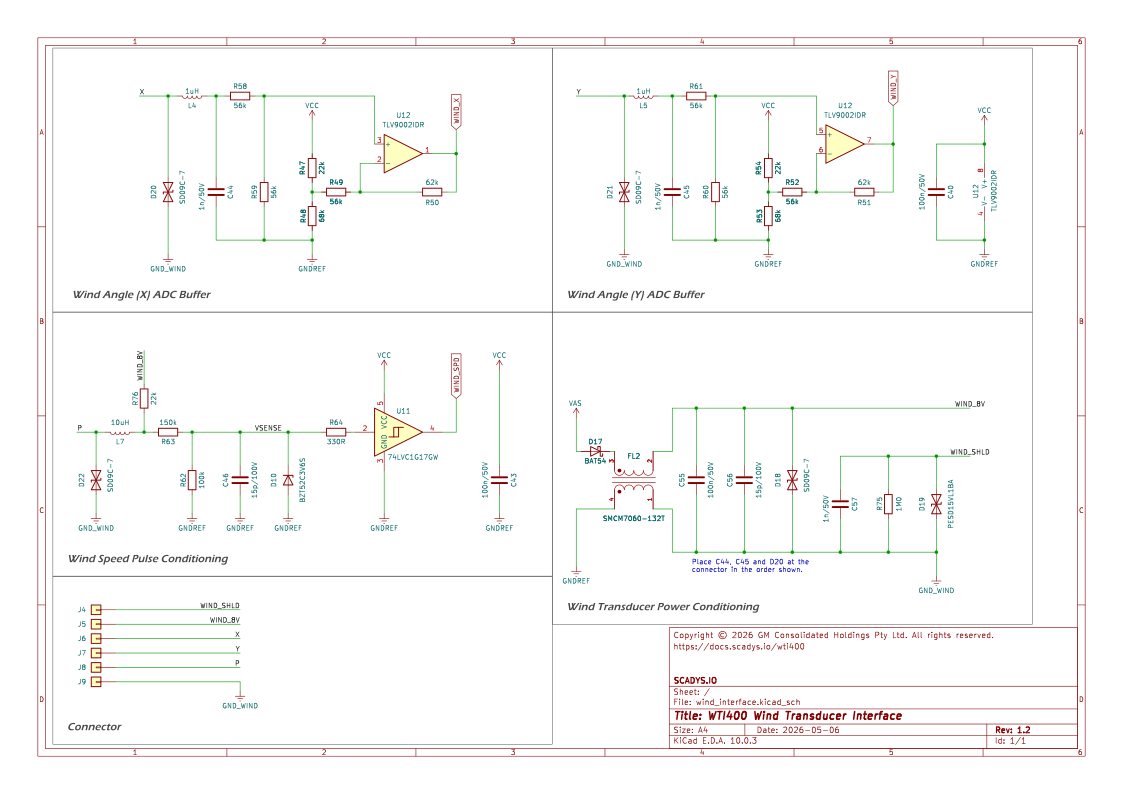
WTI400 v1.2 — In service on the test vessel. Approximately 1,000 sea miles accumulated with basic self-calibrating firmware. Subjective in-service performance satisfactory; no quantitative bench measurements yet for angle accuracy, ADC clipping, atan2 reconstruction, speed-pulse PPR, VAS rail under load, or LP2951 thermal soak. The Testing & Verification section lists the measurements required.
Overview
This page documents the wind transducer interface: everything between the masthead transducer's mast cable and the ESP32. It spans two KiCad sheets:
wind_interface.kicad_sch— the analog signal chain, the connector ring, cable shield conditioning, the supply path from the LDO to the transducer, and the speed-pulse conditioning.- A portion of
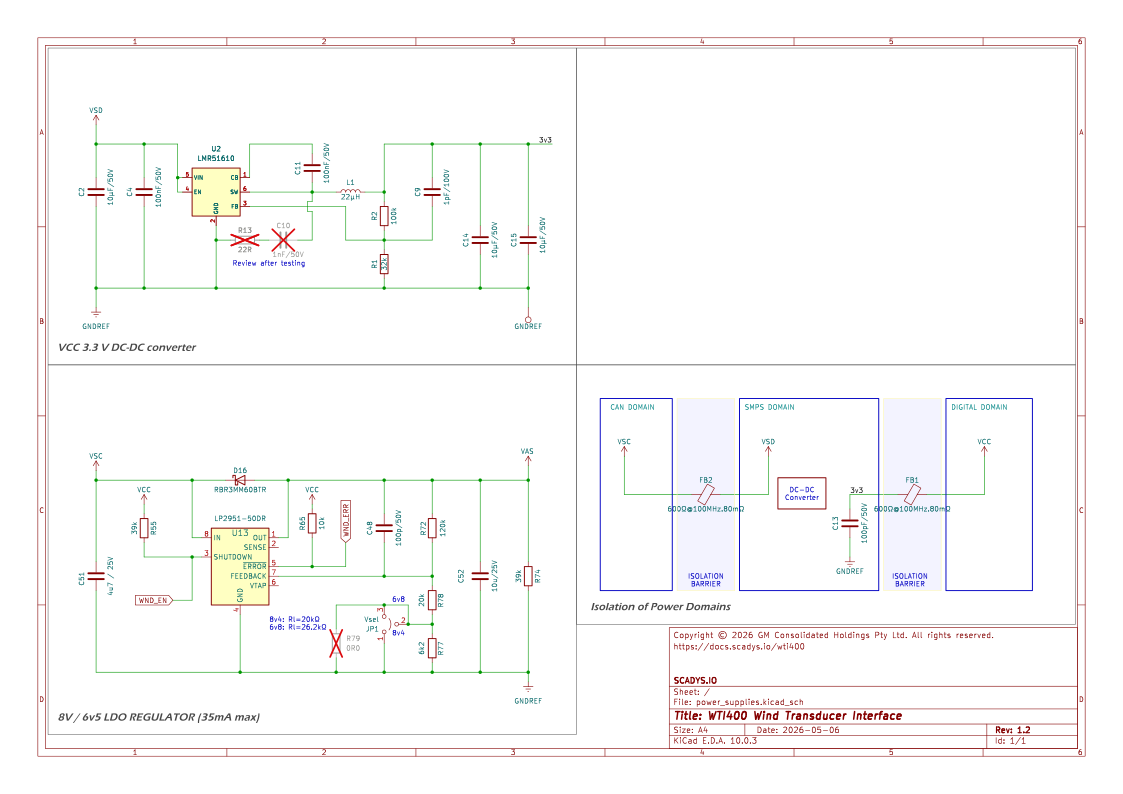
power_supplies.kicad_sch— the LP2951 LDO (sub-block titled "8V / 6v5 LDO REGULATOR (35mA max)") that produces the VAS rail. The Power Supply page documents only the LMR51610 SMPS portion of that sheet and cross-links here for the LDO.
Five sub-circuits in narrative order:
- Wind transducer supply (VAS rail) — LP2951 LDO from the power_supplies sheet. JP1 selects between two output setpoints; WND_EN / WND_ERR firmware handshake controls and monitors the rail.
- Connector and cable shield — six Keystone 1211 quick-connect tabs, cable shield conditioning, the connector-side TVS row.
- Wind transducer power conditioning — series Schottky D17, common-mode filter FL2 (also the GND_WIND ↔ GNDREF star point), local broadband bypass.
- Wind angle X and Y channels — two functionally identical mirrored channels: protection chain, RF/EMI filter, non-inverting amplifier with input attenuation and DC bias.
- Wind speed pulse conditioning — TVS, RF choke, divider to U11 input, Schmitt-trigger output to the ESP32.
Functional specification and design objectives
The wind interface must:
- deliver 8.65 V or 6.89 V to the transducer connector (after the series D17 drop: 8.30 V or 6.54 V respectively at the connector), user-selectable via JP1 or hard-wired via R79 at the factory;
- provide software-controlled enable (WND_EN GPIO → LP2951 SHUTDOWN) and fault reporting (LP2951 ERROR → WND_ERR GPIO) so firmware can power-cycle and monitor the transducer independent of the digital VCC rail;
- keep LDO output noise and ripple low enough that the high-impedance op-amp input chain on the same board does not pick up LDO noise;
- clamp every incoming conductor — supply, X, Y, P, shield — with a TVS sized for the expected operating voltage on that conductor, and prevent the cable shield from floating;
- keep the GND_WIND transducer return domain electrically isolated from the board GNDREF except at a single deliberate star point (FL2 winding 2);
- block back-EMF and reverse current from the transducer or its long cable reaching the VAS rail, and strip common-mode EMI conducted on the supply and ground conductors before it reaches the LDO or the board analog reference;
- take each transducer Hall-sensor output (referenced to GND_WIND) and deliver it to an ESP32 ADC GPIO (referenced to GNDREF) over the full 0–3.3 V range, with matched gain and offset between the X and Y channels so
atan2(WIND_Y, WIND_X)direction reconstruction is symmetric; - convert the anemometer reed-switch pulse (open-circuit HIGH at ~8 V, momentary LOW during contact) into a clean 3.3 V logic edge for interrupt-driven pulse counting, with Schmitt-trigger hysteresis as a hardware fallback against contact bounce.
Scope limitation, V1.2: the U12 amplifier bias is referenced to VCC rather than WIND_8V, so the operating point does not track the JP1 setpoint. WTI400 V1.2 supports the Raymarine ST60 / E22078 family at JP1 8v4 only. The 6v8 setting correctly supplies B&G 213 transducers but the X / Y channel output clips on negative half-cycles. The V2.0 fix is to tie R48 to WIND_8V and rescale.
Wind transducer supply (VAS rail)
How it works
The LDO and its supply
U13 — LP2951-50DR is the adjustable variant of TI's classic LP2951 micropower LDO (100 mA rated, 30 V max input, SOIC-8). It is operated in adjustable mode with an external feedback divider so the output voltage can be programmed by jumper. The input rail is VSC (the CAN-domain unregulated supply, nominally 9.0–14.8 V), which arrives via FB2 from the upstream protection chain documented on the CAN Bus Power page. C51 (4.7 µF X7R 0805) bypasses VSC at the LP2951 input pin.
Voltage selection — JP1 and R79
The LP2951's adjustable feedback architecture uses an internal 1.235 V reference and an external resistor divider from VAS to the FEEDBACK pin:
V_VAS = V_ref × (1 + R_upper / R_lower)
      = 1.235 × (1 + 120 kΩ / R_lower)
- R72 (120 kΩ) is the fixed upper divider leg.
- R78 (20 kΩ) is the always-present lower leg.
- R77 (6.2 kΩ) is an optional series element in the lower leg.
JP1 (3-pin 2.54 mm header, labelled Vsel) is the selector. With the jumper in the 8v4 position, R77 is bypassed and the lower leg is R78 alone (20 kΩ) → V_VAS = 1.235 × (1 + 120/20) = 8.65 V (Raymarine setpoint). With the jumper in the 6v8 position, R77 is in series with R78 (26.2 kΩ) → V_VAS = 1.235 × (1 + 120/26.2) = 6.89 V (B&G setpoint).
R79 (0 Ω, 0805) is a factory-only zero-ohm alternative to JP1 — it bypasses R77 directly, hard-wiring the 8v4 setpoint without a user-accessible jumper. Three production assembly stances are valid:
| Assembly | JP1 | R79 | VAS setpoint |
|---|---|---|---|
| Field-configurable (test-vessel unit) | Fitted | DNP | Operator-selectable: 8.65 V or 6.89 V |
| Factory Raymarine | DNP | Fitted | Hard-wired 8.65 V |
| Factory B&G | DNP | DNP | Hard-wired 6.89 V (R77 always in series) |
D16 is a protection diode, not in the VAS current path
D16 (RBR3MM60BTR, SOD-123FL Schottky) is wired anode = VAS, cathode = VSC — that is, output-to-input, reverse-biased in normal operation. It is the classic LP2951 Vout-to-Vin protection diode: it conducts only during a fast power-down where the VAS output capacitors would otherwise back-drive the LDO. VAS at the LP2951 output pad is the LP2951's regulated output directly — 8.65 V or 6.89 V; D16 does not appear in the VAS current path and does not affect the setpoint voltage. (The ~0.35 V drop that reduces VAS to WIND_8V at the connector comes from a different diode — D17 in the wind_interface sheet — covered in the Wind transducer power conditioning section below.)
Enable / fault — SHUTDOWN, ERROR, and the firmware handshake
The LP2951 has two interface pins that connect to ESP32 GPIOs as the global signals WND_EN and WND_ERR:
- SHUTDOWN (pin 3) is active-HIGH — pulling SHUTDOWN high disables the regulator. R55 (39 kΩ) pulls SHUTDOWN to VCC = 3.3 V, so VAS is OFF at boot. The ESP32 drives WND_EN low to enable the rail.
- ERROR (pin 5) is open-drain, active-LOW — asserts during overcurrent fold-back or output undervoltage. R65 (10 kΩ) pulls it up to VCC. The WND_ERR global label carries this fault signal back to the ESP32 as a power-good / fault indicator.
The intended firmware control sequence:
- Boot complete → ESP32 drives WND_EN low → LP2951 SHUTDOWN low → VAS enabled.
- No transducer signal detected (open-circuit cable, missing transducer) → firmware releases WND_EN → R55 pulls SHUTDOWN high → LP2951 disabled → RGB LED flashes the no-transducer error code.
- LP2951 ERROR asserts (overcurrent or output undervoltage) → ERROR pin pulls WND_ERR low → firmware releases WND_EN → R55 pulls SHUTDOWN high → LP2951 disabled → RGB LED flashes the transducer-fault error code.
R55's HIGH pull-up state is the safe state — any GPIO floating (boot, reset, brownout) leaves VAS off rather than energising the transducer with no firmware oversight.
Output filtering and bleed
C52 (10 µF X7R 0805) is the VAS output capacitor — sole output cap on this rail, comfortably above the LP2951's 1 µF minimum stability requirement. C48 (100 pF C0G) is a feedforward capacitor across the upper divider leg (VAS → FEEDBACK), tightening transient response when the long masthead cable adds significant capacitive load at the connector. C48 is a candidate for an increase to 150–220 pF if instability is observed during bring-up — the validation tuning knob noted in the power-supplies review.
R74 (39 kΩ) is a gentle bleed across the VAS output. When the LDO is disabled, R74 discharges C52 (and the small connector-side bypass downstream) so the rail collapses promptly rather than holding a residual charge for several seconds.
FB2 (BLM31KN601SN1L, 1206, 600 Ω @ 100 MHz, 80 mΩ DCR) is the ferrite bead at the LDO output / wind-interface domain boundary. It is the only copper path between the LP2951 output node (POWER domain on the schematic) and the VAS rail that feeds the wind_interface sheet (DIGITAL domain label). This isolates any residual switching artefacts from the upstream SMPS / CAN-domain from the high-impedance op-amp input chain.
Performance
| Parameter | Value | Condition | Notes |
|---|---|---|---|
| V_VAS at JP1 8v4 | 8.65 V | R_lower = 20 kΩ | Raymarine setpoint; designed |
| V_VAS at JP1 6v8 | 6.89 V | R_lower = 26.2 kΩ | B&G setpoint; designed |
| WIND_8V at connector (after D17) | 8.30 V / 6.54 V | I = 25 mA | See Wind transducer power conditioning |
| LP2951 rated I_out | 100 mA | Datasheet | 65–75 mA headroom over typical transducer loads |
| Expected transducer load — Raymarine E22078 | ~22–25 mA | Hall + dual op-amp quiescent | Measured |
| Expected transducer load — B&G 213 | 25–30 mA | Per wind.md empirical data | V2.0-only at correct ADC bias |
| LP2951 dropout @ 30 mA | < 0.4 V | Datasheet | VSC ≥ ~9 V required to regulate 8v4 setpoint |
| LDO dissipation @ VSC = 14.8 V, 25 mA, 8v4 | 154 mW | (14.8 − 8.65) × 25 mA | Continuous worst-case |
| LDO dissipation @ VSC = 14.8 V, 30 mA, 6v8 | 237 mW | (14.8 − 6.89) × 30 mA | Continuous worst-case |
| LP2951 SOIC-8 θJA | 123 °C/W | Datasheet, D package | No exposed pad |
| ΔTj @ 237 mW | 29.2 °C | P × θJA | Worst-case B&G operating point |
| Tj @ 85 °C ambient worst case | ~114 °C | 85 + 29 | 11 °C margin below 125 °C limit |
| D16 dissipation (normal operation) | 0 mW | Reverse-biased | Conducts only during fast power-down |
A V1.3 / V2.0 candidate is the DRG package of the LP2951 (LP2951CSDRG, exposed pad, θJA = 48 °C/W) — would more than halve the junction-temperature rise. Tracked in v2.0-improvements.md.
Connector and cable shield
How it works
Six quick-connect tabs, not a multi-way housing
J4–J9 are six Keystone 1211 solder tabs in a row at the board edge. The mast cable is wired one conductor per tab by the installer; there is no keyed connector body. Silkscreen labels at each tab identify the function:
| Tab | Net | Function | Raymarine wire colour | B&G 213 wire colour |
|---|---|---|---|---|
| J4 | WIND_SHLD | Cable shield (terminates to GND_WIND) | (drain) | (screen) |
| J5 | WIND_8V | Transducer supply | RED | ORANGE |
| J6 | X | Wind angle X (cosine / PORT) | BLUE | BLUE (Phase B) |
| J7 | Y | Wind angle Y (sine / STB) | GREEN | GREEN (Phase G) |
| J8 | P | Speed pulse | YELLOW | VIOLET |
| J9 | GND_WIND | Transducer ground return | BLACK | BLACK |
(Raymarine ST60, E22078, ST50, Autohelm transducers are pin-compatible across the family. B&G 213 post-March-1996 uses a 7-pin Network connector with different assignments — earlier B&G 213 units have a 6-pin connector and should be wired with reference to the B&G service documentation.)
Cable shield conditioning — a three-component sub-circuit at J4
The cable shield gets its own protection treatment at the connector — distinct from the signal/power TVS row:
- D19 (PESD15VL1BA) — bidirectional TVS, 15 V standoff, 200 W (8/20 µs). Clamps the shield to GND_WIND. The 15 V standoff is generous: the shield has no defined operating voltage (typically near 0 V because the cable's outer conductor is tied to vessel earth at the far end), so the wide standoff provides headroom for shield-ground potential differences in the marine environment.
- R75 (1 MΩ) — DC bleed from WIND_SHLD to GND_WIND. Prevents the shield from floating when the transducer cable is disconnected. The 1 MΩ value is high enough to be electrically invisible during normal operation (an 8 V miswiring fault would draw only 8 µA) but low enough to drain accumulated static charge in seconds.
- C57 (1 nF C0G) — HF bypass from WIND_SHLD to GND_WIND. Provides a low-impedance return path (≈ 159 Ω at 1 MHz, 16 Ω at 10 MHz) for RF currents arriving on the shield conductor, shorting them into the transducer ground domain rather than letting them propagate onto the board analog reference.
Connector-side TVS row — one clamp per incoming conductor
Each non-shield conductor gets its own bidirectional TVS at the connector entry, all clamping to GND_WIND:
- D18 (SD09C-7) — WIND_8V supply, 9 V standoff. Placed on the connector side of FL2 so the CMF acts on conducted transients before the TVS clamps them.
- D20 (SD09C-7) — X analog line, 9 V standoff. Trace from J6 signal pad to D20 = 3 mm.
- D21 (SD09C-7) — Y analog line, 9 V standoff. Mirror of D20.
- D22 (SD09C-7) — P speed pulse, 9 V standoff. Trace from J8 to D22 = 3 mm.
The 9 V standoff is the right size for the 8.3 V or 6.5 V operating voltage on these conductors: above any normal level (no leakage at operating voltage), below the cable insulation rating, comfortably below the absolute-maximum input on downstream silicon. Peak clamp voltage at 1 A surge = ~15 V (datasheet 8/20 µs waveform); the LC chokes downstream (L4, L5, L7) and series resistors (R63, R64) further attenuate the clamp tail before it reaches U11 / U12.
The schematic carries an explicit placement instruction: "Place C44, C45 and D20 at the connector in the order shown." This means the cap–TVS–choke topological order on the X and Y lines is a fixed layout constraint, not a routing convenience.
Performance
| Parameter | Value | Notes |
|---|---|---|
| TVS standoff vs operating voltage (8 V conductors) | 9 V > 8.3 V | All clear; no normal-operation conduction |
| TVS standoff vs shield (D19) | 15 V > 0 V | Wide margin for marine shield-ground potential |
| TVS pad-to-connector-pad trace | 3 mm | Meets ≤ 3 mm guideline (measured 2026-05-08) |
| C57 impedance at 1 MHz | 159 Ω | Adequate HF shield-to-ground shunt |
| R75 leakage at fault (8 V) | 8 µA | Negligible |
Wind transducer power conditioning
How it works
D17 — series Schottky in the supply path
D17 (BAT54J,115, Nexperia, SOD-323F) is a small-signal Schottky diode placed in series in the VAS → FL2 → connector path. Anode = VAS (LDO output domain); cathode = FL2 pin 3 (winding 1 input).
Two design intentions in one part:
-
Voltage drop — the forward drop (~0.35 V at 25 mA, datasheet typ) is the deliberate margin between the LP2951 setpoint and the connector voltage. WIND_8V = VAS − V_f(D17):
JP1 VAS D17 V_f WIND_8V Transducer expected supply 8v4 8.65 V 0.35 V 8.30 V Raymarine E22078: 7.5–10 V ✅ 6v8 6.89 V 0.35 V 6.54 V B&G 213: ~6.5 V nominal ✅ -
Reverse-current block — the diode is reverse-biased to back-EMF from the transducer (e.g. when an inductive transducer winding flies back during a power-cycle, or when the long mast cable's distributed inductance releases stored energy). This prevents transients from punching back into the LP2951 output and stressing C52.
D17 is placed in the LDO region of the PCB (8 mm from FL2, 28 mm from the connector). Counter-intuitive at first glance — protection is usually at the connector — but D17 is a series block, not a surge clamp. The connector-side TVS D18 handles surges. Placing D17 at the LDO end keeps the unprotected VAS trace short and routes the post-D17 supply through the entire common-mode filter and TVS chain before it reaches the cable.
FL2 — common-mode filter AND star ground
FL2 (SXN SMCM7060-132T) is a 4-pin two-winding common-mode filter (1.3 kΩ at 100 MHz, 21 mΩ DCR per winding, 7×6 mm SMD). Its connectivity:
| FL2 pin | Net | Role |
|---|---|---|
| 3 | Net-(D17-K) | VAS-side input (winding 1) |
| 2 | WIND_8V | Connector-side output (winding 1) |
| 4 | GNDREF | Board reference side (winding 2) |
| 1 | GND_WIND | Transducer return side (winding 2) |
Two roles:
- Common-mode filter — windings 1 and 2 are wound on a single common ferrite core, so any common-mode current on the supply+ground pair (current flowing in the same direction on both conductors) sees a high impedance, while differential-mode current (the actual supply current flowing out on +V and returning on the ground) sees only the winding DCR. This attenuates conducted EMI arriving from the mast cable as common-mode noise.
- Star ground point — winding 2 is the only electrical connection between GNDREF (board analog/digital reference) and GND_WIND (transducer cable return). The PCB enforces this — GNDREF and GND_WIND have isolated copper pours bounded at the right edge of FL2 (x = 88.1 mm) with no parallel copper bridge. All TVS cathodes at the connector (D18, D19, D20, D21, D22) reference GND_WIND. The signal-chain GNDREF references (R59, R60 divider lower legs; U12 GND pin; VSENSE shunt R62; all op-amp decoupling) reference GNDREF. The two only meet at FL2.
The 21 mΩ winding 2 DCR translates to a 0.5 mV drop at 25 mA — well below 0.1 ADC LSB at 12-bit / 3.3 V — so the star point doesn't introduce a measurable bias error on the analog readings.
C55, C56 — broadband bypass on WIND_8V at the connector
C55 (100 nF X7R, Murata GCM188R71H104KA57D) and C56 (15 pF C0G, Murata GCM1885C2A150JA16D) sit on the connector side of FL2 between WIND_8V and GND_WIND. They cooperate:
- C55 handles bulk decoupling — supports any load step the transducer takes (Hall sensor switching, op-amp current draw inside the transducer head).
- C56 handles the upper-frequency band that C55's parasitic ESL can't reach.
Together they supplement the FL2 common-mode filtering with a local energy reservoir for transducer-side transients. At 25 mA load and a 100 mV allowable rail droop, the 100 nF holds the rail for ~2 µs — adequate for any transducer-internal transient.
Performance
| Parameter | Value | Notes |
|---|---|---|
| WIND_8V @ 8v4, 25 mA | 8.30 V | VAS − V_f(D17) |
| WIND_8V @ 6v8, 25 mA | 6.54 V | VAS − V_f(D17) |
| D17 dissipation @ 25 mA | 8.75 mW | I × V_f; SOD-323F θJA ≈ 300 °C/W |
| D17 ΔTj @ 25 mA | 2.6 °C | Negligible |
| FL2 winding 1 DCR drop @ 25 mA | 0.5 mV | Negligible |
| FL2 winding 2 GND offset @ 25 mA | 0.5 mV | < 0.1 ADC LSB; analog accuracy preserved |
| C55+C56 stored energy | 3.24 µJ | Available for transducer-side load step |
| GND_WIND ↔ GNDREF copper paths outside FL2 | 0 | PCB verified 2026-05-08 |
Wind angle X and Y channels
The two analog wind angle channels are functionally and electrically identical — exact mirrors of each other, so that the firmware atan2(WIND_Y, WIND_X) direction reconstruction sees a symmetric pair. The pair occupies the top half of the schematic with X on the left and Y on the right; the PCB layout mirrors trace lengths and component orientations around U12's vertical centreline. Any systematic offset or gain mismatch between the two would appear as a fixed angular error in atan2 output, so symmetry is a first-class requirement.
How it works
Designator map (X ↔ Y)
| Function | X channel | Y channel |
|---|---|---|
| Connector tab | J6 | J7 |
| Connector TVS (9 V SD09C-7) | D20 | D21 |
| Series RF/EMI choke (1 µH) | L4 | L5 |
| LC filter cap (1 nF C0G) | C44 | C45 |
| Input series attenuator (56 kΩ) | R58 | R61 |
| Input shunt to GNDREF (56 kΩ) | R59 | R60 |
| Op-amp half | U12 unit A (pins 1–3) | U12 unit B (pins 5–7) |
| Gain Rg (56 kΩ) | R49 | R52 |
| Feedback Rf (62 kΩ) | R50 | R51 |
| Bias upper (22 kΩ from VCC) | R47 | R54 |
| Bias lower (68 kΩ to GNDREF) | R48 | R53 |
| Output to ESP32 | WIND_X | WIND_Y |
The remainder of this section describes the X channel; everything applies identically to the Y channel with the designator substitutions above.
Protection chain ordering
From the J6 connector tab to U12A's input, the X-channel signal traverses (in PCB order):
J6 tab → D20 TVS (9 V standoff, GND_WIND) → L4 (1 µH choke) → C44 (1 nF shunt to GNDREF) → R58 (56 kΩ series) → R59 (56 kΩ shunt to GNDREF) → U12A pin 3 (+ input)
Each stage adds a different kind of protection: TVS clamps the fast surge tail, L4/C44 forms an LC filter, the R58/R59 divider provides 2× attenuation while presenting a high impedance to the op-amp input.
L4/C44 — RF/EMI filter, not anti-aliasing
The LC corner is:
f_c = 1 / (2π √(L × C)) = 1 / (2π √(1 µH × 1 nF)) ≈ 5.03 MHz
5 MHz is five orders of magnitude above the wind signal bandwidth (< 10 Hz — a 50-knot wind through a typical anemometer produces a few hertz of angle modulation at most). The role of L4/C44 is RF/EMI mitigation — attenuating conducted noise arriving on the 10–20 m mast cable acting as a long antenna for VHF, marine SSB, and broadcast band signals. The large aliasing margin over the ESP32 ADC's sample rate is a free side-effect, not the design intent. Calling these "anti-aliasing" caps in earlier evidence understated the role.
The Murata LQM18FN1R0M00D self-resonant frequency is ~350 MHz — five decades above the LC corner, so L4 behaves as a pure inductor at the filter operating frequency.
Non-inverting amplifier with input attenuation and DC level shift
U12A is configured as a non-inverting op-amp with two extra features at its inputs: a divider on the (+) input and a DC bias network on the (−) input.
At the non-inverting input (pin 3):
- R58 (56 kΩ) in series from the L4/C44 filter output.
- R59 (56 kΩ) shunt to GNDREF.
These form a divide-by-two attenuator:
V_plus = V_signal × R59 / (R58 + R59) = V_signal × 0.5
At the inverting input (pin 2):
- R47 (22 kΩ) from VCC to bias junction.
- R48 (68 kΩ) from bias junction to GNDREF.
This generates the DC bias voltage:
V_bias = VCC × R48 / (R47 + R48) = 3.3 × 68 / (22 + 68) = 2.49 V
- R49 (56 kΩ, Rg) from bias junction to inverting input.
- R50 (62 kΩ, Rf) from WIND_X output back to inverting input.
Combined transfer function (ideal op-amp):
V_out = V_plus × (1 + Rf/Rg) − V_bias × (Rf/Rg)
      = (V_signal / 2) × (1 + 62/56) − 2.49 × (62/56)
      = V_signal × 1.054 − 2.76 V
Designed for the Raymarine Hall sensor mid-point at ~4.15 V (half of WIND_8V = 8.30 V at JP1 8v4):
| V_signal (transducer X output) | V_out (to ESP32 ADC) | Notes |
|---|---|---|
| 2.62 V | 0.00 V | ← lower clip threshold |
| 3.00 V | 0.40 V | Measured min, Raymarine ±1.0 V swing |
| 4.15 V | 1.61 V | Hall mid-point @ 8v4 — ADC centre ✅ |
| 5.00 V | 2.51 V | Measured max, Raymarine ±1.0 V swing |
| 5.73 V | 3.28 V | ← upper clip threshold |
| 6.00 V | 3.56 V → clipped to 3.28 V | Measured max, Raymarine ±1.5 V worst-case |
| 2.50 V | −0.125 V → clipped to 0 V | Measured min, Raymarine ±1.5 V worst-case |
The U12 TLV9002 is RRIO, so its output saturates at the supply rails (≈ 20 mV from VCC and GND); the clip thresholds correspond to the rail limits, not internal headroom loss.
V1.2 design limitation — bias is VCC-referenced, not WIND_8V-referenced
V_bias = 2.49 V is fixed regardless of JP1 setpoint because R47/R48 reference VCC = 3.3 V, not WIND_8V. The amplifier is centred on the Raymarine Hall mid-point at 8v4. At JP1 6v8 the Hall mid-point drops to ~3.27 V, the input divider produces V_plus = 1.64 V, and:
V_out_mid (6v8) = 1.64 × 2.107 − 2.49 × (62/56) = 0.69 V
The amplifier is no longer ADC-centred. The negative half-wave of the X signal (V_signal < 2.62 V) clips to 0 V, the atan2 reconstruction loses the lower half of every direction cycle, and the firmware cannot recover a usable angle.
WTI400 V1.2 supports the Raymarine ST60 / E22078 family at JP1 8v4 only. JP1 6v8 produces the correct WIND_8V supply for B&G 213 but the U12 output is not usable. The V2.0 fix is to tie R48 to WIND_8V instead of VCC and rescale R47/R48 so V_bias tracks the setpoint — tracked in v2.0-improvements.md.
Performance
| Parameter | Value | Notes |
|---|---|---|
| Gain (1 + Rf/Rg) | 2.107× | 1 + 62 kΩ / 56 kΩ |
| Input divider ratio | 0.5× | R59 / (R58 + R59) |
| Effective transfer slope | 1.054× | gain × divider |
| V_bias (fixed) | 2.49 V | VCC × R48 / (R47 + R48) |
| Transfer | V_out = V_signal × 1.054 − 2.76 V | At JP1 8v4 |
| ADC mid-range output @ Raymarine Hall mid (4.15 V) | 1.61 V | ✅ centred |
| Negative clip threshold (V_signal) | 2.62 V | Below this → V_out = 0 V |
| Positive clip threshold (V_signal) | 5.73 V | Above this → V_out ≈ 3.28 V |
| Measured Raymarine swing | 2.5–6.0 V | Bench data; clips ~0.4 V at both ends |
| Gain-bandwidth headroom | 47,000× over 10 Hz | 1 MHz GBW / (2.107 × 10) |
| Op-amp input impedance | ~ 112 kΩ | R58 + R59 |
| LC filter corner | 5.03 MHz | Five decades above wind signal BW |
| Inductor SRF margin | 70× | L4 SRF ~350 MHz / 5 MHz operating |
Wind speed pulse conditioning
How it works
The signal path from the J8 connector tab to the WIND_SPD GPIO traverses (in PCB order):
J8 tab → D22 TVS (9 V, GND_WIND)
       → L7 (10 µH RF choke)
       → [R76 pull-up to WIND_8V]
       → R63 (150 kΩ series upper divider)
       → VSENSE node [R62 100 kΩ shunt to GNDREF, C46 15 pF HF cap]
       → R64 (330 Ω current-limit)
       → U11 input
       → U11 output → WIND_SPD → ESP32 GPIO
R76 (22 kΩ) is the pull-up that holds the P line HIGH when the reed switch is open. With the transducer's reed switch normally open, P sits at ~ WIND_8V; the reed pulls P to GND_WIND for the brief duration of each rotation pulse.
R63 / R62 voltage divider brings the ~8 V P-HIGH down to a level compatible with U11's 3.3 V supply:
V_VSENSE = WIND_8V × R62 / (R63 + R62 + R76_effective)
         ≈ 8 × 100 / 250 = 3.2 V    (R76 in parallel-pull-up is negligible; first-order calc)
VSENSE at 3.2 V is just below VCC = 3.3 V, well above U11's V_IH (≈ 1.65 V at 3.3 V supply for the 74LVC family), and below the 3.6 V D10 zener clamp threshold (so D10 is reverse-biased and draws no current in normal operation).
R64 (330 Ω) is the series current-limit between the divider output and U11's input pin. If a fault drives VSENSE above U11's V_in,max, R64 holds the fault current below the input clamp diode rating until D10 conducts.
D10 (BZT52C3V6S, 3.6 V zener) clamps VSENSE during transients. Normal operation: V_VSENSE = 3.2 V < V_Z = 3.6 V → D10 off. Fault: V_VSENSE driven above 3.6 V → D10 conducts, capping VSENSE at ~3.6 V. With R63 = 150 kΩ in series, the worst-case fault current at V_P = 18 V into the divider is (18 − 3.6) / 150 kΩ = 96 µA → D10 dissipation = 0.35 mW — well below the 200 mW rating.
C46 (15 pF C0G) filters HF noise at the VSENSE node — important because R64 + the U11 input capacitance + C46 form a low-pass filter that smooths the very fast leading edge of the divided P signal before it crosses U11's Schmitt threshold.
U11 (Nexperia 74LVC1G17GW, TSSOP-5) is a Schmitt-trigger buffer with ~0.8 V hysteresis at VCC = 3.3 V (V_T+ ≈ 1.6 V, V_T− ≈ 0.8 V). The hysteresis is a hardware safety net: a slowly-changing input from a marginal reed-switch contact gets cleanly squared up at the output. Firmware does the primary debounce by interrupt-timing the WIND_SPD edges — but U11 ensures the interrupt sees a single clean edge per actual reed contact, not a burst of micro-edges from contact bounce.
Performance
| Parameter | Value | Notes |
|---|---|---|
| P HIGH @ JP1 8v4 | ~8.0 V | WIND_8V via R76 pull-up |
| P LOW (reed closed) | ~0 V | GND_WIND via reed switch |
| VSENSE @ P HIGH | 3.2 V | Within U11 V_in range; D10 off |
| U11 V_IH (typ) | 1.65 V | Logic HIGH recognised |
| U11 hysteresis (typ) | 0.8 V | V_T+ − V_T− |
| D10 P_diss @ 18 V fault | 0.35 mW | Well below 200 mW |
| R76 P-line risetime constant | 0.45 ns | L7/R76; orders of magnitude faster than reed bounce |
| Expected reed-switch pulse rate | 1–100 Hz | 2 pulses per anemometer rotation (Raymarine) |
PCB Layout
The wind interface occupies approximately x:80–133, y:100–126 on the 95.2 × 95.2 mm four-layer board (ENIG, dark blue mask). All 44 wind_interface footprints sit on F.Cu. The layout uses three horizontal rows to separate power/protection from analog conditioning: connector tabs J4–J9 at y=116, the protection/power-conditioning devices (D18–D22, D19, FL2, D17) at y=121.5–122.5, and the signal processing (L4/L5, divider resistors, U12, U11) at y=103–106 — roughly 16 mm of vertical separation that keeps connector and clamp-energy coupling out of the analog inputs.
- Two isolated ground domains, one star point. GND_WIND (transducer cable return) and GNDREF (board analog/digital ground) are filled as separate zones. GND_WIND occupies the connector/TVS row on all four layers (F.Cu+B.Cu at x:88.1–101.9, y:121.8–124.0; In1/In2 at x:88.1–132.5, y:111.2–124.0); GNDREF fills the rest. The sole GND_WIND ↔ GNDREF connection is FL2 winding 2 (pin 4 GNDREF → pin 1 GND_WIND), with FL2 at (88.0, 121.5) sitting exactly on the x=88.1 zone boundary. No parallel copper bridge was found (verified 2026-05-08). 46 GNDREF vias and 11 GND_WIND vias stitch F.Cu to B.Cu in the wind zone.
- Connector-first protection. All connector TVS (D18 WIND_8V, D20 X, D21 Y, D22 P, D19 shield) clamp to GND_WIND. The X/Y signal pad-to-TVS trace is 3 mm (meets the ≤ 3 mm guideline; the earlier 6 mm reading was to the connector body, not the signal pad). The X line runs J6 → D20 → via to B.Cu → via back to L4 → C44/R58 divider → U12A; the Y line is the mirror via B.Cu to L5. X/Y signal traces are routed at 0.2 mm and kept ≥ 16 mm clear of FL2.
- Power conditioning order. VAS → D17 (at 80.07, 119.8, in the LDO region, 8 mm from FL2, 28 mm from the connector — acceptable because D17 is a series reverse-current block, not a surge clamp) → FL2 pin 3 → FL2 pin 2 WIND_8V → C55/C56 bypass → D18 TVS → J5. The WIND_8V net is distributed as a copper pour (F.Cu+B.Cu, priority 12) rather than a routed trace; at 30 mA there is no width concern.
- P (speed-pulse) line. L7 (10 µH) sits in the P line, not the supply: J8 → D22 TVS → L7 → R76 pull-up node / R63 divider → VSENSE (R62 shunt, D10 zener, C46 HF cap) → R64 series → U11. The VSENSE cluster is compact (4.6 mm span). The schema review had mis-described L7 as a WIND_8V supply choke; the PCB places it correctly in the P line.
- Decoupling and digital/analog separation. C40 (100 nF) is 1.88 mm from U12 VCC (the SOIC-8 GND pin is necessarily on the far side); C43 (100 nF) is 2.31 mm from U11. The X/Y pre-amp clusters are mirror-symmetric about U12's centreline (±5.5 mm) with equal L→divider→input trace lengths (~6.7 mm each side). WIND_SPD routes ≥ 14–15 mm east of the X/Y analog traces. WIND_X and WIND_Y route to the ESP32 5 mm apart with pour fill between them — negligible mutual capacitance.
As-built note — schema-review designator corrections. The PCB netlist resolved six designator/role discrepancies that were wrong in the original schema review: D18 = WIND_8V TVS (not a secondary Y TVS), D22 = P-line TVS (not WIND_8V), D19 = cable-shield TVS (not WIND_Y ADC), L7 = P-line choke (not supply choke), R75 = WIND_SHLD-to-GND_WIND bleed (not WIND_Y ADC bleed), C57 = WIND_SHLD-to-GND_WIND HF bypass (not Y anti-aliasing). The protection coverage is complete and correctly ordered; these were documentation errors only. The page above reflects the corrected PCB connectivity throughout.
Components
Wind transducer supply (LP2951 portion, on power_supplies.kicad_sch)
| Ref | Value | Function | Datasheet |
|---|---|---|---|
| U13 | LP2951-50DR | Adjustable LDO regulator, 100 mA, 30 V max, SOIC-8 — generates the VAS rail from VSC | TI LP2951 |
| D16 | RBR3MM60BTR | Schottky barrier, 60 V / 3 A, SOD-123FL — LP2951 Vout-to-Vin protection diode (anode=VAS, cathode=VSC) | ROHM RBR3MM60BTR |
| JP1 | Vsel | 3-pin 2.54 mm pin header — Raymarine / B&G transducer setpoint selector | LCSC C2937625 |
| FB2 | BLM31KN601SN1L | 1206 ferrite bead, 600 Ω @ 100 MHz, 80 mΩ DCR — LDO output / VAS domain boundary | Murata BLM31KN601SN1L |
| R55 | 39 kΩ 0603 ±1 % | LP2951 SHUTDOWN pull-up to VCC (rail off at boot) | Yageo RC Group |
| R65 | 10 kΩ 0603 ±1 % | LP2951 ERROR pull-up to VCC (open-drain output) | Yageo RC Group |
| R72 | 120 kΩ 0603 ±1 % | LP2951 feedback divider upper leg | Yageo RC Group |
| R74 | 39 kΩ 0603 ±1 % | VAS output bleed (discharges C52 when LDO disabled) | Yageo RC Group |
| R77 | 6.2 kΩ 0603 ±1 % | Feedback divider lower-leg option for 6v8 setpoint | Yageo RC Group |
| R78 | 20 kΩ 0603 ±1 % | Feedback divider lower-leg main resistor (always present) | Yageo RC Group |
| R79 | 0 Ω 0805 | Factory voltage-select alternative to JP1 (bypasses R77 → hard-wires 8v4) | — |
| C48 | 100 pF / 50 V C0G 0603 | LP2951 feedforward across upper feedback resistor (820 pF candidate pending InvenTree part) | — |
| C51 | 4.7 µF / 25 V X7R 0805 | LP2951 input (VSC) bypass | — |
| C52 | 10 µF / 25 V X7R 0805 | LP2951 output (VAS) bypass | — |
Wind interface (on wind_interface.kicad_sch)
| Ref | Value | Function | Datasheet |
|---|---|---|---|
| J4 | 1211 | Keystone 1211 solder tab — WIND_SHLD (cable shield) | Keystone 1211 |
| J5 | 1211 | Keystone 1211 solder tab — WIND_8V (transducer supply) | Keystone 1211 |
| J6 | 1211 | Keystone 1211 solder tab — X analog (cosine / PORT) | Keystone 1211 |
| J7 | 1211 | Keystone 1211 solder tab — Y analog (sine / STB) | Keystone 1211 |
| J8 | 1211 | Keystone 1211 solder tab — P (speed pulse) | Keystone 1211 |
| J9 | 1211 | Keystone 1211 solder tab — GND_WIND (transducer return) | Keystone 1211 |
| U12 | TLV9002IDR | TI dual RRIO op-amp, 1 MHz GBW, SOIC-8 — X (unit A) and Y (unit B) non-inverting amplifiers | TI TLV9002 |
| U11 | 74LVC1G17GW | Nexperia Schmitt-trigger buffer, TSSOP-5 — speed pulse conditioning | Nexperia 74LVC1G17 |
| FL2 | SMCM7060-132T | SXN 4-pin two-winding common-mode filter, 1.3 kΩ @ 100 MHz, 21 mΩ DCR — supply/return CMF and GND_WIND ↔ GNDREF star point | SXN SMCM7060-132T |
| D17 | BAT54J,115 | Nexperia Schottky, V_f ≈ 0.35 V @ 25 mA, SOD-323F — series reverse-current block in VAS supply path | Nexperia BAT54 series |
| D18 | SD09C-7 | Diodes Inc. bidirectional TVS, 9 V standoff, 400 W (8/20 µs) — WIND_8V connector clamp | Diodes SD09C |
| D19 | PESD15VL1BA | Nexperia bidirectional TVS, 15 V standoff, 200 W — cable shield clamp | Nexperia PESD15VL1BA |
| D20 | SD09C-7 | Diodes Inc. bidirectional TVS, 9 V standoff — X analog clamp at connector | Diodes SD09C |
| D21 | SD09C-7 | Diodes Inc. bidirectional TVS, 9 V standoff — Y analog clamp at connector | Diodes SD09C |
| D22 | SD09C-7 | Diodes Inc. bidirectional TVS, 9 V standoff — P speed-pulse clamp at connector | Diodes SD09C |
| D10 | BZT52C3V6S | Vishay zener, 3.6 V, 200 mW, SOD-323 — VSENSE clamp at U11 input | Vishay BZT52C series |
| L4 | 1 µH 0603 | Murata LQM18FN1R0M00D, 150 mA, 260 mΩ DCR — RF/EMI choke on X line | Murata LQM18FN1R0M00D |
| L5 | 1 µH 0603 | Murata LQM18FN1R0M00D — RF/EMI choke on Y line | Murata LQM18FN1R0M00D |
| L7 | 10 µH 0603 | Murata LQM18FN100M00D, 50 mA, 1.17 Ω DCR — RF choke on P (speed pulse) line | Murata LQM18FN100M00D |
| R47, R54 | 22 kΩ 0603 ±1 % | U12 bias divider upper leg (X and Y; VCC → bias junction) | — |
| R48, R53 | 68 kΩ 0603 ±1 % | U12 bias divider lower leg (X and Y; bias junction → GNDREF) | — |
| R49, R52 | 56 kΩ 0603 ±1 % | U12 gain resistor Rg (X and Y) | — |
| R50, R51 | 62 kΩ 0603 ±1 % | U12 feedback resistor Rf (X and Y) | — |
| R58, R61 | 56 kΩ 0603 ±1 % | U12 input series attenuator (X and Y) | — |
| R59, R60 | 56 kΩ 0603 ±1 % | U12 input shunt to GNDREF (X and Y) | — |
| R62 | 100 kΩ 0603 ±1 % | VSENSE divider lower leg (shunt to GNDREF) | — |
| R63 | 150 kΩ 0603 ±1 % | VSENSE divider upper leg (P → VSENSE) | — |
| R64 | 330 Ω 0603 ±1 % | Series current-limit into U11 input | — |
| R75 | 1 MΩ 0603 ±1 % | Cable shield DC bleed (WIND_SHLD → GND_WIND) | — |
| R76 | 22 kΩ 0603 ±1 % | P-line pull-up to WIND_8V (P HIGH when reed open) | — |
| C40 | 100 nF / 50 V X7R 0603 | U12 VCC supply bypass | Murata GCM188R71H104KA57D |
| C43 | 100 nF / 50 V X7R 0603 | U11 VCC supply bypass | Murata GCM188R71H104KA57D |
| C44 | 1 nF / 50 V C0G 0603 | LC filter cap on X line (with L4) | Murata GRM1885C1H102JA01D |
| C45 | 1 nF / 50 V C0G 0603 | LC filter cap on Y line (with L5) | Murata GRM1885C1H102JA01D |
| C46 | 15 pF / 100 V C0G 0603 | VSENSE HF filter at U11 input node | Murata GCM1885C2A150JA16D |
| C55 | 100 nF / 50 V X7R 0603 | WIND_8V broadband bypass at connector side of FL2 | Murata GCM188R71H104KA57D |
| C56 | 15 pF / 100 V C0G 0603 | WIND_8V HF bypass at connector side of FL2 (with C55) | Murata GCM1885C2A150JA16D |
| C57 | 1 nF / 50 V C0G 0603 | Cable shield HF bypass (WIND_SHLD → GND_WIND) | Murata GRM1885C1H102JA01D |
Testing & Verification
The V1.2 prototype on the test vessel has accumulated ~1,000 sea miles with basic self-calibrating firmware. In-service performance is satisfactory subjectively but no quantitative bench measurements have been performed on the wind interface yet. The following are required.
Hardware bring-up (rig at the bench, transducer attached):
- WIND_8V rail at J5 under load — Measure at the connector tab at JP1 8v4, transducer connected and rotating. Expected 8.30 V at 25 mA. Repeat at JP1 6v8 → expected 6.54 V at 25 mA.
- VAS rail voltage — Confirm 8.65 V (8v4) / 6.89 V (6v8) at the LP2951 output pad under each load condition.
- LP2951 thermal soak — 30 min run at VSC = 14.8 V, JP1 6v8, 30 mA load. Record package temperature. Pass if estimated Tj stays below 110 °C at 40 °C ambient.
- VSENSE voltage at P HIGH — Reed switch open, transducer connected. Expected ~3.0–3.3 V.
- WND_EN / WND_ERR handshake — Verify VAS is off at boot, enables when WND_EN is driven low, asserts WND_ERR low when the cable is disconnected (transducer absent).
- ADC range characterisation — Rotate vane through full 360°, log raw WIND_X / WIND_Y ADC counts. Identify clipping bearings and quantify atan2 reconstruction error. Decision point: if clipping is unacceptable, reduce R50/R51 (Rf) in a V2.0 spin; if acceptable, document the angular error budget for firmware compensation.
- atan2 zero-angle calibration — Hold vane at 0°, 90°, 180°, 270° (referenced to a marked heading). Record firmware-reported angle. Document zero offset and maximum reconstruction error across all four quadrants.
- Speed pulse PPR calibration — Drive anemometer at measured RPM, log WIND_SPD ISR rate, confirm 2 PPR (Raymarine spec), derive firmware calibration constant.
- Inter-channel crosstalk — 1 kHz, 1 V_pk on WIND_X with WIND_Y open. Pass if < 1 LSB of 1 kHz content appears on WIND_Y.
Gaps & next version
Before next production run
- C48 stability tuning — With the longest representative mast cable attached, monitor VAS for sustained oscillation at JP1 6v8 / 30 mA. If observed, increase C48 from 100 pF toward 150–820 pF as the V1.2 tuning knob.
- F.Cu GND_WIND / GNDREF zone clearance — On F.Cu the GND_WIND fill (priority 15, x:88.1–101.9) and the GNDREF unnamed fill (priority 15) share equal priority, so they are separated only by the 0.2 mm zone clearance. Verify the Gerber output shows a ≥ 0.2 mm copper-free gap along the x=88.1 boundary; if the fills merge, GND_WIND and GNDREF would short. Re-prioritise the F.Cu GND_WIND zone to priority 16 so domain separation is enforced by zone priority rather than the clearance rule alone.
Next version (V1.3)
- LP2951 DRG (exposed-pad) package — Move U13 to LP2951CSDRG (θJA = 48 °C/W vs 123 °C/W) to more than halve the junction-temperature rise at the worst-case B&G operating point. Tracked in
v2.0-improvements.md.
Next version (V2.0)
- B&G 213 X/Y ADC-bias fix — Tie R48 (and the R53 mirror) to WIND_8V instead of VCC and rescale R47/R48 so V_bias tracks the JP1 setpoint. This centres V_out at the ADC mid-range at both setpoints, enabling B&G 213 (and similar 6.5 V Hall-bias transducers) on the same hardware. Until this lands, WTI400 V1.2 supports the Raymarine ST60 / E22078 family at JP1 8v4 only.
- Rf rescale (conditional) — If ADC range characterisation shows unacceptable clipping at the measured Raymarine swing, reduce R50/R51 (Rf, currently 62 kΩ) to bring the full swing inside the 3.3 V ADC range in the same spin.
References
- Texas Instruments, LP2951 Series of Adjustable Micropower Voltage Regulators.
- Texas Instruments, TLV9001/2 1-MHz, Low-Power, RRIO Op Amp.
- Nexperia, 74LVC1G17 Single Schmitt-trigger Buffer.
- Nexperia, BAT54 Series Schottky Barrier Diodes.
- ROHM, RBR3MM60BTR Schottky Barrier Diode.
- Diodes Incorporated, SD09C Low-Capacitance TVS Array.
- Nexperia, PESD15VL1BA ESD Protection Diode.
- Vishay, BZT52C3V6S Zener Diode.
- SXN, SMCM7060-132T Common-Mode Filter.
- Murata Electronics, LQM18FN1R0M00D 1 µH Inductor.
- Murata Electronics, LQM18FN100M00D 10 µH Inductor.
- Transducer Compatibility Reference — per-transducer pin-outs, supply requirements, signal-level characteristics, and WTI400 V1.2 compatibility for the Raymarine ST60 / E22078 / E22079 / ST50 / Autohelm family, B&G 213 and Network units, and the Navman 3150.
Related pages
- Power Supplies — the LMR51610 SMPS and VSC rail that feed the LP2951 LDO documented here
- CAN Bus Power — derives the VSC unregulated supply at the LDO input
- ESP32 Module — the WND_EN / WND_ERR GPIOs and the WIND_X / WIND_Y / WIND_SPD ADC and pulse inputs
- External Connectors — the J4–J9 transducer tab roster and pin-outs