Programming Socket
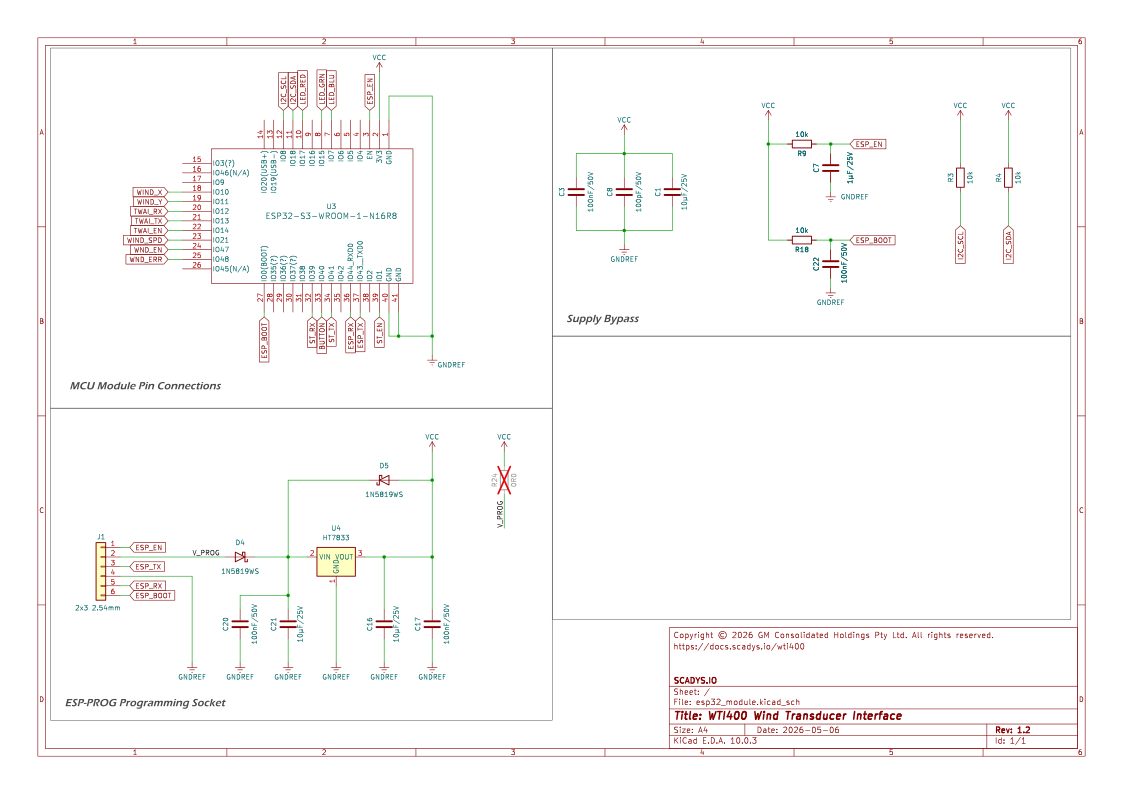
WTI400 v1.2 — In service on the test vessel. The page covers the developer/kit assembly variant currently fitted (U4 / D4 / D5 / J1 populated, R24 DNP); the Production variant section below describes the configuration the same PCB will carry once volume builds use the pogo-pin fixture.
Overview
This page documents the WTI400 firmware-programming hardware on esp32_module.kicad_sch: the ESP-PROG-compatible IDC header J1, the optional HT7833 LDO (U4) with its isolation Schottky diodes (D4, D5), and the production-variant zero-ohm bridge (R24) that takes their place. The host MCU and its supply bypass are on the ESP32 Module page.
This page covers a single sub-circuit — the Programming Socket — drawn on the esp32_module KiCad sheet.
The two assembly variants share the same footprint:
- Developer/kit variant — J1, U4, D4, D5 are populated; R24 is DNP. Programming is done with the standard Espressif ESP-PROG adapter and cable through J1; the LDO regulates the programmer's V_PROG (nominally 5 V) down to VCC (3.3 V) so the module can't be damaged if the adapter is mis-jumpered to 5 V output. This is the V1.2 build deployed on the test vessel.
- Production variant — R24 is populated and J1 / U4 / D4 / D5 are DNP. The zero-ohm link bridges VCC directly to V_PROG; programming uses a custom pogo-pin fixture contacting the J1 THT pad footprint from the top side of the board, and the board's own VCC powers the programming session.
The two variants are mutually exclusive — never populate both R24 and U4 (would short the LDO output to its own input through R24 in an uncontrolled way).
Functional specification and design objectives
- Expose a programming interface compatible with Espressif's standard ESP-PROG 6-pin adapter for the developer/kit build, so off-the-shelf tools can flash and debug the device.
- Protect U3 from over-voltage if the ESP-PROG jumper is inadvertently set to 5 V instead of 3.3 V.
- Prevent the programmer from being back-fed by the board's own VCC rail when both are connected.
- Provide a zero-cost path to delete all programmer-side parts in volume production where a pogo-pin fixture replaces the IDC socket.
Programming Socket
How it works
J1 — ESP-PROG-compatible IDC header
J1 (XFCN BH254V-6P) is a 2×3, 2.54 mm pitch through-hole IDC header matching the standard Espressif ESP-PROG pinout. From the module's frame of reference:
| Pin | Net | ESP-PROG function |
|---|---|---|
| 1 | ESP_EN | Reset / EN |
| 2 | V_PROG | Programmer 5 V supply |
| 3 | ESP_TX | UART0 TX (out from module) |
| 4 | GNDREF | Ground |
| 5 | ESP_RX | UART0 RX (in to module) |
| 6 | ESP_BOOT | IO0 boot-strap |

TX and RX are named from the module's perspective; the ESP-PROG adapter performs the crossover internally. The pinout has been verified working with the standard ESP-PROG cable on both WTI400 V1.2 and MDD400 V2.9.
Developer/kit V_PROG path
The current path from the programmer to VCC is a single forward-isolation Schottky followed by an LDO:
J1 pin 2 V_PROG (5 V from programmer)
   → D4 anode  (1N5819WS Schottky, forward isolation)
   → D4 cathode = U4 V_IN = Net-(D4-K)
   → U4 (HT7833 3.3 V LDO, SOT-89-3)
   → U4 V_OUT = VCC (3.3 V)
D4 — forward isolation / back-feed protection. When the programmer is disconnected and the board is powered normally (VCC = 3.3 V from the on-board SMPS), D4's anode sits at 0 V (J1 pin 2 unloaded) while its cathode is at U4 VIN ≈ VCC during start-up. D4 is reverse-biased and prevents any current path from board VCC back into the programmer's V_PROG pin.
D5 — Vout-to-Vin protection. Cathode at Net-(D4-K) (U4 VIN), anode at VCC. During normal LDO operation, U4 VIN sits ~1.35 V above VCC and D5 is reverse-biased (no current). During programmer-disconnection, the LDO input collapses while the VCC output capacitors (notably the C1 + C16 cluster) hold VCC for a few milliseconds. When VCC > U4 VIN, D5 conducts and bleeds VCC back through D5 to U4 VIN, preventing the output caps from back-charging U4 through its internal body diode. Same topology as D16 on the Power Supply sheet.
The WTI400 LDO path has one isolation Schottky in the forward direction (D4), as opposed to MDD400's two in series — the WTI400 has no separate 5 V VDD bus that needs OR-ing protection at the same node, so the simpler chain suffices.
LDO input decoupling
C20 (100 nF X7R 0603) and C21 (10 µF X7R 0805) sit on Net-(D4-K), 3.6 mm and 5.4 mm from U4 VIN respectively. Two-tier decoupling on the LDO input is required by the HT7833 datasheet for stable regulation. The LDO output decoupling (C16 / C17) is described on the ESP32 Module page — those caps double as VCC bypass on the host side.
Production variant
R24 (0 Ω 0805) is populated, J1 / U4 / D4 / D5 are DNP. The zero-ohm link bridges VCC directly to V_PROG. A custom pogo-pin fixture contacts the J1 THT pad footprint from the top side; the board's own VCC supplies the programming session current, so no external 5 V source is needed during flashing. Once production-flashed and the cover is fitted, no further programmer access is required for normal field operation.
Performance
| Parameter | Value | Notes |
|---|---|---|
| D4 VF at ~200 mA | 0.35 V typ / 0.40 V worst | JSMSEMI 1N5819WS |
| U4 VIN (typical) | 4.65 V | V_PROG 5.00 V − 0.35 V D4 |
| U4 dropout at 300 mA | 0.30 V | HT7833 datasheet |
| U4 headroom (typical) | 1.05 V | 4.65 V − (3.3 V + 0.30 V) — passes |
| U4 Pd @ 100 mA programming | 0.135 W | (4.65 − 3.3) × 0.10 |
| U4 Pd @ 450 mA abs-max | 0.608 W | Reference; not the operating point |
| U4 RθJA,eff (as-built) | ~50 °C/W | 56 mm² 4-layer copper + 9 thermal vias |
| U4 Tj @ 100 mA, 70 °C amb | 76.8 °C | 48.2 °C margin (38 %) to 125 °C Tj,max |
| U4 tab net | VIN (Net-(D4-K)) | Tab is VIN, not GND — layout must not connect to GNDREF |
| ESP_TX trace length | 33.1 mm | Under 50 mm; no series damping needed |
| ESP_RX trace length | 30.6 mm | Under 50 mm; no series damping needed |
| ESP_EN trace length | 57.1 mm | Exceeds 50 mm guideline; RC-limited signal — accepted for V1.2 |
| Schottky type | JSMSEMI 1N5819WS, 40 V / 350 mA, SOD-323 | D4 + D5 same part |
| Header type | 2×3, 2.54 mm IDC THT (XFCN BH254V-6P) | ESP-PROG compatible |
Why thermal is fine even at modest copper spreading. U4 is only active during programming sessions. During normal operation (Wi-Fi running, programmer disconnected) the V_PROG path is at 0 V, D4 is reverse-biased, U4 sees no input voltage, and U4 dissipates nothing. The 76.8 °C / 100 mA / 70 °C-ambient figure above is for a worst-case programming session in a hot enclosure — outside that window U4 is dormant.
PCB Layout
The programmer-power parts form a compact cluster on the left side of the board (x ≈ 107–111 mm, y ≈ 63–78 mm), with U4 (HT7833 LDO) at its centre and J1 12.8 mm away. The V_PROG isolation path is short and runs left across the board: J1 (pin 2) → D4 → Net-(D4-K) → U4 VIN, a span of about 12 mm.
- V_PROG isolation path. D4 sits 7.3 mm from U4 and 11.5 mm from J1; D5 is 9.1 mm from U4. D4, D5 and U4 form a vertical stack at x ≈ 107–108 mm, keeping the LDO input node (Net-(D4-K)) localised. The Net-(D4-K) copper has a dedicated F.Cu fill zone over the U4 VIN area. V_PROG traces use 0.2–0.4 mm widths; at the 450 mA programmer-supply maximum the 0.4 mm segments are marginal but safe for the short runs involved.
- LDO decoupling. C20 (100 nF) is 3.6 mm from U4 VIN and C21 (10 µF) is 5.4 mm — the input two-tier decoupling cluster is compact and adjacent to the LDO. C16 (10 µF) and C17 (100 nF), the VCC/LDO-output decoupling, sit 3.5 mm from U4 (their VCC role is described on the ESP32 Module page).
- U4 thermal. The tab pad (Net-(D4-K) = VIN, not GND) spreads onto all four layers — about 14 mm² per layer, 56 mm² total — bonded by 9 thermal vias. Because U4 is energised only during programming, this gives an effective RθJA of roughly 50 °C/W and ample margin (Tj ≈ 76.8 °C at 100 mA / 70 °C ambient).
- R24 (DNP). Placed at the LDO/V_PROG cluster (2.9 mm from D4, 7.4 mm from U4), where the production-variant zero-ohm link would bridge VCC to V_PROG; its DNP attribute is confirmed in the layout.
- J1 placement. J1 is in the board interior (119.0, 72.5) rather than at an edge — nearest edge 30.1 mm (top), with the right, left and bottom edges 42–65 mm away. No high-dV/dt switching nodes are adjacent. Interior placement means programmer access needs a cable or a top-side pogo-pin fixture rather than an edge-mounted connector; this is functional but not at a board edge as Espressif guidance prefers.
- ESP_EN routing. The ESP_EN net runs 57.1 mm from J1 through the R9 / C7 RC pair to U3's EN pad, exceeding the 50 mm guideline. As an RC-limited (R9 10 kΩ + C7 1 µF) signal the integrity risk is negligible and the path is confirmed working on the test vessel; a shorter route is tracked for V1.3.
Components
| Ref | Value | Function | Datasheet |
|---|---|---|---|
| U4 | HT7833 | UMW HT7833-A 3.3 V fixed-output LDO, SOT-89-3, 450 mA. Regulates programmer V_PROG to VCC during firmware flashing. Developer/kit variant only — DNP in production builds | UMW HT7833-A |
| D4 | 1N5819WS | JSMSEMI Schottky, 40 V / 350 mA, SOD-323. Input isolation Schottky on the V_PROG path (anode = J1 V_PROG, cathode = U4 VIN). Prevents back-feed from VCC to the programmer | JSMSEMI 1N5819WS |
| D5 | 1N5819WS | JSMSEMI Schottky, SOD-323. Vout-to-Vin protection on the LDO (cathode = U4 VIN, anode = VCC). Conducts only during power-down to discharge VCC output caps without back-charging U4. Same topology as D16 on the power_supplies sheet | JSMSEMI 1N5819WS |
| J1 | XFCN BH254V-6P | 2×3, 2.54 mm pitch THT IDC header — ESP-PROG-compatible programming interface. Developer/kit variant only | XFCN BH254V-6P |
| R24 | 0 Ω 0805 (DNP on V1.2) | Production-variant zero-ohm bridge VCC ↔ V_PROG. Populated only when U4 / D4 / D5 / J1 are DNP. Never populate alongside U4 | Yageo RC Group |
| C20 | 100 nF / 50 V X7R 0603 | LDO input bypass (Net-(D4-K) to GNDREF), 3.6 mm from U4 VIN | Murata GCM188R71H104KA57D |
| C21 | 10 µF / 25 V X7R 0805 | LDO input bulk bypass (Net-(D4-K) to GNDREF), 5.4 mm from U4 VIN | Murata GRM21BZ71E106KE15L |
The LDO output-side decoupling caps (C16 / C17) double as VCC bypass on the host side and are listed in the Components table on the ESP32 Module page.
Testing & Verification
The developer/kit assembly variant (J1 / U4 / D4 / D5 populated, R24 DNP) is the build deployed on the test vessel. End-to-end programming via the standard Espressif ESP-PROG adapter has been confirmed working on both WTI400 V1.2 and MDD400 V2.9, and field firmware updates have been performed on the test-vessel unit without observed failures. No quantitative bench measurements have been performed on D4 back-feed leakage, U4 thermal soak during sustained programming traffic, or the production-variant R24 path under any pogo-pin fixture. The following are required.
Hardware bring-up (rig at the bench, developer/kit variant):
- End-to-end programming via ESP-PROG — Flash a known firmware image at 921600 baud over the standard ESP-PROG adapter and cable. Pass if the image flashes cleanly, the device boots, and Wi-Fi associates. (Confirmed working on WTI400 V1.2 and MDD400 V2.9.)
- D4 back-feed check — Power the board from its own SMPS only, with the programmer disconnected. Probe J1 pin 2 (V_PROG). Pass if pin 2 measures < 0.1 V (any voltage above this indicates leakage through D4 or contamination).
- U4 thermal soak during programming — Hold the SoC in ROM download mode while the programmer drives sustained UART traffic for 60 s. Probe U4 body temperature with a contact thermocouple and record peak. Pass if peak ≤ 95 °C in a 70 °C ambient (≥ 30 °C Tj margin).
Gaps & next version
Before next production run
- Pogo-pin fixture programming — Once the pogo-pin fixture exists, verify end-to-end flashing of the production variant (R24 populated, J1 / U4 / D4 / D5 DNP) through it using the board's own VCC for the programming session. Confirm no contamination, no over-stress, and matching pinout to the J1 THT pad footprint.
Next version (V1.3)
- Shorten the ESP_EN routing — V1.2 has a 57.1 mm ESP_EN trace from J1 through R9 / C7 to U3 pad 3 (EN). Re-route R9 / C7 closer to U3's EN pad to bring the trace below the 50 mm guideline. (Also tracked on the ESP32 Module page; tracked in
v1.3-improvements.md.)
References
- Espressif Systems, ESP-PROG Hardware Guide.
- UMW, HT7833-A SOT-89 LDO.
- JSMSEMI, 1N5819WS SOD-323 Schottky.
- XFCN, BH254V-6P 2×3 2.54 mm IDC Header.
- Yageo, RC Group Chip Resistor.
Related pages
- ESP32 Module — host MCU; VCC bypass; EN / BOOT control-line networks
- Power Supplies — VCC rail generation; D5 mirrors D16 (Vout-to-Vin protection) on that sheet
- Pin Assignments — UART0 / EN / BOOT / I²C GPIO map for the host module