ESP32 Module
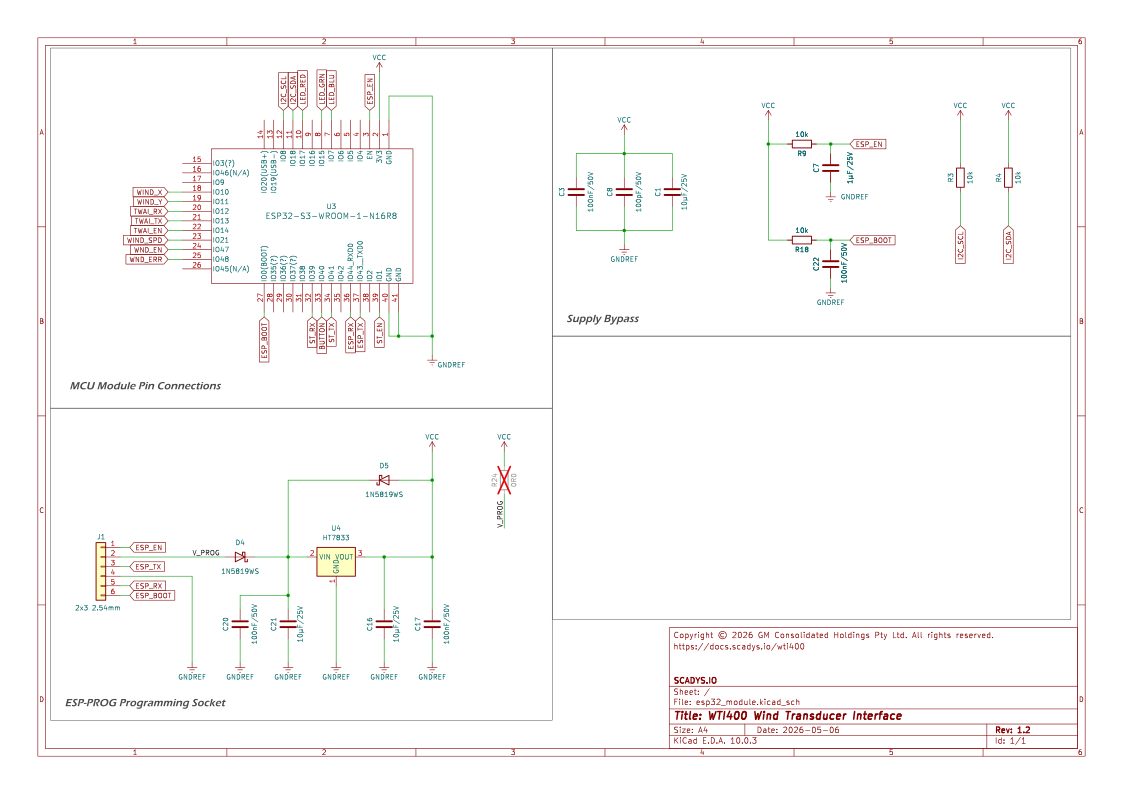
WTI400 v1.2 — In service on the test vessel. Approximately 1,000 sea miles accumulated running a simple PlatformIO/Arduino firmware on the ESP32 with Wi-Fi never enabled and BLE only exercised during early BLE-library development on test hardware. The firmware emits NMEA 2000 wind sentences with hard-coded start-up speed-conversion and installation-angle constants and hard-coded initial WIND_X / WIND_Y ADC limits; the limits and midpoint are then self-adjusted at run-time as new extremes are observed. I2C bus runs at Standard mode (100 kHz). A production ESP-IDF firmware is the next major project task. Subjective in-service performance is satisfactory; the Testing & Verification section lists what's still to be measured.
Overview
This page documents the WTI400's main application processor — an Espressif ESP32-S3-WROOM-1-N16R8 module — and its host-side surroundings on esp32_module.kicad_sch: VCC bypass, control-line RC networks, and the I2C bus pull-ups. The firmware-programming hardware (J1 ESP-PROG IDC socket, the optional HT7833 LDO U4, isolation Schottkys D4 / D5, and the production-variant R24 zero-ohm bridge) is also on this sheet but is documented on its own Programming Socket page.
Two sub-circuits in narrative order:
- ESP32-S3 module and signal map — U3 itself, its global-label fan-out to every other sub-sheet, and the antenna-end clearance treatment.
- VCC supply bypass and control-line RC networks — multi-stage VCC decoupling at U3's 3V3 pads, the EN power-on RC, the IO0 boot-strap RC, and the I2C bus pull-ups (R3 SCL, R4 SDA).
Functional specification and design objectives
The ESP32 module circuit must:
- house a pre-certified, dual-core Wi-Fi/Bluetooth MCU module with enough on-board flash and PSRAM to run the WTI400 firmware without external memory;
- expose the module's I/O cleanly to every other sub-sheet via hierarchical global labels so the system-level schematic stays readable;
- maintain the module's pre-certification by satisfying Espressif's antenna keep-out requirement on the PCB;
- provide multi-stage VCC bypass at U3's 3V3 castellated pads, sized to handle ESP32-S3 Wi-Fi TX current pulses without sagging the 3.3 V rail;
- hold ESP_EN (CHIP_PU) and ESP_BOOT (IO0) at clean, well-defined logic states during power-up and during normal operation;
- time the EN release after VCC stabilises, satisfying Espressif's minimum reset-extension requirement; and
- pull the shared I2C bus (SDA, SCL) up to VCC at a value compatible with both the current Standard-mode firmware and the on-PCB bus capacitance.
ESP32-S3 module and signal map
How it works
U3 — ESP32-S3-WROOM-1-N16R8 is an Espressif system-in-package module carrying:
- ESP32-S3 dual-core Xtensa LX7 SoC at up to 240 MHz,
- 16 MB QSPI flash,
- 8 MB PSRAM,
- 2.4 GHz Wi-Fi + BT 5 LE radio with integrated PCB antenna,
- FCC / CE / IC pre-certifications.
The module's only supply input is the 3.3 V VCC rail from the Power Supply page. All bypass, EN, BOOT, and I2C pull-up infrastructure on this sheet sits on that rail.
U3 fans out to every other sub-sheet through hierarchical global labels. Functionally:
| Signal group | Labels | Direction | Counterpart sub-sheet |
|---|---|---|---|
| Wind transducer analog | WIND_X, WIND_Y | ADC input (U3 → ADC) | Wind Interface |
| Wind transducer pulse | WIND_SPD | Edge-triggered GPIO | Wind Interface |
| Wind transducer control | WND_EN, WND_ERR | GPIO out / GPIO in | Wind Interface |
| CAN / NMEA 2000 | TWAI_TX, TWAI_RX, TWAI_EN | UART-like | CAN Transceiver |
| Legacy serial | ST_TX, ST_RX, ST_EN | UART2 | Legacy Serial Interface |
| Motion sensing | I2C_SDA, I2C_SCL | I2C bus | Motion Sensor |
| Local UI | BUTTON, LED_RED, LED_GRN, LED_BLU | GPIO | Button Input / LED Indicator |
| Programming | ESP_TX, ESP_RX, ESP_EN, ESP_BOOT | UART0 + control | J1 (this sheet) |
The I2C bus pull-ups (R3, R4) live on this sheet rather than on the motion-sensor sheet because the bus is shared and the pull-ups belong with the master rather than any one slave. They're described under the VCC supply bypass and control-line RC networks sub-circuit below.
Antenna-end clearance. The Espressif module datasheet requires the antenna projection area to be free of copper on all PCB layers. The WTI400 V1.2 layout achieves this with a physical PCB cutout under the antenna section: the substrate is removed entirely, which also removes any fill copper that might otherwise have been carried there by zone priority alone. No keepout rule area is needed because the cutout makes the requirement self-enforcing. Module pre-certification is preserved.
Performance
| Parameter | Value | Notes |
|---|---|---|
| CPU clock (max) | 240 MHz | Dual-core LX7 |
| Flash | 16 MB QSPI | On-package |
| PSRAM | 8 MB | On-package |
| Wi-Fi PHY | 802.11 b/g/n, 2.4 GHz | Pre-certified module |
| Pre-certifications | FCC ID 2AC7Z-ESP32S3WROOM1, CE RED 2014/53/EU, IC | Maintained by antenna keep-out (cutout) |
| Antenna keep-out method | PCB cutout under antenna section | Substrate + copper removed; no rule area needed |
| Bypass and control-line decoupling | Described in next sub-circuit | C1/C3/C8 + EN/BOOT RC + I2C pull-ups |
VCC supply bypass and control-line RC networks
How it works
Multi-stage VCC bypass at U3, ordered for force-commutation. The bypass cluster is placed in a straight line from U3's pad 2 (the 3V3 castellated supply pad), smallest cap first:
- C8 — 100 pF / 50 V C0G 0603 at the front, VCC pad as close to U3 pad 2 as the courtyards allow.
- C3 — 100 nF / 50 V X7R 0603 immediately adjacent to C8, as close as the courtyards allow.
- C1 — 10 µF / 25 V X7R 0805 immediately adjacent to C3, again as close as the courtyards allow.
Critically, the VCC pads of C8 / C3 / C1 are isolated from the surrounding F.Cu VCC pour: a narrow private VCC trace daisy-chains the three VCC pads, and the trace ties into the broader VCC pour through a single via only at the far end of C1. The current path from the pour into U3 is therefore forced to be pour → via → C1 → C3 → C8 → U3 pad 2, with no short-cut path that bypasses the caps. Each cap sees the U3 load current and contributes its frequency band — C8 catches the fastest transients first because of its low-ESL C0G construction, C3 fills in the mid band, C1 supplies bulk charge replenishment. Spreading-inductance shortcuts through the pour can't bypass any of them.
A second VCC bypass pair (C16 10 µF + C17 100 nF) sits 3.5 mm from U4 on the LDO output / programmer power side, providing decoupling on the same VCC node near the LDO junction. Total VCC bypass on the U3 supply: 100 pF + 2× 100 nF + 2× 10 µF — two times the Espressif minimum (100 nF + 10 µF).
The stack-up does the very-high-frequency work. Across the digital area, the four-layer board is poured as VCC – GNDREF – GNDREF – VCC (F.Cu and B.Cu both carry VCC; In1.Cu and In2.Cu carry unbroken GNDREF). This creates two VCC↔GNDREF plane pairs separated by 0.1855 mm prepreg — a distributed bypass capacitor across the whole digital region with no parasitic inductance and no ESR. The full reasoning is on the Power Supply page; the consequences specifically for U3 are:
- The 31 GND vias under U3's footprint drop straight to the two inner GNDREF planes — the return path for any current entering U3 pad 2 has essentially zero parasitic inductance.
- The discrete C8 / C3 / C1 chain handles transients up to the frequency where its own package ESL starts to dominate; above that, the plane-pair capacitance takes over with effectively zero ESL. The plane pair, not the discrete cluster, is what decouples U3 at the antenna's 2.4 GHz fundamental and its harmonics — which is also why the single tie-in via at C1's far end is sufficient rather than risky: the pour-side decoupling at GHz frequencies is the plane pair, not the via inductance.
- The unbroken inner GNDREF planes give the antenna an unbroken reference under its entire projection back into the board — important for the module's pre-certified RF behaviour to be preserved.
EN power-on delay. R9 (10 kΩ) pulls ESP_EN up to VCC; C7 (1 µF) sits from ESP_EN to GNDREF. The pair forms an RC charge curve that delays the EN assertion after the VCC rail comes up:
τ_EN = R9 × C7 = 10 kΩ × 1 µF = 10 ms
Time to reach the ESP32-S3's valid-HIGH threshold (≥ 0.75 × VCC ≈ 2.48 V) is approximately 1.4 × τ ≈ 14 ms. Espressif requires the EN RC to be ≥ 1 ms; 10 ms is a 10× margin and ensures the rail is fully stable before the SoC starts.
BOOT strap. R18 (10 kΩ) pulls ESP_BOOT (U3 IO0) up to VCC; C22 (100 nF) filters noise on the IO0 boot-strap node. The RC is much shorter:
τ_BOOT = R18 × C22 = 10 kΩ × 100 nF = 1 ms
IO0 reaches the valid HIGH well before EN releases (~14 ms later), so the module enters normal SPI-flash boot mode. During programming, ESP-PROG pulls IO0 low through J1 pin 6, overriding the pull-up, and the module enters ROM download mode when EN is then toggled.
I2C bus pull-ups. R3 (10 kΩ) on I2C_SCL and R4 (10 kΩ) on I2C_SDA are the bus pull-ups for the shared I2C connecting U3 to the Motion Sensor sub-sheet (and any other I2C peripherals added in future revisions). At Standard mode (100 kHz) the pull-up value is fine for any reasonable on-PCB bus capacitance. The Fast-mode (400 kHz) margin tightens (see the performance table); a V1.3 backlog item tracks reducing R3 / R4 to 4.7 kΩ if a firmware upgrade to 400 kHz is needed.
Performance
| Parameter | Value | Notes |
|---|---|---|
| C8 (RF, first in chain) | 100 pF C0G | VCC pad courtyard-touching U3 pad 2 |
| C3 (mid, second in chain) | 100 nF X7R | Adjacent to C8 (courtyard-touching) |
| C1 (bulk, third in chain) | 10 µF X7R | Adjacent to C3 (courtyard-touching); single via to F.Cu VCC pour at far end |
| C16, C17 (LDO output side) | 10 µF + 100 nF | 3.5 mm from U4 |
| Total VCC bypass on U3 | 20 µF + 200 nF + 100 pF | 2× Espressif minimum |
| Bypass topology | Force-commutated daisy chain | Private VCC trace, isolated from F.Cu pour except at C1-far via |
| EN RC time constant τ | 10 ms | R9 × C7 |
| EN time to valid HIGH | ~14 ms | 1.4 × τ, threshold = 0.75 × VCC |
| EN trace length (J1 → R9/C7 cluster → U3 pad 3 / EN) | 57.1 mm | RC-limited signal, accepted for V1.2 (see Gaps & next version) |
| BOOT RC time constant τ | 1 ms | R18 × C22 |
| BOOT time to valid HIGH | ~2.2 ms | 2.2 × τ |
| I2C bus rise time tr @ Cbus = 30 pF | 254 ns | 0.8473 × 10 kΩ × 30 pF — Standard mode pass, Fast mode pass |
| I2C bus rise time tr @ Cbus = 50 pF | 424 ns | Standard mode pass, Fast mode fail |
| Maximum Cbus for Standard mode (100 kHz) | 118 pF | tr ≤ 1000 ns at Rpu = 10 kΩ |
| Maximum Cbus for Fast mode (400 kHz) | 35 pF | tr ≤ 300 ns at Rpu = 10 kΩ |
| I2C pull-up current | 0.29 mA per line | (3.3 − 0.4) V / 10 kΩ — well below ESP32-S3 IOL 20 mA spec |
PCB Layout
All esp32_module components sit on F.Cu, on a four-layer board (1.6 mm total, ENIG finish) poured for the digital domain as VCC – GNDREF – GNDREF – VCC: F.Cu and B.Cu carry VCC, the two inner planes (In1.Cu / In2.Cu) carry unbroken GNDREF. U3 (148.3, 62.1, rotated −90°) is in the upper-right of the board with its antenna end at the right board edge (x ≈ 161.6).
- Antenna clearance. U3's antenna end faces the right board edge. A PCB board cutout under the antenna section physically removes the substrate and all fill copper from the antenna projection area, so no
rule_areakeepout is required and module pre-certification is preserved. - VCC bypass cluster — force-commutated daisy chain. C8 (100 pF C0G), C3 (100 nF), and C1 (10 µF) are courtyard-touching adjacent to U3 pad 2 (the 3V3 supply pad), daisy-chained smallest-cap-first: C8 nearest pad 2 (y = 51.15), C3 next (y = 49.6), C1 outermost (y = 47.8). The three caps' VCC pads are deliberately isolated from the surrounding F.Cu VCC pour and connected to it through a single via at the C1-far end only (a ~0.2 mm private VCC trace at x ≈ 152.32), forcing the load current to traverse pour → via → C1 → C3 → C8 → U3 pad 2. (An earlier review pass mis-identified pad 3 as the VCC pad; corrected 2026-05-27 — pad 2 is 3V3/VCC, pad 3 is EN. The as-built layout has the caps courtyard-touching pad 2.)
- LDO-output decoupling. C16 (10 µF) and C17 (100 nF) are 3.5 mm from U4 on the VCC node near the LDO output (U4 pad 3 = VCC directly). LDO input decoupling (C20 100 nF at 3.6 mm, C21 10 µF at 5.4 mm) and the U4/D4/D5/R24 programmer cluster sit at x ≈ 107–111 on the board's left side and are covered on the Programming Socket page.
- EN RC pair. R9 (10 kΩ pull-up) and C7 (1 µF timing cap) are tightly paired 1.6 mm apart at (150.8, 50.4) / (149.2, 50.4), at the top of the VCC cluster (~21 mm from U3's EN pad at y = 70.85). The ESP_EN route from U3 through R9/C7 to J1 totals 57.1 mm — above the 50 mm guideline but accepted for V1.2 because the signal is RC-limited (see Gaps & next version).
- BOOT RC pair. R18 (10 kΩ pull-up) and C22 (100 nF filter) are paired 1.5 mm apart at (134.5, 73.7) / (136.0, 73.7), nearer J1 than U3. ESP_BOOT routes J1 pin 6 → R18/C22 → U3 pad 27 in 18.8 mm total — adequate, as BOOT is toggled only during programming.
- I2C pull-ups. R3 (SCL) and R4 (SDA) are co-located 1.4 mm apart at (139.2, 50.2) / (140.6, 50.2) in the VCC cluster area, feeding the I2C bus labels that route to the motion-sensor sub-sheet. Adequate for a 400 kHz I2C bus.
- UART routing. ESP_TX (~33.1 mm) and ESP_RX (~30.6 mm) are both under the 50 mm threshold, so no 33 Ω series damping resistors are required.
- Ground / decoupling planes. 31 GNDREF vias under U3's footprint stitch F.Cu to B.Cu and drop straight to the two inner GNDREF planes, giving near-zero return-path inductance for current entering U3 pad 2. U3 pad 41 (the internal exposed-pad array) uses a solid (zone_connect = 2) connection to the GNDREF fill. No inner-plane copper sits under the U3 module body, and the unbroken inner GNDREF planes provide a continuous RF reference under the antenna projection.
Components
| Ref | Value | Function | Datasheet |
|---|---|---|---|
| U3 | ESP32-S3-WROOM-1-N16R8 | Espressif dual-core Xtensa LX7 MCU module, 240 MHz, 16 MB QSPI flash, 8 MB PSRAM, 2.4 GHz Wi-Fi + BT 5 LE, pre-certified | Espressif ESP32-S3-WROOM-1 |
| R3 | 10 kΩ 0603 ±1 % | I2C bus pull-up — VCC to I2C_SCL | Yageo RC Group |
| R4 | 10 kΩ 0603 ±1 % | I2C bus pull-up — VCC to I2C_SDA | Yageo RC Group |
| R9 | 10 kΩ 0603 ±1 % | EN pull-up — VCC to ESP_EN (U3 CHIP_PU). With C7 forms power-on RC delay (τ = 10 ms) | Yageo RC Group |
| R18 | 10 kΩ 0603 ±1 % | BOOT pull-up — VCC to ESP_BOOT (U3 IO0). Selects SPI flash boot mode during normal operation | Yageo RC Group |
| C1 | 10 µF / 25 V X7R 0805 | VCC main-cluster bulk bypass, third in chain from U3 pad 2 (single via to F.Cu VCC pour at far end) | Murata GRM21BZ71E106KE15L |
| C3 | 100 nF / 50 V X7R 0603 | VCC main-cluster mid-frequency bypass, second in chain (between C8 and C1) | Murata GCM188R71H104KA57D |
| C7 | 1 µF / 25 V X7R 0603 | EN RC timing capacitor (ESP_EN to GNDREF). τ = 10 ms with R9 | Murata GCM188R71E105KA64D |
| C8 | 100 pF / 50 V C0G 0603 | VCC main-cluster RF bypass, first in chain (VCC pad courtyard-touching U3 pad 2) | Murata GRM1885C1H101JA01D |
| C16 | 10 µF / 25 V X7R 0805 | LDO-output-side VCC bulk bypass, ~3.5 mm from U4 (LDO described on the Programming Socket page) | Murata GRM21BZ71E106KE15L |
| C17 | 100 nF / 50 V X7R 0603 | LDO-output-side VCC mid-frequency bypass | Murata GCM188R71H104KA57D |
| C22 | 100 nF / 50 V X7R 0603 | BOOT filter (ESP_BOOT to GNDREF). τ = 1 ms with R18 | Murata GCM188R71H104KA57D |
Programming-socket components (U4, D4, D5, J1, R24, C20, C21) are listed on the Programming Socket page.
Testing & Verification
The V1.2 prototype on the test vessel has been in service for approximately 1,000 sea miles running the PlatformIO/Arduino firmware described in the operating-context note at the top of this page (Wi-Fi has never been enabled; BLE only exercised during early library development on test hardware). Programming via the ESP-PROG adapter has been confirmed working on both WTI400 V1.2 and MDD400 V2.9. No quantitative bench measurements have been performed on the VCC bypass, EN RC, BOOT RC, or LDO thermal behaviour yet. The following are required.
Hardware bring-up (rig at the bench):
- VCC rail under Wi-Fi TX — Probe at U3 pad 2 during a sustained 802.11b TX burst. Pass if the rail stays within ±3 % of 3.30 V with no individual dip below 3.10 V.
- EN release timing — Trigger on VCC rising; capture ESP_EN. Pass if ESP_EN crosses 2.48 V ≥ 10 ms after VCC reaches 3.0 V.
- I2C rise time — Capture SDA / SCL transitions during normal Standard-mode (100 kHz) operation. Record 30 %-to-70 % tr and infer Cbus. Pass if tr ≤ 1000 ns.
Programmer-side bring-up (end-to-end programming, D4 back-feed check, U4 thermal soak) is on the Programming Socket page.
Gaps & next version
Before next production run
- I2C Fast-mode bus characterisation — If firmware is upgraded to I2C Fast mode (400 kHz), measure SCL / SDA rise time at 400 kHz. Pass if tr ≤ 300 ns. If Cbus exceeds 35 pF (the threshold for 400 kHz with 10 kΩ pull-ups), reduce R3 / R4 to 4.7 kΩ before enabling Fast mode.
Next version (V1.3)
- Shorten the ESP_EN routing — V1.2 has a 57.1 mm ESP_EN trace from J1 through R9 / C7 to U3 pad 3 (EN). The signal is RC-limited and the trace is acceptable as-is, but the route picks up board noise before the SoC is active. Re-route R9 / C7 closer to U3's EN pad to bring the trace below the 50 mm guideline.
- Reduce I2C pull-ups for Fast-mode capability — If firmware needs 400 kHz I2C, drop R3 / R4 to 4.7 kΩ to widen the Cbus margin from 35 pF up to ~75 pF.
References
- Espressif Systems, ESP32-S3-WROOM-1 & WROOM-1U Module Datasheet.
- Espressif Systems, ESP32-S3 Datasheet.
- Espressif Systems, ESP-IDF API Reference — GPIO & RTC GPIO.
- NXP Semiconductors, UM10204 I²C-bus specification and user manual, Rev 7.0, 2021.
- Yageo, RC Group Chip Resistor.
- Murata Electronics, GRM21BZ71E106KE15L — 10 µF X7R 0805.
- Murata Electronics, GCM188R71H104KA57D — 100 nF X7R 0603.
- Murata Electronics, GCM188R71E105KA64D — 1 µF X7R 0603.
- Murata Electronics, GRM1885C1H101JA01D — 100 pF C0G 0603.
Related pages
- Programming Socket — J1 ESP-PROG IDC header, HT7833 LDO, isolation Schottkys, and the production-variant R24 bridge that share this sheet
- Power Supplies — derives the 3.3 V VCC rail and the VCC–GNDREF plane-pair stack-up that decouples U3
- Motion Sensor — the I2C slave served by the R3 / R4 bus pull-ups on this sheet
- Pin Assignments — the full U3 GPIO map behind the signal-fan-out table