Button Input
WTI400 v1.2 — In service — installed on test vessel
Overview
The button is the primary user input on the WTI400 and is part of the user-facing button/LED UI on the front face of the device. It supports three interaction types — single press, double-click, and long press — allowing the user to give different instructions without additional controls. This page covers the hardware circuit that takes the raw mechanical switch signal and delivers a clean, debounced digital input to the ESP32 using a Schmitt trigger buffer.
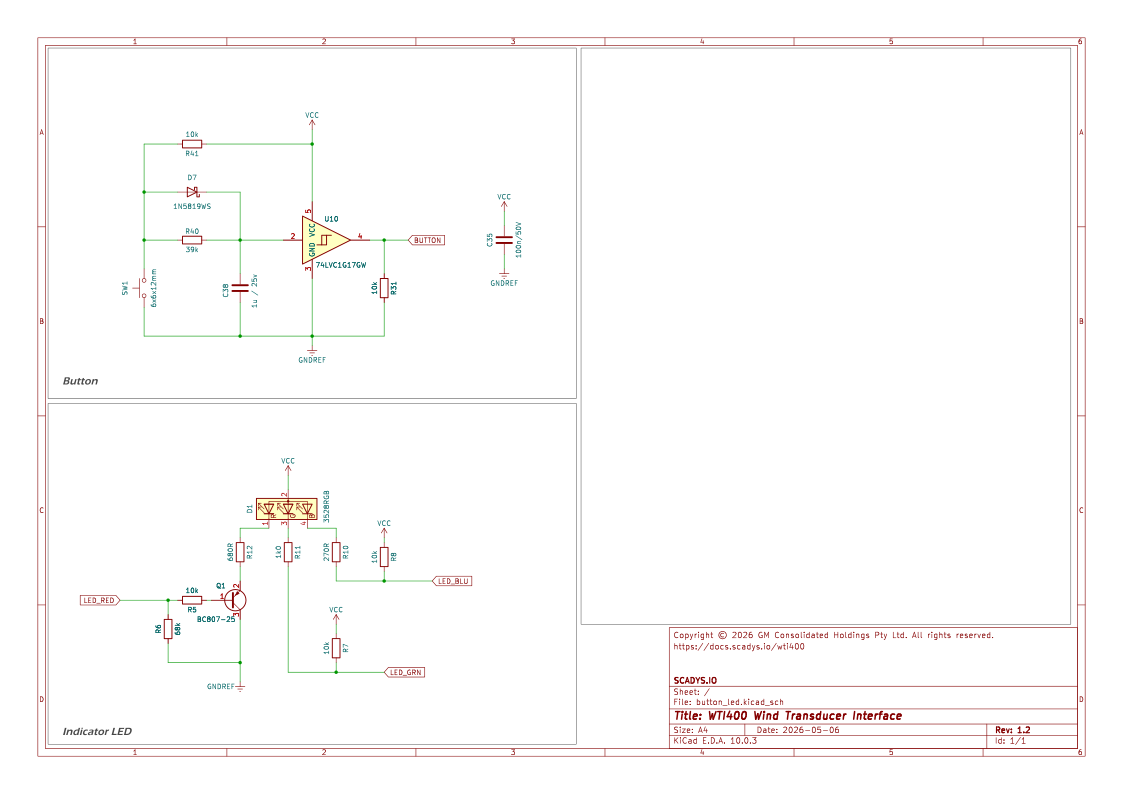
This page covers a single sub-circuit — the Button Input — drawn on the button_led KiCad sheet (which it shares with the RGB LED indicator):
- Button Input — SW1 tactile switch, ESD protection, RC debounce, and Schmitt-trigger conditioning to the BUTTON GPIO.
Functional specification and design objectives
The button input circuit must:
- detect a press of SW1 and deliver a clean, glitch-free digital signal to an ESP32 GPIO;
- eliminate contact bounce — the rapid make-and-break transitions that occur in the first few milliseconds of any mechanical switch press;
- protect the input from electrostatic discharge (ESD) at the switch terminals; and
- present a defined signal level to the ESP32 during boot, before firmware has initialised.
Button Input
How it works
Mechanical switch and pull-up
SW1 is an SPST (single-pole, single-throw) SMD tactile switch with a 12 mm actuator. One terminal connects to the button input node; the other connects to GNDREF.
R41, a 10 kΩ resistor, pulls the button input node up to VCC (3.3 V) (pull-up). When SW1 is open (not pressed), R41 holds the input node firmly at 3.3 V — a logic HIGH. When SW1 is pressed, it connects the input node directly to ground, pulling it to 0 V — a logic LOW. The switch current at the moment of pressing is 3.3 V / 10 kΩ = 0.33 mA, well within SW1's 50 mA rating.
BUTTON HIGH — button not pressed (R41 holds input to VCC) BUTTON LOW — button pressed (SW1 pulls input to GNDREF)
ESD protection
D7, a 1N5819WS Schottky diode in a SOD-323 package, sits in series with the signal path between SW1 and the rest of the circuit. Any electrostatic discharge arriving at the switch terminals (from a user touch, for example) is clipped by D7 before it can reach the more sensitive components downstream. The Schottky forward voltage is low (~0.3 V), so normal signal levels pass through with minimal drop.
RC debounce filter
When a mechanical switch closes, its contacts do not make a single clean connection. They bounce — rapidly opening and closing many times over a period of typically 5–20 ms — before settling. To a fast digital input, this looks like a rapid burst of HIGH/LOW transitions rather than a single clean edge. If passed directly to the ESP32 it would trigger multiple false button-press events per physical press.
R40 (39 kΩ) and C38 (1 µF) form an RC low-pass filter in the signal path. When SW1 closes, C38 does not discharge instantly — it discharges through R40 at a rate set by the RC time constant:
τ = R × C = 39,000 Ω × 0.000001 F = 39 ms
This means the voltage at C38 takes roughly 39 ms to fall from VCC to near zero — far slower than the 5–20 ms bounce window. The bounce transients are averaged out, and the filter output is a smooth, slow-falling ramp. Similarly on release, C38 charges slowly through R40 and R41, producing a smooth-rising signal. The RC filter trades response speed for cleanliness: a 39 ms debounce time is imperceptible to a human user but eliminates bounce entirely.
Why hardware debounce rather than software-only? Software debounce is possible — the firmware can ignore transitions within a fixed window after the first edge — but it requires careful interrupt or timer management and must be re-implemented in every firmware version. A hardware RC filter solves the problem unconditionally, in silicon, regardless of what the firmware does. The Schmitt trigger (described below) adds a further layer that software cannot easily replicate.
Schmitt-trigger buffer
The RC filter output is a slow ramp, not a fast digital edge. If connected directly to a standard logic input, the slow transition through the input's switching threshold could cause the input to oscillate briefly — producing multiple output edges from a single input ramp.
U10, a Nexperia 74LVC1G17GW Schmitt-trigger buffer in a TSSOP-5 package, solves this. A Schmitt-trigger input has two separate switching thresholds:
- V_T+ (positive-going threshold) ≈ 1.8 V at VCC = 3.3 V — the input must rise above this level before the output goes HIGH;
- V_T− (negative-going threshold) ≈ 1.0 V at VCC = 3.3 V — the input must fall below this level before the output goes LOW; and
- Hysteresis band = V_T+ − V_T− ≈ 0.8 V.
The 0.8 V gap between the two thresholds means that once the output has switched, the input must travel a full 0.8 V in the opposite direction before it switches back. Any noise or slow wavering near the threshold is ignored. The RC ramp passes cleanly through both thresholds, producing a single, sharp output edge in each direction.
U10 is a non-inverting buffer, so the BUTTON signal is LOW when pressed and HIGH when not pressed — the same polarity as the switch.
C35 (100 nF, X7R 0603) decouples U10's VCC pin, suppressing any supply noise that could affect the threshold voltages.
Output and boot-state pull-down
U10's output drives the BUTTON global label, which connects to the ESP32 GPIO on the esp32_module sheet. R31 (10 kΩ) connects BUTTON to GNDREF.
U10 is a push-pull output — it actively drives both HIGH and LOW, so BUTTON is always in a defined state during normal operation. R31 has no effect on normal operation. Its purpose is to hold BUTTON LOW during the brief window at power-up before VCC has stabilised and U10 has started driving.
During boot, R31 holds BUTTON LOW, which reads as a button press. A weak pull-up to VCC (e.g. 100 kΩ) would be more correct: it would hold BUTTON HIGH during boot (not-pressed = idle), which is the safe default. It would also eliminate the ~0.33 mA continuous current drain that R31 currently causes (U10 driving HIGH against a 10 kΩ pull-down). The necessity of any pull resistor should also be reviewed — U10's push-pull output means the line is never floating during normal operation.
Performance
| Parameter | Value | Notes |
|---|---|---|
| Pull-up current (R41) | 0.33 mA | SW1 rated 50 mA — 150× margin |
| Debounce time constant τ | 39 ms | R40 × C38 = 39 kΩ × 1 µF |
| Typical contact bounce duration | 5–20 ms | τ is 2–8× the bounce window |
| Schmitt V_T+ (at 3.3 V) | ≈ 1.8 V | 74LVC1G17 datasheet |
| Schmitt V_T− (at 3.3 V) | ≈ 1.0 V | 74LVC1G17 datasheet |
| Hysteresis band | ≈ 0.8 V | V_T+ − V_T− |
| R31 continuous drain | 0.33 mA | VCC / R31; flows when button not pressed |
Firmware notes
Interrupt vs polling
The current firmware uses a FreeRTOS task that polls the BUTTON GPIO at a fixed interval and tracks elapsed time to distinguish press types. An interrupt-driven approach is an alternative worth considering.
Polling approach (current):
- a task wakes on a timer tick, reads the BUTTON GPIO state, and compares it to the previous state;
- on a LOW→HIGH transition (release), the elapsed time since the LOW→LOW (press) transition determines the press type;
- simple to implement; no risk of missing events if the poll interval is shorter than the minimum press duration; and
- consumes CPU time even when the button is idle.
Interrupt-driven approach:
- the ESP32 GPIO is configured to trigger an interrupt on a falling edge (press) and a rising edge (release);
- each interrupt records the current timestamp (e.g.
esp_timer_get_time()); - a lightweight ISR records the edge time and posts to a queue; a FreeRTOS task processes the queue and classifies the press;
- CPU is idle between presses; timing precision is limited only by interrupt latency (~1 µs on ESP32), not the poll interval; and
- slightly more complex to implement correctly (ISR must be minimal; queue sizing must handle rapid button activity).
Both approaches work with the hardware as built. The interrupt approach is more efficient and gives higher timing precision for double-click detection.
Classifying press types
Regardless of the approach, the classification logic is the same. Three timings define the three press types:
| Press type | Detection criterion |
|---|---|
| Long press | BUTTON LOW for > T_long (e.g. 800 ms) |
| Double-click | Two LOW pulses, each < T_short (e.g. 300 ms), separated by a gap < T_gap (e.g. 400 ms) |
| Single press | BUTTON LOW for < T_short, no second press within T_gap |
The thresholds T_long, T_short, and T_gap should be configurable constants, not magic numbers. Human reaction time varies and the right values depend on the specific UX decisions for each firmware function assigned to the button.
Single press must be detected after the T_gap window has elapsed — otherwise the firmware cannot distinguish a single press from the first click of a double-click. This introduces a T_gap delay in single-press response. If instant single-press response is needed, consider acting on press (falling edge) rather than release, and cancelling the action if a second press follows within T_gap.
PCB Layout
The button input circuit shares the button_led sheet and PCB region with the RGB LED indicator. The button components form a compact cluster spanning roughly 13 mm × 6 mm on F.Cu: SW1, U10, C35, D7, R40, C38, R41, and R31. D7, R40, C38, and R41 occupy a tight 5 mm row; U10, C35, and R31 sit 3.5–4 mm north of it. SW1 is 9.5 mm east of U10 at the same latitude.
- Switch placement. SW1 (12 mm SMD tactile switch) is at board centre (119.0, 90.0). The WTI400 enclosure provides a front-panel aperture aligned with this board-centre position, and the enclosure standoff provides the depth required for the 12 mm actuator. SW1 is activated from the front panel in normal use — confirmed working on the test vessel.
- Signal-path ordering. The debounce chain is placed in signal order: SW1 → D7 (ESD) / R41 (pull-up) → R40 → C38 → U10 input, keeping the high-impedance debounced node compact (under 5 mm span). The exposed pull-up node from SW1 to the D7 anode (Net-(D7-A)) is 18.6 mm total; the debounced node from D7 cathode to U10 input (Net-(D7-K)) is just 4.9 mm.
- Decoupling. C35 (100 nF) sits adjacent to U10's VCC pin. Centroid-to-centroid spacing is 2.3 mm and VCC pad-to-pad is 3.0 mm — marginally outside the 2 mm guideline. For a 74LVC1G17 buffer on a 3.3 V rail at low current this bypass distance is unlikely to cause functional issues, and the VCC zone fill adds distributed capacitance. Flagged for V1.3 tightening.
- BUTTON output routing. The BUTTON net is 52.0 mm total: short F.Cu hops through R31, then a single 32.5 mm B.Cu segment (no stubs) carrying the signal at y=76.6 from the button cluster to the ESP32 module. This is acceptable for a low-speed interrupt signal. The BUTTON trace stays ≥ 22 mm clear of the LED PWM traces (LED_GRN/LED_BLU at y≈46–47) on both layers — no crossing or close proximity.
- Ground and power. A solid GNDREF zone (F.Cu, prio 15) covers the entire button region, with GNDREF stitching vias adjacent to U10 (109.25, 87.03) and C35 (107.2, 89.53) for low-impedance return near the Schmitt buffer. VCC reaches U10, C35, and R41 through the VCC zone fill with local stitching vias around the cluster.
- Trace widths. All button signal traces are 0.2 mm — appropriate for the sub-1 mA button-input currents; no high-current traces exist in this section.
Components
| Ref | Value | Function | Datasheet |
|---|---|---|---|
| SW1 | 6×6×12 mm | SPST SMD tactile switch — user button | — |
| D7 | 1N5819WS | Schottky diode, SOD-323 — ESD protection in button path | Datasheet |
| U10 | 74LVC1G17GW | Schmitt-trigger buffer, TSSOP-5 — signal conditioning | Datasheet |
| C35 | 100 nF / 50 V | X7R 0603 — U10 VCC decoupling | — |
| C38 | 1 µF / 25 V | X7R 0603 — RC debounce capacitor | — |
| R31 | 10 kΩ | 0603 — BUTTON boot-state pull-down (see Gaps) | — |
| R40 | 39 kΩ | 0603 — RC debounce resistor | — |
| R41 | 10 kΩ | 0603 — button input pull-up to VCC | — |
Testing & Verification
The V1.2 prototype on the test vessel responds to single press, double-click, and long press inputs without observed false triggers or missed presses across approximately 1,000 sea miles of in-service use. The RC debounce + Schmitt-trigger chain operates as designed in normal field conditions. No quantitative bench measurements have been performed on debounce effectiveness with a scope, boot-state behaviour during VCC ramp-up, or the R31 continuous-drain figure. The following are required.
Hardware bring-up (rig at the bench):
- Input logic levels — With SW1 open, measure BUTTON at U10 output. Pass if ≥ 2.0 V (logic HIGH). Press and hold SW1; pass if ≤ 0.4 V (logic LOW).
- Debounce effectiveness — Connect an oscilloscope to U10 output and press SW1 rapidly several times. Pass if no more than one LOW transition per press is visible at U10 output.
- ESD protection present — Verify D7 is fitted and oriented correctly (cathode toward input node, anode toward GNDREF path). Visual inspection; pass if D7 marking matches silkscreen.
- Boot-state pull-down — Power the board with no firmware running. Measure BUTTON; pass if LOW (≤ 0.4 V). Note: this is the current expected behaviour but is flagged for review in V1.3.
Gaps & next version
Next version (V1.3)
- R31 pull-down direction — R31 currently holds BUTTON LOW during boot, which reads as a button press. A weak pull-up (e.g. 100 kΩ) to VCC would hold BUTTON HIGH (not-pressed = idle) during boot — the correct safe default. Review whether any pull resistor is needed at all given U10's push-pull output. Also eliminates the ~0.33 mA continuous drain that R31 currently causes.
- C35 decoupling distance — C35 VCC pad sits 3.0 mm pad-to-pad from U10's VCC pin, marginally outside the 2 mm guideline. Move C35 adjacent to U10's VCC pin in the next layout revision.
References
- Nexperia, 74LVC1G17 Single Schmitt-trigger Buffer
- JSMSEMI / Vishay, 1N5819WS Schottky Diode
- Murata, GCM188R71E105KA64D 1 µF / 25 V X7R 0603
Related pages
- RGB LED Indicator — the other half of the user-facing button/LED UI, sharing the
button_ledsheet - ESP32-S3 Module — receives the BUTTON signal on its GPIO
- Pin Assignments — the BUTTON GPIO assignment and the full pin roster