Power Monitor
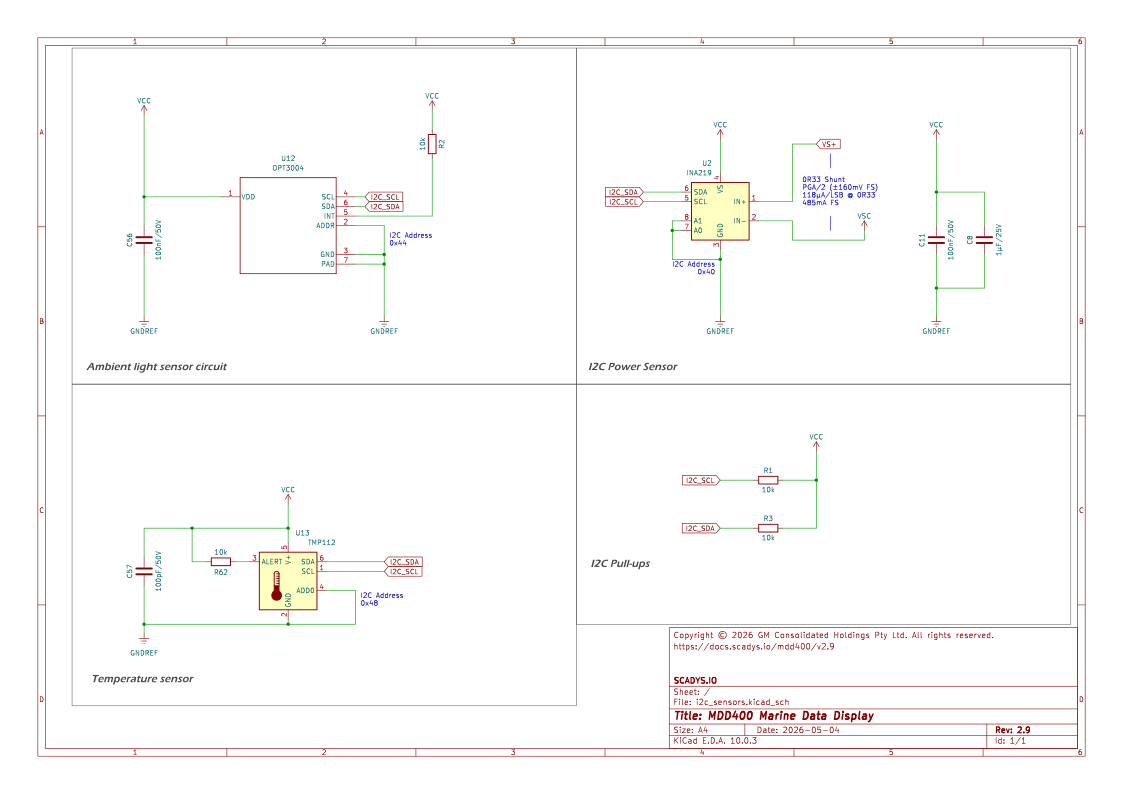
MDD400 v2.9 — Fabricated prototype, bench-test phase. The INA219 has been bench-tested on this prototype: I²C addressing, current reading, and bus-voltage reading are all functional. Quantitative accuracy checks against a reference instrument and the final firmware PGA selection are open bring-up items.
Overview
This page documents the INA219 power monitor on i2c_sensors.kicad_sch — a high-side current and bus-voltage measurement IC that lets the firmware read the MDD400's NMEA 2000 bus supply current and voltage. The I²C bus pull-ups (R1 on SCL; R2 ∥ R3 on SDA) are documented on the ESP32 Module page.
This page covers a single sub-circuit:
- Power Monitor — the INA219 (U2) at I²C address 0x40 and its 330 mΩ shunt (R33), drawn on the
i2c_sensorsKiCad sheet.
Functional specification and design objectives
- Continuously measure the MDD400's input supply current and bus voltage from the NMEA 2000 connection, with enough resolution and update rate to drive a Power page on the DWIN display and to raise low- / high-voltage alerts.
- Place the current-sense shunt where it sees only the regulated, OVP-protected supply (not the raw N2K cable input), so the INA219 is never exposed to N2K transients above its 26 V VS absolute maximum.
- Keep the shunt low enough that its voltage drop is negligible compared to the bus regulation, and small enough that the INA219's full-scale current range matches the actual peak load.
- Run on the shared 3.3 V I²C bus (Standard Mode, 100 kHz) at a distinct address so the firmware can poll it independently of the other sensors.
Power Monitor
How it works
U2 — TI INA219AIDCNR is a high-side current / power monitor in SOT-23-8 with an integrated 12-bit ADC, a programmable-gain front-end on the differential shunt input, and an I²C interface. The shunt (R33, 330 mΩ, Yageo PT0603FR-070R33L thick-film precision resistor, ±1 %, 10 ppm/°C) is placed in series with the high-side supply rail downstream of the OVP MOSFET on the can_bus_power.kicad_sch sheet — so the INA219 never sees a supply above the ~19 V OVP cutoff, well within its 26 V VS absolute maximum.
The INA219's differential shunt input measures the VR33 drop directly. With a 10 µV / LSB shunt-register resolution and the 330 mΩ shunt value:
- Current LSB = 10 µV / 0.33 Ω ≈ 30 µA
- Full-scale current at PGA /4 (±160 mV FSR): 160 mV / 0.33 Ω ≈ 485 mA
- Full-scale current at PGA /2 (±80 mV FSR): 80 mV / 0.33 Ω ≈ 242 mA
At PGA /4 the INA219 measures up to ~485 mA — a comfortable margin above the MDD400's expected peak load (~250 mA at Wi-Fi TX + display backlight). At PGA /2 the same load would clip at ~242 mA, leaving no margin — so the firmware must configure PGA /4 (CONFIG register PG1:PG0 = 0b10) before reading.
Bus voltage measurement. The INA219's VBUS pin samples the same node that the shunt's high-side is tied to (i.e. the post-OVP, post-protection supply rail). At its 4 mV / LSB resolution, this reads the regulated input bus voltage with sub-percent precision — adequate for both the firmware's low/high-voltage alerting and the on-display Power page indication.
Local supply decoupling. C8 (1 µF X7R) and C11 (100 nF X7R) sit on the INA219's VCC (the 3.3 V digital supply, separate from the VS shunt-high-side pin). Standard two-tier decoupling: C11 for HF, C8 for bulk.
Shunt placement note. R33 is physically located ~60 mm away from U2 in the can_bus_power section of the board. The differential IN+ / IN− sense traces run that 60 mm distance. For V2.9 this is acceptable (single-frequency DC measurement; INA219's input is high-impedance and the differential reading rejects common-mode noise), but a V2.10 layout pass could shorten the sense paths by moving U2 closer to R33 or routing the sense pair on an inner layer away from SMPS switching activity — see the V2.10 backlog.
Performance
| Parameter | Value | Notes |
|---|---|---|
| I²C address | 0x40 | Configured by A0 / A1 pin tie-offs at U2 |
| Shunt-voltage LSB | 10 µV | Fixed per INA219 datasheet |
| Current LSB at R33 = 330 mΩ | ~30 µA | 10 µV / 0.33 Ω |
| Full-scale current at PGA /4 (±160 mV) | 485 mA | 160 mV / 0.33 Ω — used by firmware |
| Full-scale current at PGA /2 (±80 mV) | 242 mA | Insufficient for the MDD400 peak — don't use |
| Bus-voltage LSB | 4 mV | Fixed per INA219 datasheet |
| VS abs-max | 26 V | Protected by upstream OVP (~19 V cutoff) |
| R33 voltage drop at 250 mA | 82.5 mV | 0.33 Ω × 0.25 A — negligible vs bus regulation |
| R33 self-heating at 250 mA | 20.6 mW | 0.0625 × 0.33 W — within 0603 100 mW rating (79 % margin) |
| Sense-pair length, R33 → U2 | ~60 mm | Acceptable for V2.9; V2.10 backlog item |
Firmware notes
The INA219 underpins the NMEA 2000 bus power monitoring feature in the MDD400 firmware:
- The firmware polls the INA219 at a low rate (1 Hz is fine — the bus voltage and current are slow-moving variables in normal operation).
- Bus current and bus voltage are presented on a dedicated Power page on the DWIN display (via DGUS II variable writes — see the Display Interface page).
- Firmware raises low-voltage and high-voltage alerts when bus voltage falls below or rises above configured thresholds. Low-voltage indicates either upstream cable trouble or a deep-discharge battery; high-voltage indicates a charging system fault (alternator over-voltage, etc.).
- Always configure PGA /4 before the first measurement read — the default at reset is PGA /1, which would clip far below the 250 mA peak load. The CONFIG register write must precede the first useful read.
PCB Layout
The INA219 (U2) and its local decoupling sit in the sensor cluster on F.Cu, while the 330 mΩ shunt R33 is an outlier ~60 mm away in the can_bus_power section of the board — so the differential IN+ / IN− sense pair runs that full distance between the two regions.
- Decoupling. C11 (100 nF) is placed immediately adjacent to U2's VS/VCC pin (~3.6 mm centre-to-centre) per the INA219 datasheet, with C8 (1 µF bulk) downstream in the VCC rail at ~3.4 mm — at the 3 mm guideline.
- Shunt sense routing. The IN+ / IN− pair should tap the inner pad edges of R33 (Kelvin connection) and run as an equal-length, tight parallel pair on the same layer. On V2.9 the ~60 mm run is user-verified as acceptable for the DC measurement, but inner-pad-edge Kelvin connection and trace length/layer equality are not confirmed from footprint data — Gerber review is recommended.
- Noise isolation. The ~60 mm sense pair crosses board regions carrying SMPS and CAN activity; it should be routed away from the LMR51610 switching node, SMPS ground-return currents, CAN bus traces, and via stitching rows to protect the differential measurement.
- Ground. All I²C sensor grounds connect to a continuous GNDREF — there is no isolation boundary in V2.9 (the ISO1541 was removed); GNDREF is continuous from the sensors through to the ESP32 and CAN transceiver domain.
Components
| Ref | Value | Function | Datasheet |
|---|---|---|---|
| U2 | INA219AIDCNR | TI bidirectional current / power monitor, SOT-23-8, I²C address 0x40 | TI INA219 (SBOS448) |
| R33 | 330 mΩ 0603 | Yageo PT0603FR-070R33L precision thick-film shunt, ±1 %, 10 ppm/°C. Located on can_bus_power.kicad_sch in series with the post-OVP supply rail | Yageo PT0603FR-070R33L |
| C8 | 1 µF / 25 V X7R 0603 | INA219 VCC bulk bypass | Murata GCM188R71E105KA64D |
| C11 | 100 nF / 50 V X7R 0603 | INA219 VCC high-frequency bypass | Murata GRM188R71H104KA93D |
The I²C bus pull-ups (R1, R2, R3) are listed in the ESP32 Module Components table.
Testing & Verification
V2.9 is a fabricated prototype in the bench-test phase. The INA219 acknowledges on the I²C bus and returns plausible current / bus-voltage readings on the prototype. No quantitative accuracy or drift measurements have been performed yet. The following are required.
Hardware bring-up (rig at the bench):
- I²C addressing — Issue a
read manufacturer IDto address 0x40. Pass if the INA219 acknowledges and returns the expected manufacturer ID. - PGA configuration — Read back the CONFIG register after firmware initialisation. Pass if PG1:PG0 = 0b10 (PGA /4, ±160 mV FSR).
- Calibrated current accuracy — At a known load (e.g. 100 mA / 200 mA / 400 mA drawn through a bench-confirmed resistive load), read the INA219 current register and compare against a reference instrument. Pass if within ±1 % at full-scale (~485 mA) and within ±5 % at 10 % full-scale.
- Bus voltage accuracy — Compare the INA219 bus-voltage register against a calibrated DMM on the post-OVP rail. Pass if within ±1 %.
- Shunt self-heating drift — Hold the load at the expected peak (250 mA) for 30 minutes and record any drift in the indicated current. Pass if drift < ±0.5 % over the test period.
Gaps & next version
Before next production run
- R33 Kelvin connection — Verify in Gerber review that IN+ / IN− tap from the inner edges of R33's pads (not from a downstream point), so the sense voltage is exactly VR33 rather than VR33 + trace drop, and that the pair is equal-length on the same layer.
- Sense-pair noise exposure — The ~60 mm IN+ / IN− pair crosses board regions with SMPS and CAN activity. Inspect the route to confirm it is isolated from the LMR51610 switching node and SMPS ground-return currents.
Next version (V2.10)
- Shorten sense-pair routing — The IN+ / IN− pair currently runs ~60 mm from R33 (in the CAN bus-power section) to U2 (in the sensor cluster). Move U2 closer to R33 or route the sense pair on an inner layer away from SMPS switching activity to tighten common-mode rejection.
References
- Texas Instruments, INA219 Zerø-Drift, Bidirectional Current/Power Monitor With I²C Interface (SBOS448).
- Yageo, PT0603FR-070R33L Precision Thick Film Chip Resistor.
- Murata, GCM188R71E105KA64D — 1 µF X7R 0603.
- Murata, GRM188R71H104KA93D — 100 nF X7R 0603.
- NXP Semiconductors, I²C-bus specification and user manual (UM10204).
Related pages
- CAN Bus Power — upstream OVP and the post-OVP supply rail that R33 is in series with
- ESP32 Module — host MCU and the I²C bus pull-ups (R1 / R2 / R3) that this sensor shares
- Display Interface — the Power page on the DWIN display is fed by INA219 readings
- Pin Assignments — I²C bus GPIO assignments for the sensor bus