ESP32 Module
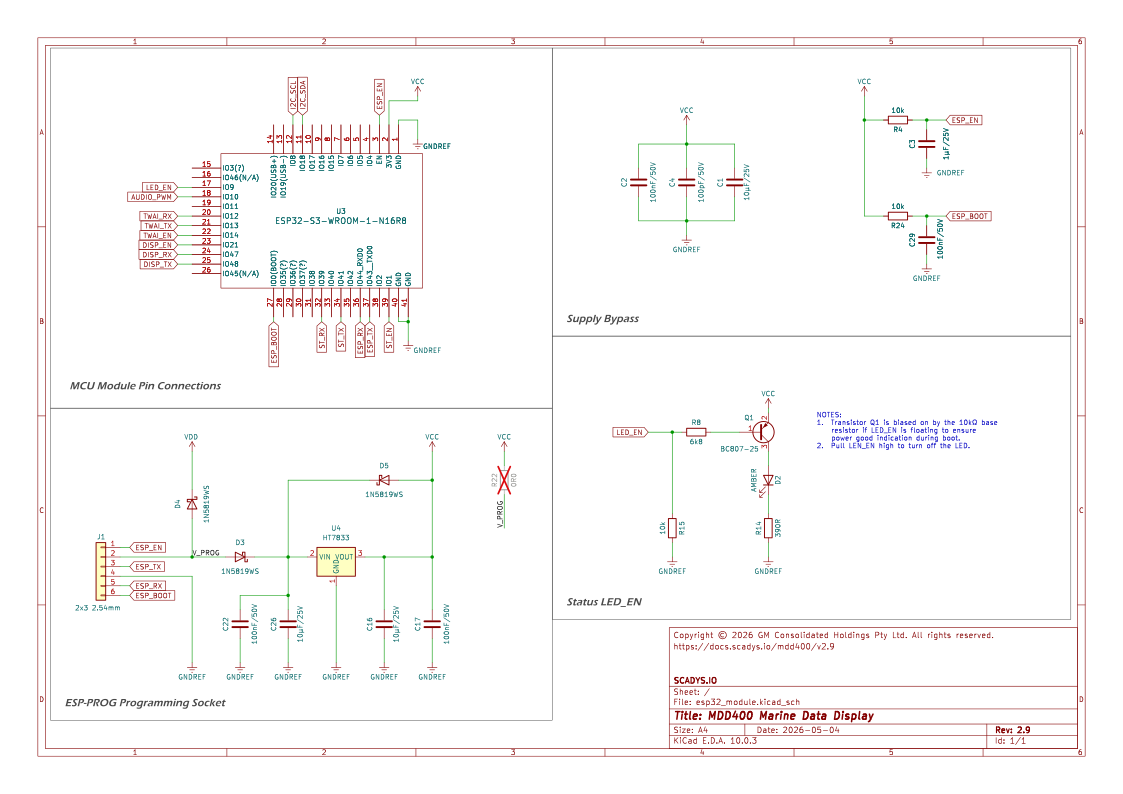
MDD400 v2.9 — Fabricated prototype, bench-test phase. The board is the developer/kit assembly variant. The firmware-programming hardware (J1 / U4 / D3 / D4 / D5 populated, R22 DNP) is documented on its own Programming Socket page.
Overview
This page documents the MDD400's main application processor — an Espressif ESP32-S3-WROOM-1-N16R8 module — and its host-side surroundings on esp32_module.kicad_sch: VCC bypass and the EN / BOOT control-line networks. Two other functional blocks are drawn on the same sheet but live on their own pages:
- The firmware programming socket (J1 IDC header, the optional HT7833 LDO U4, the three OR'ing Schottky diodes D3 / D4 / D5, and the production-variant zero-ohm bridge R22) → Programming Socket.
- The status LED (Q1 PNP switching the amber D2 LED via the LED_EN signal) → LED Indicator.
Two sub-circuits are covered on this page, in narrative order:
- ESP32-S3 module and signal map — U3 itself, its global-label fan-out to every other sub-sheet, the I²C bus pull-ups (logically the MCU's, physically on the sensor sub-sheet), and the antenna-end clearance treatment.
- VCC supply bypass and control-line RC networks — multi-stage VCC decoupling at U3's 3V3 pad, the EN power-on RC, and the IO0 boot-strap pull-up.
Functional specification and design objectives
- House a pre-certified, dual-core Wi-Fi/Bluetooth MCU module with enough on-board flash and PSRAM to run the MDD400 firmware (DGUS UI assets in flash, OTA dual-image layout, SPIFFS) without external memory.
- Expose the module's I/O cleanly to every other sub-sheet via hierarchical global labels so the system-level schematic stays readable.
- Maintain the module's pre-certification by satisfying Espressif's antenna keep-out requirement on the PCB.
- Provide multi-stage VCC bypass at U3's 3V3 castellated pad, sized to handle ESP32-S3 Wi-Fi TX current pulses without sagging the 3.3 V rail.
- Hold ESP_EN (CHIP_PU) and ESP_BOOT (IO0) at clean, well-defined logic states during power-up and during normal operation.
- Time the EN release after VCC stabilises, satisfying Espressif's minimum reset-extension requirement.
ESP32-S3 module and signal map
How it works
U3 — ESP32-S3-WROOM-1-N16R8 is an Espressif system-in-package module carrying:
- ESP32-S3 dual-core Xtensa LX7 SoC at up to 240 MHz,
- 16 MB QSPI flash,
- 8 MB PSRAM,
- 2.4 GHz Wi-Fi + BT 5 LE radio with integrated PCB antenna,
- FCC / CE / IC pre-certifications.
Why the N16R8 part variant. The DGUS II display protocol on the Display Interface page uploads UI asset binaries to ESP flash; the OTA firmware update strategy requires a dual-partition layout holding two full firmware images simultaneously; and SPIFFS or LittleFS occupies additional flash. The 16 MB flash + 8 MB PSRAM variant provides the headroom for all three without a board revision when feature scope grows.
The module's only supply input is the 3.3 V VCC rail — described in the VCC supply bypass sub-circuit below.
U3 fans out to every other sub-sheet through hierarchical global labels. Functionally:
| Signal group | Labels | Direction | Counterpart sub-sheet |
|---|---|---|---|
| CAN / NMEA 2000 | TWAI_TX, TWAI_RX, TWAI_EN | UART-like | CAN Transceiver |
| Display interface | DISP_TX, DISP_RX, DISP_EN | UART + control | Display Interface |
| Legacy serial | ST_TX, ST_RX, ST_EN | UART | Legacy Serial Interface |
| I²C peripherals | I2C_SDA, I2C_SCL | I²C bus | Power Monitor, Ambient Light Sensor, Temperature Sensor |
| Audio | AUDIO_PWM | PWM out | Buzzer Driver |
| Status LED | LED_EN | GPIO out (default-on by HW bias) | LED Indicator |
| Programming | ESP_TX, ESP_RX, ESP_EN, ESP_BOOT | UART0 + control | J1 (this sheet) |
I2C bus pull-ups
The MDD400 I²C bus is shared across three sensor slaves on the i2c_sensors.kicad_sch sub-sheet: the Power Monitor (INA219 at 0x40), the Ambient Light Sensor (OPT3004 at 0x44), and the Temperature Sensor (TMP112 at 0x48). The bus pull-ups are placed physically on that sub-sheet (near the sensor cluster, so the GND return paths to the slaves are short), but logically they belong to the MCU and are documented here:
- R1 — 10 kΩ on I2C_SCL to VCC.
- R2 + R3 — both 10 kΩ on I2C_SDA to VCC, in parallel — i.e. 5 kΩ effective on SDA.
The asymmetric pull-up choice (10 kΩ SCL, 5 kΩ SDA) compensates for the higher capacitive load on SDA — every slave on the bus contributes capacitance on SDA when it acknowledges, but only the master drives SCL. The bus runs at I²C Standard Mode (100 kHz); rise-time at 5 kΩ ∥ 50 pF bus capacitance is τ ≈ 250 ns, well inside the 1000 ns Standard-Mode limit.
Antenna-end clearance
The Espressif module datasheet requires the antenna projection area to be free of copper on all PCB layers. The MDD400 V2.9 layout satisfies this with generous keep-out: the F.Cu GNDREF pour boundary sits ≥ 6.3 mm beyond the antenna end, the B.Cu GNDREF pour ≥ 10.9 mm, and the antenna is aligned with a dedicated board-edge slot. The 3 mm minimum is exceeded by a factor of two. Module pre-certification is preserved.
Performance
| Parameter | Value | Notes |
|---|---|---|
| CPU clock (max) | 240 MHz | Dual-core LX7 |
| Flash | 16 MB QSPI | On-package |
| PSRAM | 8 MB | On-package |
| Wi-Fi PHY | 802.11 b/g/n, 2.4 GHz | Pre-certified module |
| Pre-certifications | FCC ID 2AC7Z-ESP32S3WROOM1, CE RED 2014/53/EU, IC | Maintained by antenna keep-out |
| Antenna keep-out (F.Cu) | ≥ 6.3 mm | Exceeds 3 mm Espressif minimum |
| Antenna keep-out (B.Cu) | ≥ 10.9 mm | Exceeds 3 mm Espressif minimum |
| GND stitching vias under U3 | 41 vias, ~1.0 mm spacing at the right-column edge | ≤ 1.5 mm guideline met |
VCC supply bypass and control-line RC networks
How it works
Multi-stage VCC bypass at U3, ordered for force-commutation. The bypass cluster is placed in a straight line from U3's pad 2 (the 3V3 castellated supply pad), smallest cap first:
- C4 — 100 pF / 50 V C0G 0603 at the front, VCC pad as close to U3 pad 2 as the courtyards allow.
- C2 — 100 nF / 50 V X7R 0603 immediately adjacent to C4, as close as the courtyards allow.
- C1 — 10 µF / 25 V X7R 0805 immediately adjacent to C2, again as close as the courtyards allow.
Critically, the VCC pads of C4 / C2 / C1 are isolated from the surrounding F.Cu VCC pour: a narrow private VCC trace daisy-chains the three VCC pads, and the trace ties into the broader VCC pour through a single via only at the far end of C1. The current path from the pour into U3 is therefore forced to be pour → via → C1 → C2 → C4 → U3 pad 2, with no short-cut path that bypasses the caps. Each cap sees the U3 load current and contributes its frequency band — C4 catches the fastest transients first because of its low-ESL C0G construction, C2 fills in the mid band, C1 supplies bulk charge replenishment. Spreading-inductance shortcuts through the pour can't bypass any of them.
Additional VCC decoupling sits on the broader VCC pour:
- Mid-frequency band: C17, C22, C29 (100 nF X7R each) distributed across the VCC pour for local decoupling near peripheral load points.
- Bulk band: C16 and C26 (10 µF X7R each) plus C3 (1 µF X7R) for low-frequency reservoir.
Total VCC bypass on the digital domain: 100 pF + 4× 100 nF + 1 µF + 3× 10 µF ≈ 31.4 µF bulk + 400 nF mid + 100 pF RF — significantly above the Espressif minimum (100 nF + 10 µF at the 3V3 pin).
The stack-up does the very-high-frequency work. Across the digital area, the four-layer board is poured as VCC – GNDREF – GNDREF – VCC (F.Cu and B.Cu both carry VCC; In1.Cu and In2.Cu carry unbroken GNDREF). This creates two VCC↔GNDREF plane pairs separated by the prepreg stack — a distributed bypass capacitor across the whole digital region with no parasitic inductance and no ESR. The consequences specifically for U3 are:
- The GNDREF stitching vias under U3's footprint (41 in total, with a tight ~1.0 mm column at the right edge) drop straight to the two inner GNDREF planes — the return path for any current entering U3 pad 2 has essentially zero parasitic inductance.
- The discrete C4 / C2 / C1 chain handles transients up to the frequency where its own package ESL starts to dominate; above that, the plane-pair capacitance takes over with effectively zero ESL. The plane pair, not the discrete cluster, is what decouples U3 at the antenna's 2.4 GHz fundamental and its harmonics — which is also why the single tie-in via at C1's far end is sufficient rather than risky: the pour-side decoupling at GHz frequencies is the plane pair, not the via inductance.
- The unbroken inner GNDREF planes give the antenna an unbroken reference under its entire projection back into the board — important for the module's pre-certified RF behaviour to be preserved.
EN power-on delay. R4 (10 kΩ) pulls ESP_EN up to VCC; C3 (1 µF) sits from ESP_EN to GNDREF. The pair forms an RC charge curve that delays EN assertion after the VCC rail comes up:
τ_EN = R4 × C3 = 10 kΩ × 1 µF = 10 ms
Time to reach the ESP32-S3's valid-HIGH threshold (≥ 0.75 × VCC ≈ 2.48 V) is approximately 1.4 × τ ≈ 14 ms. Espressif requires the EN RC to be ≥ 1 ms; 10 ms is a 10× margin and ensures the rail is fully stable before the SoC starts.
BOOT strap. R24 (10 kΩ) pulls ESP_BOOT (U3 IO0) up to VCC. Unlike the EN net, there is no RC capacitor on IO0 — adding one would slow IO0's rise and could delay response to programmer-driven boot-mode entry (where the ESP-PROG tool pulls IO0 LOW via J1 just before toggling EN). The pull-up alone is sufficient: parasitic trace + pin capacitance (~ 15 pF) charges through R24 in < 1 µs, so IO0 is valid HIGH well before EN releases at ~14 ms. During programming, ESP-PROG overrides R24 by pulling IO0 LOW through J1 pin 5, and the module enters ROM download mode when EN is toggled.
Performance
| Parameter | Value | Notes |
|---|---|---|
| C4 (RF, first in chain) | 100 pF C0G | VCC pad courtyard-touching U3 pad 2 |
| C2 (mid, second in chain) | 100 nF X7R | Adjacent to C4 (courtyard-touching) |
| C1 (bulk, third in chain) | 10 µF X7R | Adjacent to C2 (courtyard-touching); single via to F.Cu VCC pour at far end |
| Additional VCC bypass on the pour | C16 / C26 10 µF, C3 1 µF, C17 / C22 / C29 100 nF | Distributed mid + bulk decoupling |
| Total VCC bypass on U3 | 31.4 µF + 400 nF + 100 pF | ~3× Espressif minimum |
| Bypass topology | Force-commutated daisy chain | Private VCC trace, isolated from F.Cu pour except at C1-far via |
| EN RC time constant τ | 10 ms | R4 × C3 |
| EN time to valid HIGH | ~14 ms | 1.4 × τ, threshold = 0.75 × VCC |
| BOOT pull-up | R24 = 10 kΩ, no RC cap | tr (parasitic) < 1 µs |
| GPIO strapping conflict check | None on this sheet | Compliant with ESP32-S3 boot requirements |
PCB Layout
U3 sits with its castellated antenna end aligned to a dedicated board-edge slot, so the antenna projection is copper-free on every layer — the F.Cu GNDREF pour clears the antenna end by 6.3 mm, the B.Cu pour by 10.9 mm, well beyond the 3 mm Espressif minimum. A solid GNDREF plane is held continuous beneath the module body, with no signal traces broken through it; 41 stitching vias (0.3 mm drill, ~1.0 mm spacing in the tight right-column run) bond U3's castellated and exposed-pad grounds down to the two inner GNDREF planes.
- VCC bypass placement. The C4 / C2 / C1 cluster sits immediately below U3's right-column 3V3 pad, in-line at minimum package spacing — C4 (100 pF C0G) pad 2 is < 1 mm from U3 pin 2 (3V3), then C2 (100 nF), then C1 (10 µF). The private daisy-chain trace ties into the F.Cu VCC pour through a single via at C1's far end (see VCC supply bypass). C16 / C17 / C22 / C26 form a second bulk/mid-frequency ring on the VCC pour near the LDO output.
- VCC rail. VCC is a copper pour (not a trace), far exceeding the 0.5 mm minimum width, spanning the digital area from the U4 LDO output to U3's supply pads so the RF-frequency return path stays low-impedance.
- Signal routing. ESP_TX / ESP_RX to J1 are kept direct and short (straight-line ~29.5 mm; target < 50 mm — routed length not yet extracted). TWAI_TX/RX route directly to the CAN sub-sheet pads; I2C_SDA / I2C_SCL use 0.2 mm traces routed away from the SMPS switching node and the antenna area, to the pull-up points near the sensor cluster.
- Ground. No isolation on this sheet — all components share the VCC / GNDREF domain. The unbroken inner GNDREF planes also provide the antenna's RF reference under its full projection back into the board.
Components
| Ref | Value | Function | Datasheet |
|---|---|---|---|
| U3 | ESP32-S3-WROOM-1-N16R8 | Espressif dual-core Xtensa LX7 MCU module, 240 MHz, 16 MB QSPI flash, 8 MB PSRAM, 2.4 GHz Wi-Fi + BT 5 LE, pre-certified | Espressif ESP32-S3-WROOM-1 |
| R4 | 10 kΩ 0603 ±1 % | EN pull-up — VCC to ESP_EN (U3 CHIP_PU). With C3 forms power-on RC delay (τ = 10 ms) | Yageo RC Group |
| R24 | 10 kΩ 0603 ±1 % | BOOT pull-up — VCC to ESP_BOOT (U3 IO0). Selects SPI flash boot mode during normal operation; no RC cap, by design | Yageo RC Group |
| R1 | 10 kΩ 0603 ±1 % | I²C bus pull-up on SCL to VCC. Physically placed on i2c_sensors.kicad_sch near the sensor cluster | Yageo RC Group |
| R2 | 10 kΩ 0603 ±1 % | I²C bus pull-up on SDA to VCC (parallel with R3). Physically on i2c_sensors.kicad_sch | Yageo RC Group |
| R3 | 10 kΩ 0603 ±1 % | Second I²C bus pull-up on SDA to VCC (parallel with R2 → 5 kΩ effective). Physically on i2c_sensors.kicad_sch | Yageo RC Group |
| C1 | 10 µF / 25 V X7R 0805 | VCC main-cluster bulk bypass, third in chain (courtyard-touching adjacent to C2); single via to F.Cu VCC pour at far end | Murata GRM21BZ71E106KE15L |
| C2 | 100 nF / 50 V X7R 0603 | VCC main-cluster mid-frequency bypass, second in chain (between C4 and C1) | Murata GCM188R71H104KA57D |
| C3 | 1 µF / 25 V X7R 0603 | EN RC timing capacitor (ESP_EN to GNDREF). τ = 10 ms with R4 | Murata GCM188R71E105KA64D |
| C4 | 100 pF / 50 V C0G 0603 | VCC main-cluster RF bypass, first in chain (VCC pad courtyard-touching U3 pad 2) | Murata GRM1885C1H101JA01D |
| C16, C26 | 10 µF / 25 V X7R 0805 | Additional VCC bulk bypass on the F.Cu VCC pour | Murata GRM21BZ71E106KE15L |
| C17, C22, C29 | 100 nF / 50 V X7R 0603 | Additional VCC mid-frequency bypass distributed across the pour | Murata GCM188R71H104KA57D |
Programming-socket components (U4, D3, D4, D5, J1, R22) are listed on the Programming Socket page. Status-LED components (Q1, R8, R14, R15, D2) are on the LED Indicator page.
Testing & Verification
V2.9 is a fabricated prototype in the bench-test phase. Programming via the ESP-PROG adapter has been confirmed working on both MDD400 V2.9 and WTI400 V1.2. No quantitative bench measurements have been performed on the VCC bypass, EN RC, or BOOT pull-up yet. The following are required.
Hardware bring-up (rig at the bench):
- VCC rail under Wi-Fi TX — Using a Wi-Fi-enabled test build (production firmware does not enable Wi-Fi), probe at U3 pad 2 during a sustained 30-minute 802.11b TX burst / TCP iperf at typical operating distance. Pass if the rail stays within ±3 % of 3.30 V with no individual dip below 3.10 V and no Wi-Fi disconnects (covers the C1 / C16 / C26 bulk reservoir combined with the plane-pair).
- EN release timing — Trigger the oscilloscope on VCC rising; capture ESP_EN. Pass if ESP_EN crosses 2.48 V (valid-HIGH threshold) ≥ 10 ms after VCC reaches 3.0 V.
- BOOT pull-up integrity — Capture ESP_BOOT over a 60 s window during normal operation. Pass if it sits stable at VCC (≥ 3.10 V) with no glitches.
Programmer-side bring-up (end-to-end programming, VDD-only operation, D3 back-feed check, U4 thermal soak) is on the Programming Socket page.
Gaps & next version
Before next production run
- ESP_TX / ESP_RX routed length — Actual trace lengths from U3's pads to J1 cannot be measured from the KiCAD segment data without full routing extraction (straight-line ~29.5 mm). Measure in the KiCAD PCB editor; if either exceeds 50 mm, 33 Ω series damping at the U3 output pads is required per the ESP-PROG Hardware Guide.
Next version (V2.10)
- ESP_TX / ESP_RX trace length verification — Confirm routed length in the KiCAD PCB editor and add 33 Ω series damping at the U3 output pads if either trace exceeds 50 mm.
- DISP_TX / DISP_RX series damping — Likely longer traces than the J1 path; apply the same 33 Ω damping policy if > 50 mm. The damping resistors belong adjacent to the transmitter output (the U3 DISP_TX pad and the display module TX pad respectively).
- Move the I²C pull-up sub-circuit onto the
esp32_modulesheet — R1 (SCL) and R2 / R3 (SDA, parallel) are the bus pull-ups; they belong to the MCU but are currently drawn on thei2c_sensorsKiCad sheet, so they sit with the sensor cluster and do not appear in this page's schematic view. In the next schematic revision, relocate the pull-up sub-circuit ontoesp32_module.kicad_schalongside U3 so the schematic matches where the pull-ups logically belong. (The WTI400 already places its I²C pull-ups on the ESP32 module sheet — this aligns MDD400 with that convention.)
References
- Espressif Systems, ESP32-S3-WROOM-1 & WROOM-1U Module Datasheet.
- Espressif Systems, ESP32-S3 Datasheet.
- Espressif Systems, ESP-IDF API Reference — GPIO & RTC GPIO.
- Espressif Systems, ESP-PROG Hardware Guide.
- Yageo, RC Group Chip Resistor.
- Murata Electronics, GRM21BZ71E106KE15L — 10 µF X7R 0805.
- Murata Electronics, GCM188R71H104KA57D — 100 nF X7R 0603.
- Murata Electronics, GCM188R71E105KA64D — 1 µF X7R 0603.
- Murata Electronics, GRM1885C1H101JA01D — 100 pF C0G 0603.
Related pages
- Programming Socket — J1 IDC header, HT7833 LDO, dual-Schottky-OR'd chain, and programming bring-up (same sheet).
- LED Indicator — status LED (Q1 PNP, D2 amber, LED_EN behaviour) driven by U3 (same sheet).
- CAN Transceiver — consumes the TWAI_TX / TWAI_RX / TWAI_EN signals mapped here.
- Pin Assignments — the full GPIO signal map for U3.