Display Interface
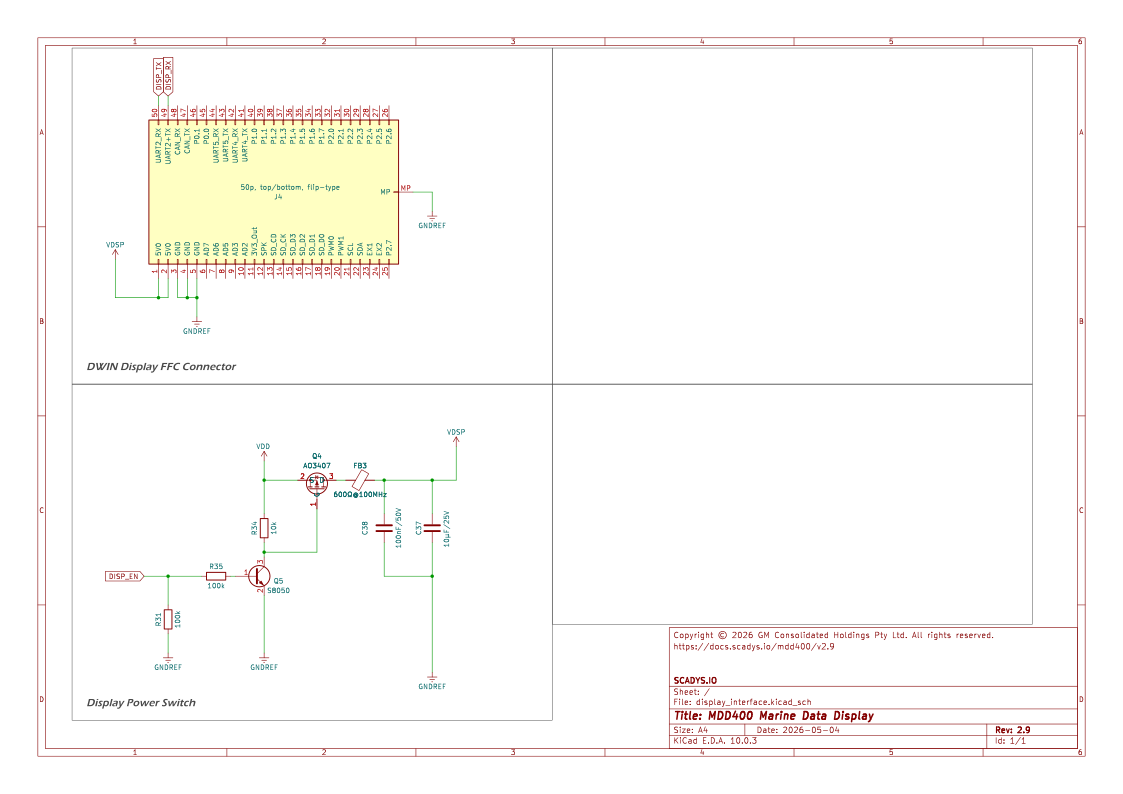
MDD400 v2.9 — Fabricated prototype, bench-test phase. The DWIN display has been driven end-to-end through DGUS II on this prototype using bench test routines: power-switching, the UART link, command issuance, and touch-event round-tripping are functional. The production firmware (planned in ESP-IDF, migrating from the MDD400 V1.0 PlatformIO/Arduino predecessor) will drive display brightness from the on-board ambient light sensor. The V2.9 housing introduces a new ALS placement, so the brightness lookup will need to be re-calibrated against the previous lookup curve — which was tuned over significant in-service open-ocean operating hours on the MDD400 V1.0 hardware — before the migrated brightness loop can ship on V2.9.
Overview
This page documents the MDD400's interface to its 4.0-inch capacitive-touch DWIN DGUS II display module, drawn on display_interface.kicad_sch. The interface consists of two sub-circuits:
- Display power switch and VDSP rail conditioning — high-side P-MOSFET (Q4) switched on by an NPN gate driver (Q5) under firmware control via DISP_EN, followed by a ferrite bead (FB3) and a two-stage bypass cluster (C37, C38) on the switched VDSP rail.
- DWIN display FPC connector and UART2 link — J4 (50-pin 0.5 mm FPC) carrying VDSP, GNDREF, and the DISP_TX / DISP_RX UART2 lines that drive the DGUS II protocol.
The display module is a DWIN DMG48480F040_01WTC — a 4.0-inch, 480 × 480 capacitive-touch panel with an integrated T5L SoC, internal backlight driver, and DGUS II serial protocol. The ESP32 acts solely as a DGUS II host: it issues display-update commands and reads back touch events; all rendering, animation, and touch-event processing run on the T5L inside the display.
Functional specification and design objectives
The display power switch sub-circuit must:
- Switch the display module's 5 V supply on and off under firmware control, so the display can be left dark during MCU boot and reset and can be hard-power-cycled by firmware to recover from any T5L lock-up.
- Default to off at power-up (display does not light before firmware initialises) and at any time DISP_EN is undriven or tri-stated.
- Decouple the switched VDSP rail well enough to absorb both the display's inrush at power-on and the high-frequency conducted noise from the display's internal backlight converter.
- Keep the conducted-noise back-flow onto the on-board 5 V VDD rail below a level that would couple into the rest of the digital domain (ESP32, sensors, CAN transceiver).
The display FPC connector sub-circuit must:
- Connect a 50-pin 0.5 mm FPC cable to the DWIN DMG48480F040 display panel.
- Carry only the four signals the DGUS II protocol needs (VDSP, GNDREF, DISP_TX, DISP_RX); leave the other 46 pins on the FPC connector unconnected.
- Mount on the back of the PCB (B.Cu) so the FPC can fold cleanly behind the display when assembled into the housing.
Display power switch and VDSP rail conditioning
How it works
High-side power switch — Q4 + Q5
The AO3407A (Q4, P-channel, VDSS = −30 V, RDS(on) = 52 mΩ at VGS = −4.5 V, SOT-23) sits between the on-board 5 V VDD rail and the switched VDSP node. Its source is at VDD; its drain feeds FB3 → the VDSP bypass cluster → J4. R34 (10 kΩ) pulls Q4's gate up to VDD by default — VGS = 0 V keeps Q4 off, and the display is unpowered until firmware acts.
Q5 (S8050 NPN, VCEO = 25 V, hFE ≥ 40 at 100 mA, SOT-23) is the gate driver. Its collector is tied to Q4's gate; its emitter to GNDREF. When the ESP32 drives DISP_EN (GPIO21) HIGH (3.3 V), the base divider R35 (100 kΩ from DISP_EN to Q5 base) + R31 (100 kΩ from base to GNDREF) gives Q5 a base current of ~19 µA, which is well above the ~12 µA needed to saturate Q5 at the 480 µA collector current drawn through R34. Q5 saturates with VCE,sat ≈ 0.2 V, pulling Q4's gate to ~0.2 V above GND. VGS = 0.2 − 5.0 = −4.8 V — well past Q4's −0.45 V to −1.5 V threshold — and Q4 turns fully on. R31 also ensures Q5 is held off when DISP_EN is floating or tri-stated, locking the display off across power-up, reset, and any firmware fault that leaves the GPIO in input mode.
Supply rail conditioning — FB3 + C37 + C38
After Q4, the VDSP rail passes through FB3 (Murata BLM31KN601SN1L, 1206, 600 Ω at 100 MHz, 50 mΩ DC resistance, 3 A rated) before reaching the bypass cluster. FB3 attenuates conducted noise from the display's internal backlight switching converter from propagating back onto the on-board 5 V rail. C37 (10 µF 0805 X7R) is the bulk reservoir; C38 (100 nF 0603 X7R) sits beside it on the same VDSP node for HF bypass. Both caps are on the display-side of the ferrite bead — placing them upstream would defeat the noise-filtering purpose.
The 5 V rail entering FB3 (Q4 drain) is therefore the clean side; the rail leaving FB3 (J4 supply) is the display-side node that the display itself can pollute, with the FB3 ↔ cap loop containing that pollution.
Performance
| Parameter | Value | Notes |
|---|---|---|
| Q5 base current IB at DISP_EN = 3.3 V | 19 µA | (3.3 V − 0.7 V) / 100 kΩ − 0.7 V / 100 kΩ |
| Q5 collector current IC | 480 µA | (5.0 V − 0.2 V) / 10 kΩ |
| IB required for Q5 saturation | ~12 µA | IC / hFE,min = 480 µA / 40 |
| Q5 saturation overdrive | 1.6× | Saturated and stable; not deep saturation |
| Q4 VGS when Q5 saturated | −4.8 V | 0.2 V − 5.0 V; threshold = −0.45 to −1.5 V |
| Q4 RDS(on) at VGS = −4.5 V | 52 mΩ typ | AO3407A datasheet |
| Q4 VDS drop at 400 mA | 21 mV | I × RDS(on) |
| Q4 Pd at 400 mA | 8.3 mW | I² × RDS(on); well within SOT-23 |
| FB3 DC voltage drop at 400 mA | 20 mV | I × RDC = 0.4 A × 0.05 Ω |
| FB3 current margin | 86.7 % | (3.0 A − 0.4 A) / 3.0 A |
| C37 voltage stress | 20 % of rating | 5 V on 25 V cap — within 50 % derating guideline |
| C37 effective capacitance at 5 V DC bias | Unverified | "BZ" Murata series code; X5R / Y5V / Z5U dielectric not yet confirmed (V2.10 item) |
| Default-off behaviour | DISP_EN floating → display off | R31 pulls Q5 base low; Q4 VGS = 0; Q4 off |
| Hard-reset capability | Cycle DISP_EN LOW for ≥ 1 ms | Recovers from T5L lock-up |
DWIN display FPC connector and UART2 link
How it works
J4 — Xunpu FPC-05FB-50PH20 is a 50-pin, 0.5 mm pitch FPC connector with a top/bottom clamshell flip-lock actuator. Only four pins are wired:
| FPC pin role | Net | ESP32-S3 endpoint | Direction (from ESP32) |
|---|---|---|---|
| Display supply | VDSP | (via Q4 / FB3 / C37 / C38) | Power |
| Display ground | GNDREF | (board GNDREF) | Power return |
| DGUS II command | DISP_TX | GPIO48 → display UART RX | Out |
| DGUS II status / touch | DISP_RX | GPIO47 ← display UART TX | In |
The remaining 46 pins are intentionally left unconnected — they're not needed for the DGUS II workflow.
DGUS II protocol. The DWIN T5L SoC inside the display handles all rendering, animation, and touch-event processing locally. The ESP32 communicates with it over UART2 by sending DGUS II command frames (write to display-variable memory, write to image area, query touch event status, etc.) and reading back response or event frames. Typical baud rate is 115 200 bps; the link is a plain 3.3 V CMOS UART (the T5L expects 3.3 V logic levels, matched by ESP32-S3 GPIO).
No backlight PWM line on the FPC. The display's internal driver controls the backlight; backlight brightness is set over the DGUS II command channel itself. There is no separate backlight-enable or PWM line on the FPC, so brightness control is purely firmware-driven through serial commands. (See Firmware notes below for the brightness-vs-ambient-light approach.)
Performance
| Parameter | Value | Notes |
|---|---|---|
| J4 part | Xunpu FPC-05FB-50PH20 | 50-pin 0.5 mm pitch FPC, top/bottom clamshell flip-lock |
| Used pins | 4 of 50 | VDSP, GNDREF, DISP_TX, DISP_RX |
| Connector mounting | B.Cu | Back of board; FPC folds behind display when housed |
| DISP_TX straight-line distance (U3 → J4) | Routed length unverified | V2.10 backlog item: if > 50 mm add 33 Ω series damping at U3 |
| DISP_RX straight-line distance (J4 → U3) | Routed length unverified | Same V2.10 backlog item |
| UART baud rate | 115 200 bps (typical) | Configurable in DGUS II project file |
| Display protocol | DGUS II (proprietary serial) | T5L SoC handles UI rendering, animation, touch processing |
| Display panel | 4.0-inch, 480 × 480, capacitive touch | DWIN DMG48480F040_01WTC |
Firmware notes
A short pointer set for firmware writers — the DGUS II side has matured on the MDD400 V1.0 PlatformIO/Arduino predecessor firmware through significant in-service operating hours (including extended open-ocean passages); that code is the planned starting point for the V2.9 production ESP-IDF firmware. V2.9 introduces a new housing and a new ambient-light-sensor placement that will require re-calibration of the brightness lookup curve against the previous behaviour before the migrated loop can ship.
Brightness control loop.
- The ambient light sensor (ALS) lives on the I²C bus — see the Ambient Light Sensor page for the sensor part and address.
- Firmware reads the ALS at a low rate (sub-second is fine — eye adaptation is slow).
- A lookup table maps ALS reading → target DGUS II brightness setpoint. The DGUS II brightness command is not very granular — only a handful of discrete steps — so the lookup must be coupled with hysteresis to prevent visible flicker as ambient light drifts across a step boundary.
- The lookup curve from the prior hardware revision is the starting point; the new V2.9 ALS placement (different housing geometry, possibly different sensor orientation relative to the panel) means the same ambient illuminance now produces a different ALS reading. The lookup table input axis must be re-mapped before re-deploying the firmware on V2.9.
- Night-vision considerations matter: avoid producing a startling brightness step when the ambient light rises briefly (e.g. a brief light-flash overhead during a night passage). Slew-limit upwards more aggressively than downwards.
DGUS II send-side cadence.
- Brightness commands: send only when the lookup decides a step has changed (don't poll-and-write).
- UI variable updates: send only when the variable's underlying value has actually changed (don't refresh the whole frame on a fixed timer; the T5L is fine letting variables persist).
T5L boot-time.
- After DISP_EN goes HIGH (or after a hard-reset cycle), wait ~600 ms before issuing DGUS II commands. The T5L is not responsive until it finishes its internal boot sequence.
PCB Layout
The power-switch cluster (Q4, FB3, C37, C38, Q5, R31, R34, R35) sits on F.Cu within roughly X: 110–118 mm, Y: 79–87 mm; J4 is on B.Cu at (124, 80), 6–14 mm away depending on which pin is referenced.
- Switched-rail order. The VDSP rail runs Q4 drain → FB3 → C37/C38 → J4. FB3 is correctly placed between Q4's drain and the decoupling node (≈ 2.4 mm from Q4, 3.3 mm from C37), so the bulk and HF caps sit on the display-side of the ferrite where they contain backlight-converter noise.
- Decoupling. C38 (100 nF) is co-located with C37 (10 µF) on the same F.Cu row, 3.25 mm centre-to-centre — good parallel decoupling. C37 is ~7.2 mm from Q4's drain, further than the 5 mm target but acceptable at display operating frequencies with no critical timing requirement.
- Gate-drive path. Q5 is ~5.1 mm from Q4's gate — acceptable for an infrequent enable/disable switch, not a high-frequency application. R31/R35 (Q5 base network) sit ~3.5 mm from Q5's base, keeping base trace inductance low. R34 (gate pull-up) is ~7.6 mm from Q4's gate; larger than ideal but a DC pull-up that need not be co-located.
- FPC mount. J4 is on B.Cu (180°) as required by the flip-lock orientation, so the FPC cable folds cleanly behind the display when housed.
Components
| Ref | Value | Function | Datasheet |
|---|---|---|---|
| J4 | Xunpu FPC-05FB-50PH20 | 50-pin 0.5 mm pitch FPC connector, top/bottom flip-lock; B.Cu mount | Xunpu FPC-05FB-50PH20 |
| Q4 | AO3407A | AOS P-channel MOSFET, SOT-23. VDSS = −30 V, ID = −4.2 A, RDS(on) = 52 mΩ at VGS = −4.5 V. High-side switch for VDSP | AOS AO3407A |
| Q5 | S8050 | NPN BJT, SOT-23. VCEO = 25 V, hFE ≥ 40 at 100 mA. Gate driver for Q4 | onsemi SS8050 |
| FB3 | BLM31KN601SN1L | Murata 1206 ferrite bead, 600 Ω at 100 MHz, 50 mΩ DCR, 3 A rated. Series filter on VDSP between Q4 drain and bypass cluster | Murata BLM31KN601SN1L |
| C37 | 10 µF / 25 V 0805 | Murata GRM21BZ71E106KE15L — bulk bypass on VDSP after FB3. Effective capacitance at 5 V bias to be confirmed (V2.10 item) | Murata GRM21BZ71E106KE15L |
| C38 | 100 nF / 50 V X7R 0603 | Murata GRM188R71H104KA93D — HF bypass on VDSP | Murata GRM188R71H104KA93D |
| R34 | 10 kΩ 0603 ±1 % | Yageo — Q4 gate pull-up to VDD (default-off bias) | Yageo RC Group |
| R31 | 100 kΩ 0603 ±1 % | Yageo — Q5 base pull-down to GNDREF (default-off bias when DISP_EN floats) | Yageo RC Group |
| R35 | 100 kΩ 0603 ±1 % | Yageo — base series resistor from DISP_EN (ESP32 GPIO21) to Q5 base | Yageo RC Group |
Testing & Verification
V2.9 is a fabricated prototype in the bench-test phase. DGUS II command issuance, touch-event reception, and power-switching have been confirmed on the prototype. The following measurements and re-calibrations are required before the page can be marked verified.
Hardware bring-up (rig at the bench):
- Default-off at power-up — Apply VDD and probe VDSP at J4 with DISP_EN unconnected (firmware-controlled GPIO held high-impedance). Pass if VDSP measures < 50 mV.
- Power-on transition — Drive DISP_EN HIGH from firmware; probe Q4 gate. Pass if Q4 gate is pulled to ≤ 0.5 V within one GPIO cycle, confirming Q5 saturates and Q4 enters full enhancement.
- VDSP rail under display load — Measure VDSP at J4 with the display fully active (backlight on, UI animation running). Pass if VDSP stays within ±2 % of the VDD rail value with no individual dip below 4.85 V.
- Operating-current characterisation — Measure VDD-side current at backlight off and 25 / 50 / 75 / 100 %, with and without active UI animation. Pass if peak current stays well within Q4's 4.2 A and FB3's 3 A ratings. (Performance review used 400 mA as a conservative estimate; replace with measured value.)
- Hard-reset recovery — With the display on, briefly drive DISP_EN LOW for 10 ms then HIGH. Pass if the T5L re-boots and DGUS II commands resume after the documented T5L boot time (~600 ms typ).
- UART round-trip — Send a DGUS II "read variable" command at a known address. Pass if the display responds within the documented latency window and the response frame parses cleanly.
- Touch event reception — Tap a documented touch zone. Pass if the corresponding DGUS II touch-event frame arrives on DISP_RX with the correct touch coordinates.
- FPC seating — After engaging the J4 clamshell, gently flex the FPC at the connector edge while monitoring the UART link. Pass if there are no momentary disconnects.
- Brightness lookup re-calibration — Bench-test at multiple ambient illuminances (direct sunlight, indoor office, night helm, totally dark) and re-fit the ALS-reading → DGUS II brightness step curve, applying hysteresis at each step boundary. Pass if brightness tracks ambient light with no visible flicker across step boundaries.
Gaps & next version
Before next production run
- Display operating-current measurement — The DWIN DMG48480F040_01WTC operating current has not been measured on the V2.9 prototype; the performance review assumes 400 mA conservatively. Measure peak current at all backlight settings and confirm Q4 (4.2 A) and FB3 (3 A) operating points before committing to a production run.
- Brightness lookup re-calibration — The V2.9 housing and ALS placement differ from the prior hardware revision, so the existing ALS-reading → DGUS II brightness step lookup table must be re-characterised on V2.9 hardware before the migrated firmware can ship.
- J4 VDSP trace length — The VDSP supply trace from C37/C38 (110.5, 79.7) to J4 (124.0, 80.0) is ~13.5 mm straight-line; effective length depends on which J4 pin carries VDSP. Verify the FPC pinout and routed trace length in Gerber review.
Next version (V2.10)
- C37 dielectric / voltage-derating confirmation — Confirm the Murata "BZ" series code (GRM21BZ71E106KE15L) corresponds to a temperature characteristic where effective capacitance at 5 V DC bias remains ≥ 4.7 µF. If the dielectric is Y5V / Z5U and derating is severe, swap for an X5R-rated 10 µF / 25 V 0805 part.
- LCSC URLs in schematic — C37, C38, and FB3 KiCAD property fields currently reference LCSC datasheet URLs. Replace with Murata manufacturer URLs in a V2.10 schematic pass.
- DISP_TX / DISP_RX series damping if traces ≥ 50 mm — Already tracked under the ESP32 module in
v2.10-improvements.md; cross-referenced here because the damping resistors belong adjacent to each transmitter (U3 DISP_TX pad and the display module TX pad respectively).
References
- DWIN, DMG48480F040_01WTC Capacitive Touch Display Datasheet —
/assets/pdf/mdd400-v2.9/DMG48480F040_01WTC_Datasheet.pdf. - DWIN, T5L DGUS II Application Development Guide V2.9 —
/assets/pdf/mdd400-v2.9/T5L_DGUSII-Application-Development-Guide-V2.9-0207.pdf. - AOS, AO3407A P-Channel MOSFET.
- onsemi, SS8050 NPN Transistor.
- Murata, BLM31KN601SN1L Ferrite Bead.
- Murata, GRM21BZ71E106KE15L — 10 µF X7R 0805.
- Murata, GRM188R71H104KA93D — 100 nF X7R 0603.
- Xunpu, FPC-05FB-50PH20 50-pin FPC Connector.
- Yageo, RC Group Chip Resistor.
Related pages
- ESP32 Module — host MCU; DISP_TX / DISP_RX / DISP_EN drive lines and the UART2 routing.
- Ambient Light Sensor — ALS used to drive the firmware brightness loop.
- Power Supplies — derives the on-board 5 V VDD rail that Q4 switches to VDSP.
- Pin Assignments — GPIO21 (DISP_EN), GPIO47/48 (UART2) mappings.