Buzzer Driver
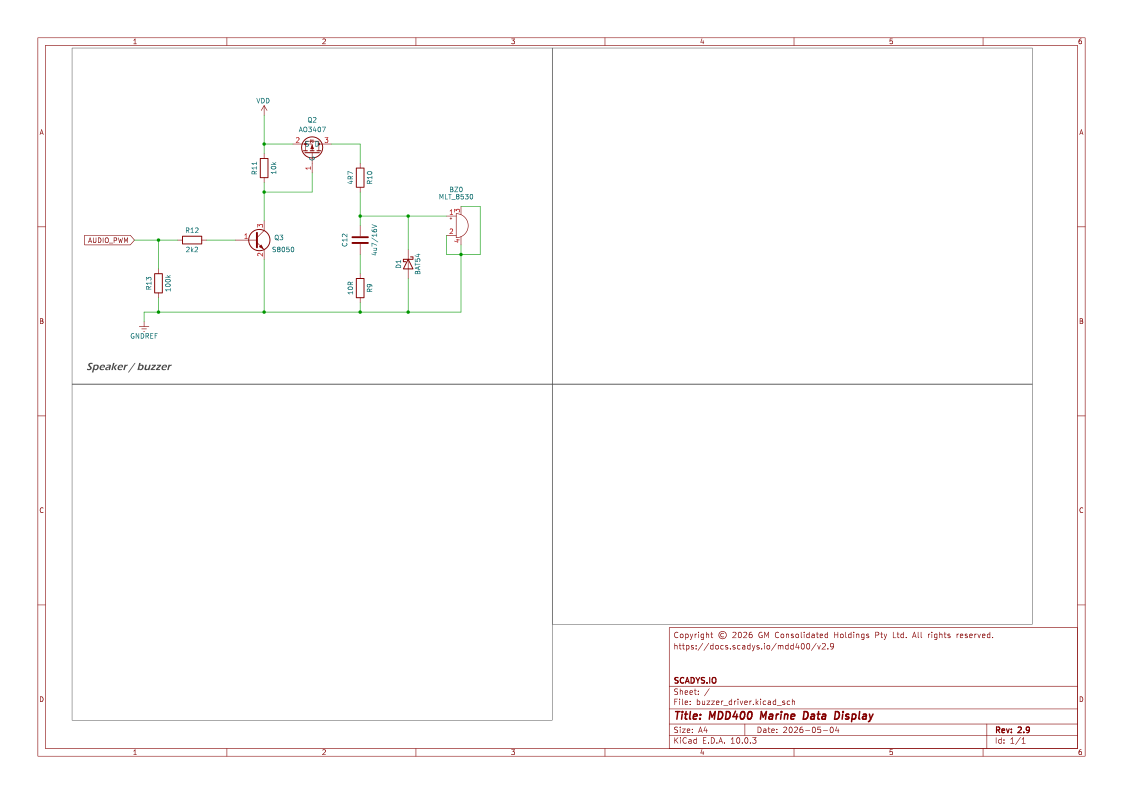
MDD400 v2.9 — Fabricated prototype, bench-test phase. PWM tone generation has been driven on this prototype: the AUDIO_PWM GPIO produces audible alert tones through the MLT-8530 transducer at expected current and frequency. The firmware tone library and alert taxonomy carry over from prior MDD400 hardware revisions. Specific bring-up items (CISPR EMI scan; filter simulation re-run with V2.9 component values) remain open and are tracked in the V2.10 backlog.
Overview
This page documents the audio-alert driver on buzzer_driver.kicad_sch — a high-side P-MOSFET buzzer driver that takes the ESP32 AUDIO_PWM signal and produces audible tones through an 16 Ω passive electromagnetic transducer (MLT-8530). The circuit is the MDD400's single audio output, used for system alerts (low-voltage, over-temperature, fault, user-acknowledged alarm) annunciated to the helm operator.
This page covers a single sub-circuit — the Buzzer Driver — drawn on the buzzer_driver KiCad sheet.
Functional specification and design objectives
The buzzer driver circuit must:
- Drive a 16 Ω passive electromagnetic transducer at 5 V (peak current ~313 mA) from a single ESP32 GPIO that can sink/source only 40 mA — i.e. amplify the GPIO's drive capability ~8× via a high-side switch.
- Default to silent at power-up and any time AUDIO_PWM is undriven or tri-stated (firmware-fault tolerance, MCU-boot tolerance).
- Suppress PWM switching harmonics enough that the audible tone is intelligible and the conducted-emission noise on the VDD rail is bounded.
- Provide flyback clamping so the transducer's inductive collapse doesn't damage the high-side MOSFET.
Buzzer Driver
The transducer is mounted on B.Cu directly underneath the driver cluster on F.Cu; the FPC-style "speaker / buzzer" label in the schematic marks this rectangle.
How it works
Drive stage — Q3 + Q2
The AUDIO_PWM signal from the ESP32 GPIO drives the base of Q3 (S8050 NPN, SOT-23, VCEO = 25 V, hFE ≥ 40 at 100 mA) through R12 (2.2 kΩ base series resistor). When AUDIO_PWM is HIGH (3.3 V), Q3 saturates and pulls the gate of Q2 (AO3407A P-channel MOSFET, SOT-23, VDSS = −30 V, RDS(on) = 54 mΩ at VGS = −4.5 V) down toward GND. With VGS ≈ −4.8 V (well past Q2's −0.45 V to −1.5 V threshold), Q2 conducts fully and connects the VDD (5 V) rail to the buzzer drive node.
When AUDIO_PWM is LOW, Q3 is off and R11 (10 kΩ pull-up from Q2 gate to VDD) holds Q2's gate at VGS = 0 — Q2 fully off, buzzer silent.
Default-off bias is enforced two ways. R11 holds Q2's gate at VDD (VGS = 0 → off) and R13 (100 kΩ pull-down on Q3's base to GND) holds Q3 off when AUDIO_PWM floats or tri-states. Either resistor alone would suffice, but both together mean any single resistor failure still leaves the buzzer silent. The default-off behaviour matters because the GPIO state during ESP32 boot, brown-out, and certain firmware-fault paths is undefined for some milliseconds — without R13, parasitic coupling on AUDIO_PWM could forward-bias Q3 through Q3's input capacitance and produce a spurious power-on chirp.
Output filter — R10 + C12 + R9
After Q2's drain, the drive node passes through a passive low-pass filter before reaching BZ0:
- R10 (4.7 Ω 0603) in series with the drive path.
- C12 (4.7 µF X7R 0603) shunt to GND immediately after R10.
- R9 (10 Ω 0603) in parallel with C12 as a damping resistor (loosens the filter Q, prevents ringing).
The −3 dB point of the R10 + C12 first-order low-pass is:
f_c = 1 / (2π × R10 × C12) = 1 / (2π × 4.7 Ω × 4.7 µF) ≈ 7.2 kHz
The MDD400 tone palette runs from C6 (1,046 Hz) to A7 (3,520 Hz) — comfortably below the filter corner, so alert tones pass with < 1 dB attenuation. Above the filter corner, PWM-edge harmonics roll off at 20 dB/decade, attenuating both audible artefacts (harsh switching edge) and conducted EMI on the VDD rail.
Flyback clamp — D1
D1 (BAT54 Schottky, SOD-323F) sits across BZ0 with its cathode at the drive node and its anode at GND. During the OFF-edge of each PWM cycle, the inductance of BZ0 tries to drive the drive node below GND (inductive kickback). D1 clamps that excursion at one Schottky VF (~0.3 V below GND), keeping Q2's VDS well within its 30 V rating and avoiding damage to its body diode.
Transducer — BZ0
BZ0 (MLT-8530) is a 16 Ω passive electromagnetic transducer rated for 5 V continuous, with mechanical resonance near 2.7 kHz (giving best efficiency in the middle of the tone palette). It's mounted on B.Cu directly beneath the driver cluster — saving F.Cu real estate and putting the transducer flush against the rear face of the MDD400 housing for the cleanest acoustic coupling out of the enclosure.
Performance
| Parameter | Value | Notes |
|---|---|---|
| Transducer impedance | 16 Ω nominal | MLT-8530, passive electromagnetic |
| Peak drive current | ~313 mA | 5 V / 16 Ω at full Q2-on |
| Q2 RDS(on) at VGS = −4.5 V | 54 mΩ typ | AOS AO3407A |
| Q2 VDS drop at 313 mA | ~17 mV | Negligible |
| Q2 Pd at 313 mA | 5.3 mW | I² × RDS(on); far inside SOT-23 limits |
| Q3 base current (AUDIO_PWM HIGH) | ~1.2 mA | (3.3 − 0.7) / 2.2 kΩ |
| Q3 collector capacity at IB = 1.2 mA | ~200 mA | hFE = 170 × IB — well above the ~500 µA needed to pull Q2's gate to within mV of GND |
| Default-off behaviour | Buzzer silent when AUDIO_PWM floats | R11 + R13 both enforce; either alone would suffice |
| Filter f−3dB | ~7.2 kHz | 1 / (2π × R10 × C12) |
| Alert tone range | C6 (1,046 Hz) to A7 (3,520 Hz) | Below f−3dB; attenuation < 1 dB at A7 |
| Transducer resonance | ~2.7 kHz | Falls inside tone palette — peak acoustic efficiency in the middle of the alert range |
| Flyback clamp | BAT54 Schottky, VF ~0.3 V | Cathode at drive node; keeps Q2 VDS safely within 30 V |
Firmware notes
The AUDIO_PWM signal is driven by the ESP32-S3's LEDC (LED-Controller) PWM peripheral configured for audio-frequency operation. LEDC is the natural choice over MCPWM because the buzzer is single-ended (no need for the complementary outputs MCPWM offers) and LEDC's hardware-driven frequency / duty change gives gap-free tone transitions.
The MDD400 firmware tone library and alert taxonomy carry over from prior hardware revisions, where the alert taxonomy was tuned through operator feedback over significant in-service hours. The current tones cover:
- Power alerts — low-voltage and high-voltage warnings derived from INA219 readings (see the Power Monitor page).
- Thermal alerts — alert / derate / shutdown progression driven by TMP112 thresholds (see the Temperature Sensor page). The graceful-shutdown event must annunciate audibly before the firmware powers the display down — the buzzer is the only output that remains accessible after the display goes dark, so it's the operator's last warning that the device is shutting down.
- N2K bus events — connection / disconnection, address-claim conflict, NMEA 2000 instance change confirmations.
- User acknowledgements — a short confirmation tone for touch-screen interactions that don't have on-screen feedback.
No mute or volume control on the hardware side. Volume is fixed at the drive level set by the R10 / C12 / R9 filter. Firmware-level muting is supported by simply stopping LEDC output; volume reduction would require a software duty-cycle reduction, which trades against tone purity (less time at full drive) — usually not worth doing.
PCB Layout
All driver and filter components are tightly grouped in a 16.9 × 7.3 mm region on F.Cu, laid out left-to-right in signal-flow order: Q3 base drive (R12/R13) → Q3 → Q2 gate (R11) → Q2 drain → output filter (R10, C12, R9) → D1 → BZ0. BZ0 is mounted on B.Cu directly beneath the driver cluster, keeping the drive-current path short through vias.
- Switching loop. Keep the Q2–BZ0–GND switching loop physically tight to minimise enclosed area. C12 sits ~3.9 mm from Q2 (well inside the 10 mm guideline), and D1's cathode is placed adjacent to the Q2 drain / BZ0 terminal with a short anode via to the GND plane.
- Gate and base drive. R11 (gate pull-up) is on the correct side of Q2, ~6 mm from the gate pin for low gate-drive impedance; R12 and R13 sit within ~4–5 mm of Q3's base for a short, noise-immune base-drive path.
- High-current routing. R10 and R9 carry the full ~300 mA peak transducer current, routed on ≥ 0.5 mm-wide traces (0.6 mm observed) in ≥ 1 oz copper.
- Grounding. AUDIO_PWM is routed away from the Q2 switching node, and the Q3/PWM digital-ground return is intended to join the Q2/BZ0 power-ground return at a single star point near Q3. A local GND pour under the BZ0 footprint on B.Cu ties back to the main GND plane. The 4-layer stack (F.Cu / In1.Cu / In2.Cu / B.Cu) provides inner-plane GND returns via vias.
Components
| Ref | Value | Function | Datasheet |
|---|---|---|---|
| BZ0 | MLT-8530 | Jiangsu Huaneng 80 dB passive electromagnetic buzzer, 16 Ω, 5 V, ~2.7 kHz resonance, 8.5 × 8.5 mm SMD, B.Cu mount | Jiangsu Huaneng MLT-8530 |
| Q2 | AO3407A | AOS P-channel MOSFET, SOT-23, VDSS = −30 V, ID = −4.3 A, RDS(on) = 54 mΩ at VGS = −4.5 V. High-side switch for the buzzer drive | AOS AO3407A |
| Q3 | S8050 | NPN BJT, SOT-23, VCEO = 25 V, hFE ≥ 40 at 100 mA. Gate driver for Q2 | onsemi SS8050 |
| D1 | BAT54 | Nexperia Schottky diode, SOD-323F, 30 V / 200 mA, VF ~0.3 V. Inductive-kickback clamp across BZ0 | Nexperia BAT54 Series |
| C12 | 4.7 µF / 16 V X7R 0603 | Murata GRM188Z71C475KE21D — output low-pass filter shunt capacitor | Murata GRM188Z71C475KE21D |
| R10 | 4.7 Ω 0603 ±1 % | Yageo — output low-pass filter series resistor | Yageo RC Group |
| R9 | 10 Ω 0603 ±1 % | Yageo — low-pass filter shunt damping resistor (loosens Q, prevents ringing) | Yageo RC Group |
| R11 | 10 kΩ 0603 ±1 % | Yageo — Q2 gate pull-up to VDD (holds Q2 OFF by default, VGS = 0) | Yageo RC Group |
| R12 | 2.2 kΩ 0603 ±1 % | Yageo — Q3 base series resistor (AUDIO_PWM to Q3 base) | Yageo RC Group |
| R13 | 100 kΩ 0603 ±1 % | Yageo — Q3 base pull-down to GND (default-off bias when AUDIO_PWM floats) | Yageo RC Group |
Testing & Verification
V2.9 is a fabricated prototype in the bench-test phase. PWM tone generation has been driven through the buzzer at expected current and frequency; the firmware tone library and alert taxonomy carry over from prior hardware. EMI scanning and the filter-simulation re-run remain open. The following are required.
Hardware bring-up (rig at the bench):
- Default-off at power-up — Apply VDD with AUDIO_PWM unconnected. Pass if no audible chirp occurs during the first 500 ms after VDD comes up.
- Single-tone correctness — Drive AUDIO_PWM with a 2 kHz square wave. Pass if the buzzer emits an audible tone of recognisable pitch at expected loudness.
- Tone-palette sweep — Drive AUDIO_PWM from 1 kHz to 4 kHz in 100 Hz steps. Pass if all tones are clearly audible without distortion or dropouts; record any resonant peaks / dips for firmware-library tuning.
- Default-off recovery — Drive a continuous tone, then release AUDIO_PWM to high-impedance. Pass if the tone stops immediately and no audible artefact persists.
- Current draw at full duty — Drive AUDIO_PWM with a 50 % duty-cycle 2 kHz square wave; probe VDD-side current. Pass if peak / average current is consistent with the calculated ~313 mA peak / ~156 mA average.
Gaps & next version
Before next production run
- Q2–BZ0 loop area — Trace/via routing in the critical switching loop is not verifiable from footprint positions; confirm minimal enclosed area in a Gerber-layer inspection.
- D1 anode return path — Confirm the exact routing of D1's anode to the GND plane (single short via vs. trace path) in the Gerber review.
- Ground star-point — Zone-polygon / copper-pour analysis is needed to confirm the Q3/Q2 ground-separation strategy and star-point location near Q3.
- AUDIO_PWM routing — Segment-level trace inspection required to confirm separation from the Q2 switching node.
- BZ0 GND pour (B.Cu) — Confirm copper-pour coverage under the BZ0 footprint on the back copper layer.
Next version (V2.10)
- Re-run the buzzer-filter simulation with V2.9 component values — R10 4.7 Ω, C12 4.7 µF, R9 10 Ω. Record operating conditions (PWM frequency, duty cycle, load impedance). Add the simulation source to
design-docs/. The waveform images currently sourced from V2.8 old-docs have unrecorded operating conditions and should be superseded. - CISPR 32 conducted-emission scan including the buzzer drive net — the R10 / C12 / R9 filter is calculated to attenuate harmonics above ~7.2 kHz, but no measurement has been performed. Include the buzzer drive net in the prototype's conducted-emission scan during V2.10 compliance pre-screening.
References
- Jiangsu Huaneng, MLT-8530 Electromagnetic Buzzer.
- AOS (Alpha & Omega Semiconductor), AO3407A P-Channel MOSFET.
- onsemi, SS8050 NPN Transistor.
- Nexperia, BAT54 Series Schottky Diode.
- Yageo, RC Group Chip Resistor.
- Murata, GRM188Z71C475KE21D — 4.7 µF / 16 V X7R 0603.
- Espressif Systems, ESP-IDF LEDC Peripheral Reference.
Related pages
- ESP32-S3 Module — host MCU; AUDIO_PWM is an ESP32 GPIO driven by the LEDC peripheral
- Power Monitor — INA219 power alerts the buzzer annunciates
- Temperature Sensor — TMP112 thermal alerts, including the audible graceful-shutdown warning
- Pin Assignments — the AUDIO_PWM GPIO assignment