Ambient Light Sensor
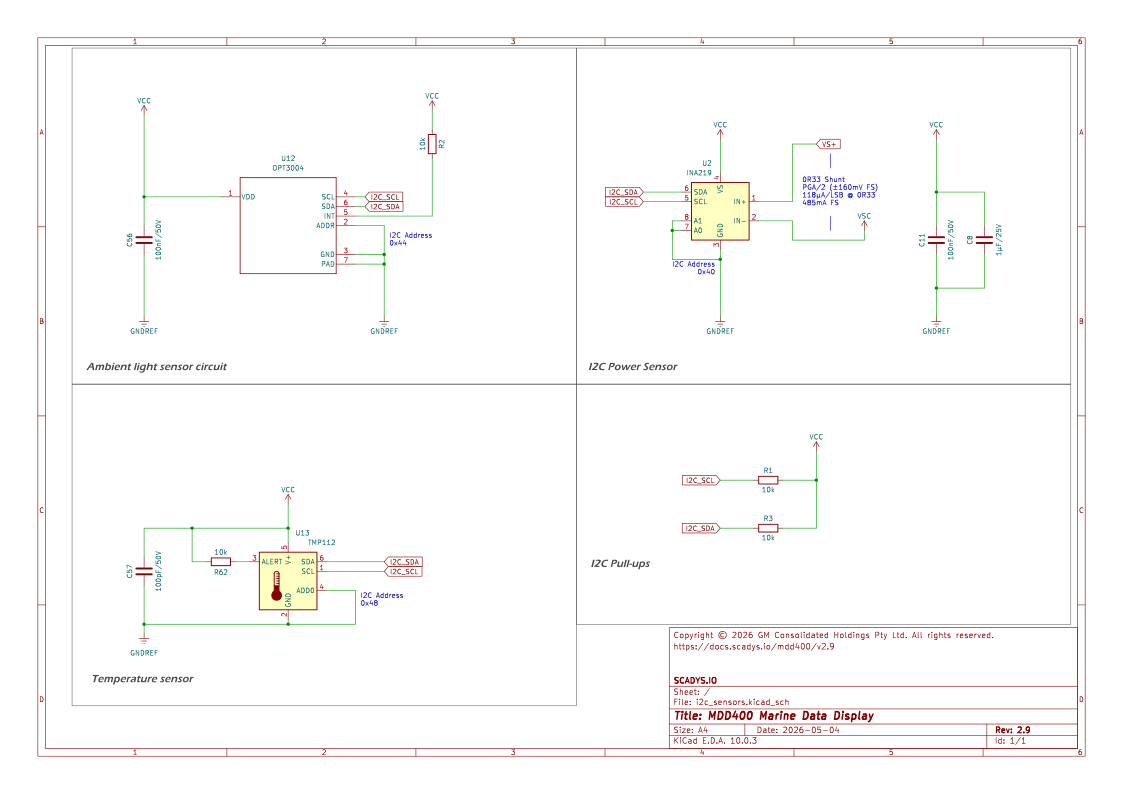
MDD400 v2.9 — Fabricated prototype, bench-test phase. The OPT3004 has been bench-tested on this prototype using hardware test routines: I²C addressing, lux readout, and auto-ranging are functional. The V2.9 housing has a new aperture / lens window relative to the previous hardware revision, so the ALS-reading → display brightness lookup table — currently in the MDD400 V1.0 PlatformIO/Arduino predecessor firmware and earmarked for migration into the planned V2.9 production ESP-IDF firmware — will need to be re-fitted on V2.9 hardware before deployment. See the Display Interface page for the firmware-side brightness control loop.
Overview
This page documents the OPT3004 ambient light sensor on i2c_sensors.kicad_sch — a digital lux sensor whose readings drive the firmware's automatic display-brightness loop. The I²C bus pull-ups (R1 on SCL; R2 ∥ R3 on SDA) are documented on the ESP32 Module page.
- Ambient Light Sensor — OPT3004 (U12) at I²C address 0x44, drawn on the
i2c_sensorsKiCad sheet.
Functional specification and design objectives
- Sense ambient light at the front face of the MDD400 housing, with a spectral response close to the human eye so that the measured value relates directly to perceived display brightness.
- Cover the full outdoor-to-night range a marine helm encounters (direct tropical sunlight at one extreme, near-total darkness on a moonless night helm watch at the other) without saturation or precision loss at either end.
- Output via I²C so no ESP32 ADC channel is consumed, freeing those channels for other measurements if needed in future.
- Run on the shared 3.3 V I²C bus (Standard Mode, 100 kHz) at a distinct address so the firmware can poll it independently of the other sensors.
Ambient Light Sensor
The OPT3004 is at I²C address 0x44.
How it works
U12 — TI OPT3004DNPR is a 16-bit digital ambient light sensor in WSON-6 (with an exposed thermal pad on the underside). It combines a photodiode, transimpedance front-end, ADC, and I²C interface in a single 2.0 × 2.0 mm package. The output range is 0.01 to 83,000 lux in auto-range mode, with the high dynamic range achieved by a floating-point-like exponent/mantissa register format that the firmware decodes back to a linear lux value.
Spectral response. The OPT3004's spectral response is photopic — it matches the human eye's sensitivity curve, peaking at ~555 nm (yellow-green) and rolling off into both blue and red. This means a reading of X lux corresponds to X lux of perceived brightness, regardless of the spectral content of the ambient light (sunlight, incandescent, LED, sodium-lamp helm lighting, moonlight). The brightness lookup table in firmware can therefore be tuned once and stay valid across illumination types.
Auto-range mode. Firmware writes the CONFIG register to enable auto-range conversion mode. The OPT3004 then adjusts its internal gain on each conversion to keep the measurement in-range. The result register contains the mantissa (12 bits) and an exponent code (4 bits); the firmware decodes lux = 0.01 × mantissa × 2^exponent.
Mounting and aperture. U12 is placed on B.Cu, immediately behind the front face of the MDD400 housing. The housing has a small aperture (or, in the V2.9 housing iteration, a small lens window) above U12's optical-active area so ambient light can reach the photodiode through the front face. The aperture / lens geometry of V2.9 differs from the previous hardware revision — that means the transfer function from outside-housing illuminance to OPT3004 raw reading has shifted, and the firmware's lookup table needs to be re-fitted. This is the single most important V2.9 bring-up task for the ALS.
INT pin. The OPT3004 has an INT output that can flag when the reading crosses high / low thresholds. The current V2.9 design does not route INT to an ESP32 GPIO — the firmware polls the OPT3004 at a sub-second rate, which is more than fast enough for eye-adaptation timescales. The INT pin is open-drain; if a future firmware revision wants to interrupt-drive on threshold crossings, an external pull-up to VDD must be added (V2.10 backlog item).
Local supply decoupling. C56 (100 nF X7R) sits adjacent to U12's VDD pin. The OPT3004 is low-power (sub-mA average) and doesn't need a separate bulk reservoir at its supply pin — the broader VCC pour and the ESP32-side bulk caps handle low-frequency reservoir duty.
Performance
| Parameter | Value | Notes |
|---|---|---|
| I²C address | 0x44 | Configured by ADDR pin tie-off |
| Dynamic range | 0.01 lux to 83,000 lux | Auto-range mode |
| Resolution at low end | 0.01 lux | Sufficient for moonless night-helm lighting |
| Spectral response | Photopic (peak ~555 nm) | Matches human eye sensitivity |
| Package | WSON-6 with exposed pad | Pad must tie to GNDREF |
| VDD bypass | C56 = 100 nF X7R, ~2.3 mm from VDD | Adequate; OPT3004 is low-power |
| INT pin connection | Open-drain, not routed to ESP32 in V2.9 | Firmware polls; INT pull-up is a V2.10 item if interrupt-driven mode is wanted |
| Mounting | B.Cu, aligned with housing aperture / lens | V2.9 aperture differs from prior hardware — firmware lookup re-fit required |
Firmware notes
The OPT3004 reading is the input to the automatic display brightness loop. The matching firmware-side guidance is on the Display Interface page. Summary of the bits that belong on the OPT3004 side:
- Re-calibration on V2.9 is mandatory. The brightness lookup table from the MDD400 V1.0 PlatformIO/Arduino predecessor firmware was tuned over significant in-service operating hours (including extended open-ocean passages). The V2.9 housing has a new ALS aperture / lens placement, so the same outside illuminance now produces a different OPT3004 raw reading. The lookup table's input axis must be re-mapped against the V2.9 housing before the migrated brightness loop can be deployed in the planned V2.9 production ESP-IDF firmware.
- Sub-second polling rate is sufficient. Eye adaptation is slow; a 1–4 Hz polling rate matches typical needs. Don't poll faster than necessary — the OPT3004's auto-range conversion time (~800 ms at full integration) is the bottleneck anyway.
- Hysteresis at brightness step boundaries. DGUS II brightness commands have a small number of discrete steps. The lookup must include hysteresis at each step boundary so the brightness doesn't flicker when ambient light drifts across a threshold.
PCB Layout
U12 (OPT3004) is placed on B.Cu at (139.0, 47.5), aligned with the window in the custom DWIN lens assembly so the ambient-light path through the lens to the sensor active area is unobstructed — this optical access is the critical placement constraint. C56 (100 nF VDD bypass) sits ~2.3 mm from U12's VDD pin on the same layer (B.Cu), close enough for effective high-frequency decoupling. The WSON-6 exposed pad (EP, GND) must tie to the GNDREF plane through at least one via directly under or adjacent to the pad; via placement under the exposed pad still requires Gerber verification. The sensor and its decoupling cap cluster with the other I²C sensors in a 15 × 20 mm area on B.Cu immediately behind the DWIN display panel; all sensor grounds connect to the continuous GNDREF plane (no isolation boundary exists in V2.9 — the ISO1541 was removed).
Components
| Ref | Value | Function | Datasheet |
|---|---|---|---|
| U12 | OPT3004DNPR | TI ambient light sensor, WSON-6, I²C address 0x44, 0.01–83,000 lux | TI OPT3004 (SBOS762) |
| C56 | 100 nF / 50 V X7R 0603 | OPT3004 VDD high-frequency bypass | Murata GRM188R71H104KA93D |
The I²C bus pull-ups (R1, R2, R3) are listed in the ESP32 Module Components table.
Testing & Verification
V2.9 is a fabricated prototype in the bench-test phase. The OPT3004 acknowledges on the I²C bus and produces plausible lux readings on the prototype. The brightness lookup table needs to be re-fitted against the V2.9 housing aperture before the firmware can be deployed. The following are required.
Hardware bring-up (rig at the bench):
- I²C addressing — Issue a
read manufacturer IDto address 0x44. Pass if the OPT3004 acknowledges and returns the expected manufacturer ID. - CONFIG register write-back — Write auto-range conversion mode to the CONFIG register, read it back. Pass if the read-back matches.
- Dark reading — Cover the housing aperture with an opaque cover. Pass if the reported lux value falls below 1 lux within a few conversion cycles.
- Bright reading — Aim a known bright source at the housing aperture (e.g. a bench LED panel with a measured lux output). Pass if reported lux is within ±20 % of a reference lux meter co-located at the housing surface.
- Auto-range stability — Sweep ambient illuminance across the full operating range (dark → indoor → direct sunlight) while logging the OPT3004 reading. Pass if there are no skipped ranges or stuck-state behaviours.
- Brightness lookup table re-fit — Characterise the V2.9 housing aperture's transfer function from outside illuminance to OPT3004 raw reading at multiple ambient levels (direct sunlight, indoor office, twilight, night helm, total dark) and re-fit the lookup. Pass if the firmware brightness loop produces the same perceived display brightness vs ambient as the prior hardware revision did, with DGUS II step-boundary hysteresis applied.
Gaps & next version
Before next production run
- OPT3004 EP via — Via placement under the WSON-6 exposed pad (EP, GND) to the GNDREF plane requires Gerber verification; confirm at least one via directly under or adjacent to the pad before committing to a production run.
- Brightness lookup table re-fit — The V2.9 housing aperture / lens differs from the prior hardware revision, shifting the illuminance-to-reading transfer function. Re-fit the lookup table against V2.9 hardware before the firmware is deployed.
Next version (V2.10)
- OPT3004 INT pull-up — If a future firmware revision wants to interrupt-drive on threshold crossings, the open-drain INT pin needs an external pull-up to VDD. Currently absent; polled mode in current firmware doesn't require it, so this is a forward-looking item. Connecting INT to a spare GPIO would also require a board respin.
References
- Texas Instruments, OPT3004 Ambient Light Sensor (SBOS762).
- Murata, GRM188R71H104KA93D — 100 nF X7R 0603.
- NXP Semiconductors, I²C-bus specification and user manual (UM10204).
Related pages
- Temperature Sensor — the TMP112 sibling sensor on the same
i2c_sensorssheet and I²C bus - ESP32-S3 Module — host MCU and the shared I²C bus pull-ups (R1 / R2 / R3)
- Display Interface — firmware-side brightness control loop driven by the OPT3004 reading
- Pin Assignments — the I²C bus GPIO assignments and sensor addresses