Connectors & Markings
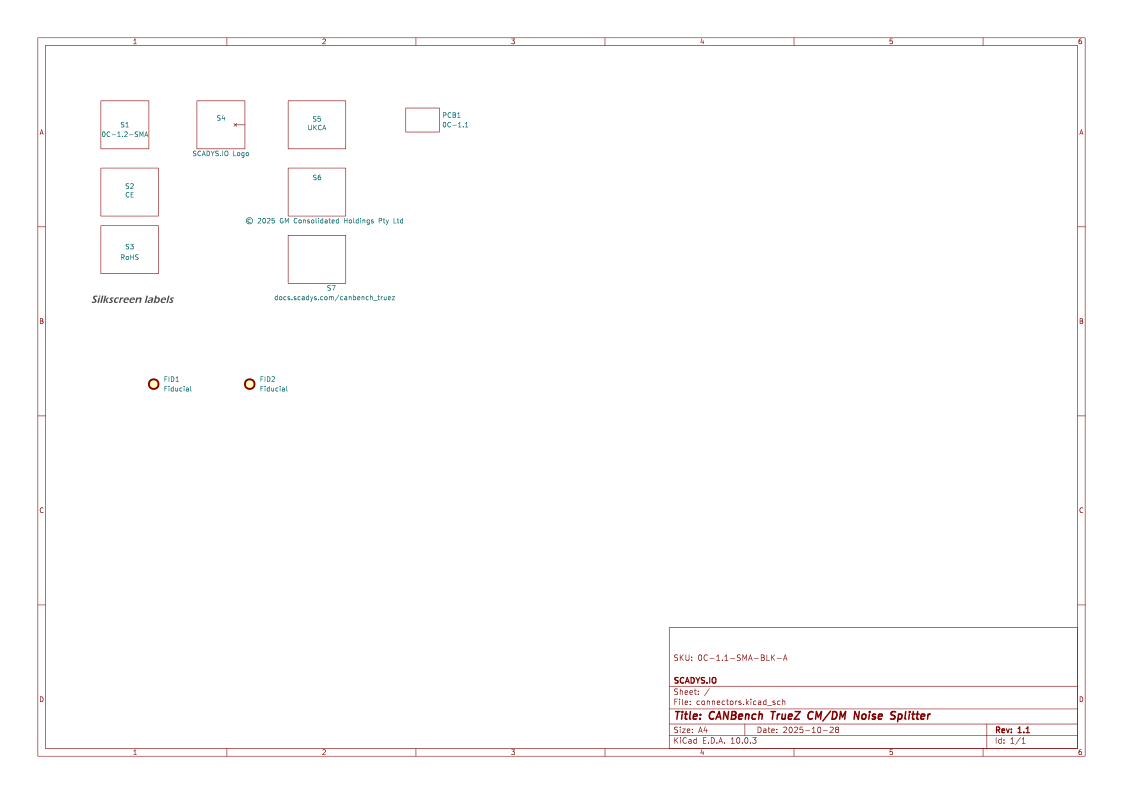
CANBench TrueZ v1.2 — Schematic-stage refresh of the V1.1 fabricated prototype. V1.2 is electrically identical to V1.1 and carries the InvenTree-canonical component metadata; no V1.2 boards exist yet — testing and bring-up reference the V1.1 hardware.
Other versions: v1.1 — fabricated prototype (current)
Overview
This page covers the board's external interface and its PCB markings. In V1.2 the connectors and the silkscreen / compliance markings share the dedicated connectors KiCad sheet (V1.1 drew the connectors on the cm_dm sheet).
The interface is five connectors: two SMA inputs (J2/J3), two SMA outputs (J4/J5), and one GNDREF banana (J1). All four RF ports are 50 Ω edge-mount SMA jacks; the banana is a Keystone 1211 quick-connect terminal. All signal processing happens on the CM & DM separator — this interface only presents the net endpoints at the connectors.
Functional specification and design objectives
The connector and marking set must:
- present the two LISN input lines (
RF_LISN_LINE+/RF_LISN_LINE−) from the CANBench Duo on two 50 Ω SMA jacks; - present the two separator outputs — common-mode (
RF_LISN_CM) and differential-mode (RF_LISN_DM) — on two 50 Ω SMA jacks, each compatible with a 50 Ω analyser input; - maintain 50 Ω controlled impedance on all four SMA centre nets and a continuous GNDREF reference across every shield;
- provide a single GNDREF banana for analyser / probe ground reference; and
- carry the standard SCADYS regulatory and identification markings as graphical silkscreen with no electrical function.
Connectors
| Ref | Type | Faceplate label | Role |
|---|---|---|---|
| J2 | Edge SMA (BWSMA-KE11), 50 Ω | LISN+ | Input — positive LISN line (RF_LISN_LINE+) from the CANBench Duo |
| J3 | Edge SMA, 50 Ω | LISN− | Input — negative LISN line (RF_LISN_LINE−) |
| J4 | Edge SMA, 50 Ω | CM-25Ω | Output — common-mode component (RF_LISN_CM) |
| J5 | Edge SMA, 50 Ω | DM-100Ω | Output — differential-mode component (RF_LISN_DM) |
| J1 | Keystone 1211 banana | — | GNDREF measurement reference |
How it works
All four SMA shields and the J1 banana land on the continuous GNDREF plane. Drive LISN+ / LISN− from the CANBench Duo's two LISN-output SMAs with two identical cables — cable skew between the two feeds converts DM↔CM and degrades the separation. The CM-25Ω / DM-100Ω impedance labels assume a 50 Ω analyser input; see CM & DM Separator. Each SMA's pin 1 is the centre net; pin 2 is the shield, tied to GNDREF.
Silkscreen & PCB markings
The connectors sheet carries the standard SCADYS marking set, all graphical (no electrical function):
- Regulatory marks — CE (S2), UKCA (S5), China RoHS / EFUP (S3)
- SCADYS.IO logo (S4 — single pad is an explicit no-connect), copyright line (S6)
- PCB version stamp (S1) and a documentation QR code (S7)
- Two fiducials (FID1, FID2) for pick-and-place
PCB Layout
The connectors define the board I/O on three edges: inputs (J2/J3) on the left, outputs (J4/J5) on the right, the GNDREF banana (J1) central.
- Placement. J2 (84.5, 75) and J3 (84.5, 105) are mirrored ±15 mm about Y=90 on the left edge and feed the central transformers (X 116.5 / 123.5). J4 (155.5, 75) and J5 (155.5, 105) sit on the right edge, each 7 mm from its coupling cap C1/C2 on the same Y row. J1 (105.5, 90) is central and clear of the RF traces. FID1 (87, 90) / FID2 (153, 90) flank the board for assembly alignment.
- Routing. The input centre nets
RF_LISN_LINE+/RF_LISN_LINE−are routed as 1.0 mm CPWG with a 0.2 mm GNDREF gap; output centre nets reach J4/J5 via C1/C2. Exact Z₀ is confirmed against the FR-4 stack-up in performance review. - Ground. Each SMA launch is via-stitched into the GNDREF plane. All SMA shields (pin 2) and the J1 banana land on the single continuous GNDREF pour (F.Cu pour + B.Cu plane); a perimeter via fence and per-launch stitching clusters provide a low-impedance return at each coax transition.
Components
| Ref | Value | Function | Datasheet |
|---|---|---|---|
| J2 | BWSMA-KE11 | Edge SMA jack, 50 Ω — input RF_LISN_LINE+ (pin 1 centre, pin 2 shield/GNDREF) | BAT WIRELESS BWSMA-KE11 |
| J3 | BWSMA-KE11 | Edge SMA jack, 50 Ω — input RF_LISN_LINE− | BAT WIRELESS BWSMA-KE11 |
| J4 | BWSMA-KE11 | Edge SMA jack, 50 Ω — common-mode output RF_LISN_CM | BAT WIRELESS BWSMA-KE11 |
| J5 | BWSMA-KE11 | Edge SMA jack, 50 Ω — differential-mode output RF_LISN_DM | BAT WIRELESS BWSMA-KE11 |
| J1 | Keystone 1211 | PCB-mount banana / quick-connect terminal — GNDREF measurement reference | Keystone 1211 |
Gaps & next version
Before next production run
- PCB version / variant inconsistency — the marked version strings disagree across the PCB part number (
PCB-0C-1.1-SMA-GRN-C, green), the S1 silk stamp ("0C-1.2-SMA"), and the title-block SKU comment ("0C-1.1-SMA-BLK-A", black). Reconcile to a single version/variant before any production artwork release. - QR-code domain — S7 silk reads
docs.scadys.com/canbench_truez; the live docs domain isdocs.scadys.io. Correct the.com→.iotypo on the next revision. - S1/S6 silk courtyard overlap at (120, 108.5) — the PCB-version (S1) and Copyright (S6) marking footprints are stacked (DRC courtyards_overlap). Cosmetic; resolve alongside the marking cleanup above.
Next version
- Clone-leftover footprint-lib refs — S1 (
mdd400:Variant) and S7 (WTI400:qr_…) reference silk symbols from the MDD400/WTI400 libraries, a remnant of the project clone. The silk renders correctly; normalise to the TrueZ silk library. - PCB title block still carries the Duo-clone title — update when the version/variant is reconciled.
The marking-placeholder items are also tracked on the Tasks page.
References
- BAT WIRELESS, BWSMA-KE11 edge-mount SMA jack.
- Keystone Electronics, 1211 PCB quick-connect terminal.
Related pages
- CM & DM Separator — the separator the SMA outputs present, and the source of the CM-25Ω / DM-100Ω impedance labels.
- External Connectors — the connector roster, faceplate labels, and cabling quick reference.