Circuit Design
CANBench TrueZ v1.1 — Fabricated prototype, sole built unit. V1.1 is electrically identical to the V1.2 schematic refresh but predates the InvenTree symbol-library migration; the schematic component metadata reflects legacy SCADYS naming. Testing and bench validation reference this V1.1 hardware.
Other versions: v1.2 — schematic refresh (next version)
The CANBench TrueZ is a fully passive instrument. There is no microcontroller, no firmware, no switching converter. The whole board is two 1:1 RF transformers and a small resistor/capacitor network on a 2-layer FR-4 board, implementing the noise-separator method of Wang, Lee & Odendaal (IEEE TPE 2005): sum the two LISN lines to recover the common-mode component, difference them to recover the differential-mode component.
TrueZ is the companion to the CANBench Duo DC LISN. The Duo supplies the RF coupling, attenuation and front-end protection; TrueZ does only the mode separation.
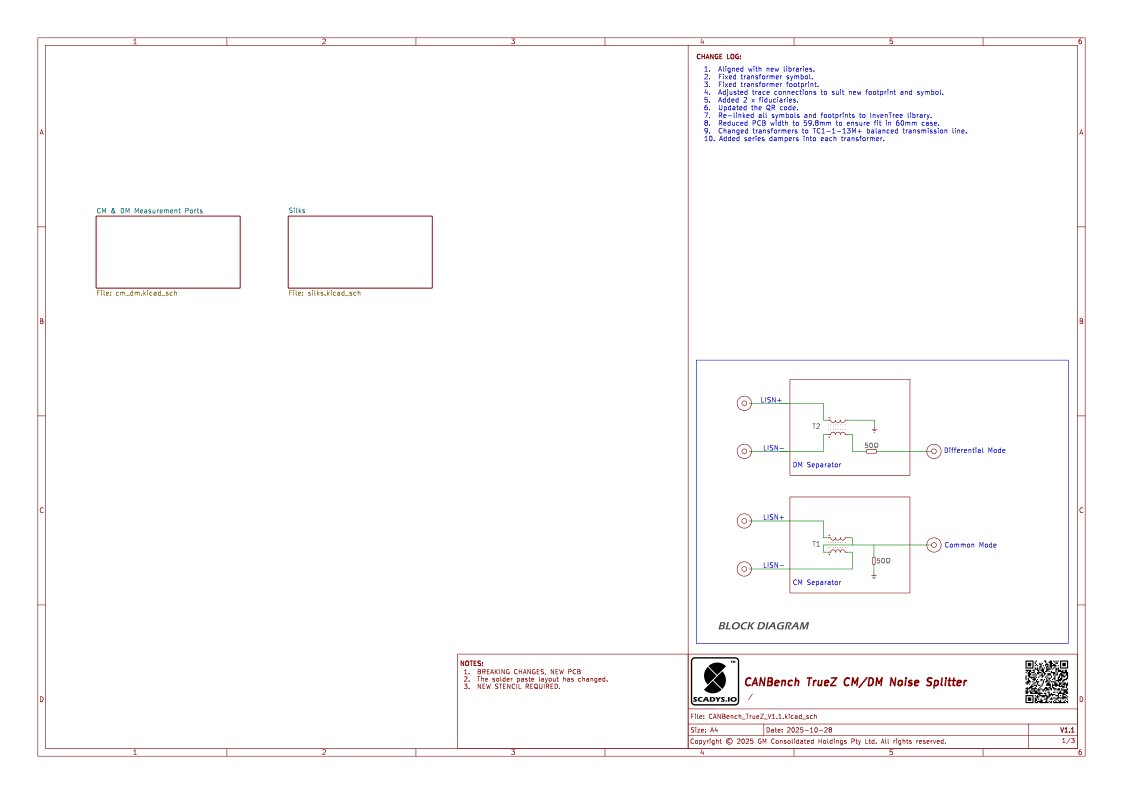
Overview
Signal flows left-to-right. The two LISN line signals enter on SMA inputs LISN+ / LISN−, each through a 10 Ω series damper, into the two transformers. They leave on two SMA outputs after their mode-specific terminations and DC-blocking capacitors:
- Common-mode (T1). The two windings of T1 are connected in series across
LISN+andLISN−; the series midpoint sits at the average (common-mode) potential. A 49.9 Ω shunt to GNDREF terminates this node, and a 100 nF cap AC-couples it to theCM-25Ωoutput. - Differential-mode (T2). The second transformer is wired to transform the line-to-line difference to a single-ended output, through a 49.9 Ω series resistor and a 100 nF DC-block to the
DM-100Ωoutput.
The mode-specific terminations are the crux of the method. With a 50 Ω analyser input, the CM output's 49.9 Ω shunt presents ≈ 25 Ω at the common-mode node (faceplate CM-25Ω), and the DM output's 49.9 Ω series gives a 100 Ω measurement condition (faceplate DM-100Ω). These labels assume the analyser presents 50 Ω; a high-impedance scope input invalidates the loading.
Functional requirements and performance criteria
TrueZ is a passive measurement fixture: a two-port-in, two-port-out RF separator that resolves a LISN's two line signals into their common-mode and differential-mode components for a spectrum analyser. The board carries no active devices, so the requirements are entirely about preserving the measurement — passing the noise spectrum faithfully, presenting the correct port impedances, and not letting one mode leak into the other.
System functional requirements
- Resolve the two LISN line signals (
LISN+/LISN−) into separate common-mode and differential-mode outputs by the Wang–Lee–Odendaal method (sum for CM, difference for DM). - Present each output on a 50 Ω SMA jack so it drives a spectrum analyser directly.
- Terminate each mode at its method-defined condition — a shunt for CM, a series element for DM — assuming a 50 Ω analyser input.
- Block the bus DC while passing the AC noise spectrum, so only disturbance reaches the analyser.
- Keep the two input feeds symmetric, so line-to-line skew does not convert DM↔CM and corrupt the separation.
- Pass the conducted-emissions band with low, repeatable insertion loss.
Performance criteria (design targets)
The values below are design intent, calculated from datasheet specifications against the V1.1 fabricated topology; empirical VNA / golden-prototype confirmation is pending.
| Criterion | Target | Basis |
|---|---|---|
| CM port effective impedance | ≈ 25 Ω (49.9 Ω shunt ∥ analyser 50 Ω) | Wang–Lee–Odendaal CM-port termination; assumes a 50 Ω analyser input |
| DM port effective impedance | ≈ 100 Ω (49.9 Ω series + analyser 50 Ω) | Wang–Lee–Odendaal DM-port termination; assumes a 50 Ω analyser input |
| Port impedance | 50 Ω at each of the four SMA jacks | Spectrum-analyser / LISN interface convention |
| Measurement bandwidth | 4.5 MHz – 3 GHz | TC1-1-13M+ transformer band; useful from the low CISPR band up |
| Insertion loss (transformer) | ≈ 0.18 dB @4.5 MHz → ≈ 0.68 dB @1 GHz | TC1-1-13M+ datasheet, applied 2× (one balun per mode path) |
| Cross-mode isolation floor | Set by transformer balance (0.5 dB amplitude, 2° phase typ) | TC1-1-13M+ datasheet balance specification |
| Low-frequency droop | Below ≈ 0.5 MHz — corrected with a one-time golden-prototype calibration curve | TC1-1-13M+ low-end roll-off; correction is the production intent, not yet measured |
The CM-25Ω / DM-100Ω semantics assume a 50 Ω analyser input; a high-impedance scope input invalidates the intended loading and the calibration. The per-circuit CM & DM Separator page carries the detailed objectives and the calculations that verify them; this section is the system-level parent they trace to.
Subsystems
| Subsystem | Schematic sheet (V1.1) | Role |
|---|---|---|
| CM & DM Separator | cm_dm | The two TC1-1-13M+ baluns (T1 common-mode, T2 differential-mode) and the 10 Ω / 49.9 Ω / 100 nF network that extract and couple out the CM and DM components. |
| Connectors & Markings | cm_dm (connectors) + silks (markings) | Four edge SMA jacks (LISN+/LISN− in, CM-25Ω/DM-100Ω out), the J1 GNDREF banana, and the PCB silkscreen / compliance markings. |
In V1.1 the entire electrical circuit — including the four SMA connectors and the J1 banana — is drawn on the cm_dm sheet; the silks sheet carries the silkscreen/markings only. The V1.2 refresh split the connectors onto a dedicated sheet.
PCB stack-up and layer allocation
The board is 71 × 42 mm, 2-layer FR-4, 1.6 mm overall thickness, 1 oz copper on both sides.
| Layer | Type | Thickness | Material | ε_r | Notes |
|---|---|---|---|---|---|
| F.SilkS | Top silkscreen | — | — | — | Markings + branding |
| F.Mask | Top solder mask | 0.010 mm | — | — | Dark (#191919) |
| F.Cu | Signal | 0.035 mm | Copper | — | Components, RF traces, coplanar GNDREF pour |
| Core | Dielectric | 1.510 mm | FR-4 | 4.5 | tan δ ≈ 0.02 |
| B.Cu | Ground | 0.035 mm | Copper | — | Continuous GNDREF plane — the RF return |
| B.Mask | Bottom solder mask | 0.010 mm | — | — | Dark (#191919) |
| B.SilkS | Bottom silkscreen | — | — | — | — |
EMC layout philosophy
- Controlled-impedance CPWG. The RF input lines are routed as coplanar-waveguide-with-ground: ≈ 1.0 mm trace, 0.2 mm gap to the GNDREF pour, on the 1.6 mm FR-4 stack — targeting 50 Ω (design estimate ≈ 50–52 Ω; exact Z₀ pending field-solver / VNA confirmation).
- Continuous ground reference. GNDREF is poured on both copper layers, with dense via stitching (≈ 500 ground vias) forming a perimeter fence and clusters at the transformers and SMA launches. The continuous plane under each transformer follows the TC1-1-13M+ datasheet's grounding guidance.
- Symmetry. The two
LISN+/LISN−feeds into each transformer are placed symmetrically; skew between them converts DM↔CM and corrupts the separation the product exists to perform.
DRC
kicad-cli DRC reports 1 cosmetic violation (silkscreen marking footprints S1/S6 overlapping at a single point) and 0 unconnected / 0 schematic-parity issues. The silk overlap is bundled with the marking cleanup tracked on the Tasks page.
References
- J. Wang, F. C. Lee, W. Odendaal, Characterization, Evaluation, and Design of Noise Separator for Conducted EMI Noise Diagnosis, IEEE Trans. Power Electronics 20(4), 2005 — the separator method.
- Mini-Circuits, TC1-1-13M+ — 1:1 50 Ω RF balun, 4.5–3000 MHz; suggested PCB layout.
- EEVblog Forum, DIY DM/CM Separator for EMC — LISN Mate.
- IEC, CISPR 25 — conducted-emissions measurement band and methods.