PCB Markings & Compliance
CANBench Duo v1.2 — Schematic-stage refresh of the V1.1 fabricated prototype. V1.2 is electrically identical to V1.1 and carries the InvenTree-canonical component metadata; no V1.2 boards exist yet — testing and bring-up reference the V1.1 hardware.
Other versions: v1.1 — fabricated prototype (current)
Overview
The CANBench Duo uses a two-place marking system. Permanent traceability markings are silkscreened on the PCB underside; user-facing operational labels are etched on the enclosure top extrusion. Separating the two roles keeps the immutable PCB record clean from the day-to-day operating labels that the user actually reads in front of them.
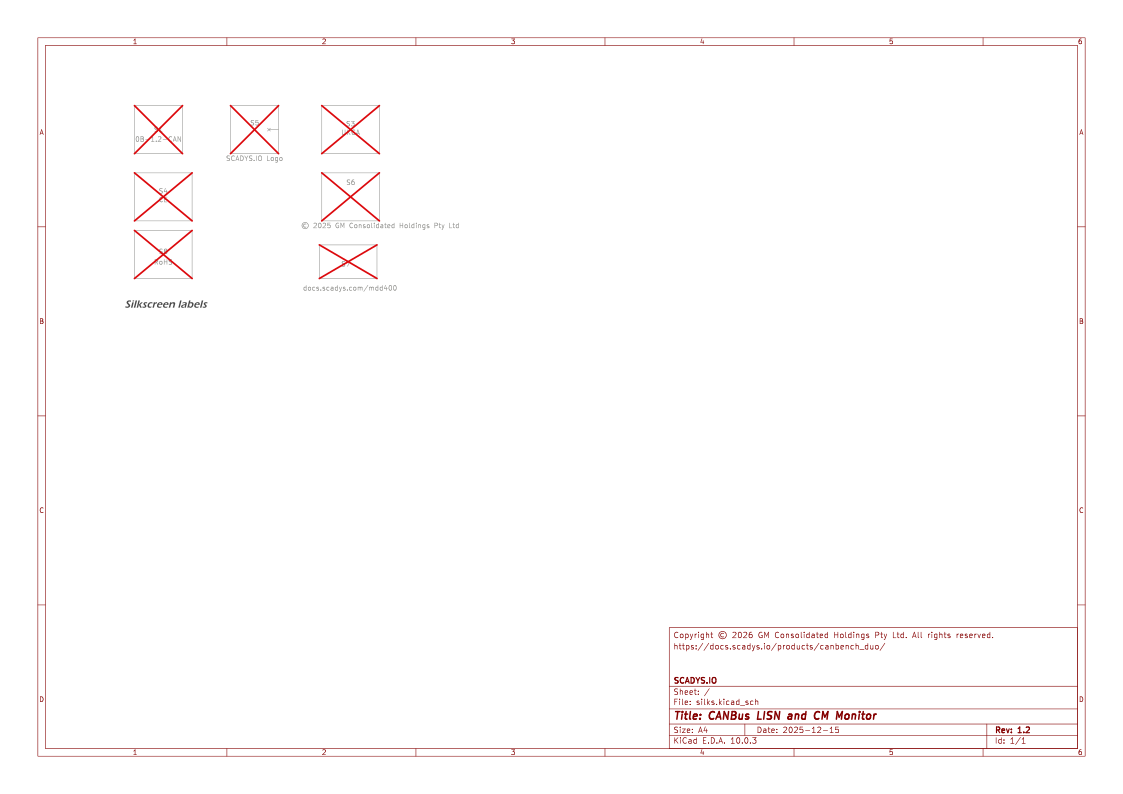
This page covers the PCB silkscreen markings — the regulatory cluster, branding, copyright, version stamp, and QR code carried on the board itself. These are drawn on the Silks sheet of the CANBench_Duo_V1.2 KiCad project and rendered on the F.SilkS copper-side silkscreen layer. The enclosure-top operational labels are documented separately on the Connectors & Mechanical page.
Functional specification and design objectives
The board-marking system must satisfy three objectives that have no electrical content but are required for a market-ready instrument:
- Permanent traceability — every fabricated board must carry an immutable record of PCB revision, product version, product family, copyright owner, and a link to the canonical documentation, independent of any enclosure label that can wear or be removed.
- Regulatory conformity declaration — the silkscreen must carry the CE, UKCA, and RoHS marks as a forward-looking conformity claim, positioned and sized for the applicable marking directives. Target mark letter height is the 5 mm minimum implied by EU Directive 765/2008/EC Annex II for products that are not size-constrained.
- Role separation — permanent traceability marks (PCB silkscreen) must be physically separated from day-to-day operating labels (enclosure top extrusion) so the immutable record stays clean from the signage the technician reads during a session.
What is on the PCB underside
Seven silkscreen marks on F.SilkS (the front-copper-side silkscreen). In the assembled YG-H10A enclosure, F.Cu faces down against the GRP test bench, so these marks are not directly visible without flipping the unit — they are the permanent traceability record, not a user-facing readout.
| Ref | Mark | Position (X, Y) mm | Purpose |
|---|---|---|---|
S1 | 0B-1.2-CAN PCB version stamp | (97, 54) | Encodes PCB revision (0B), product version (1.2), and family designator (CAN) |
S3 | UKCA | (165.5, 125) | UK conformity mark |
S4 | CE | (156.5, 125) | EU conformity mark |
S5 | SCADYS-IO logo (9 × 9 mm, with F.Mask cutout) | (77.5, 57.5) | SCADYS-IO branding |
S6 | "© 2025 GM Consolidated Holdings Pty Ltd" | (106.4, 127) | Copyright notice |
S7 | QR code | (77.5, 68) | Links to the canonical docs page for this product / version (V1.1 silkscreen carries a stale URL — see Gaps & next version below) |
S8 | RoHS (China-RoHS EFUP variant) | (148, 125) | Restriction of Hazardous Substances mark |
The regulatory marks cluster at the top edge of the board (S3 + S4 + S8); the product-identification cluster sits at the bottom-left (S5 + S7 + S1).
What is on the enclosure top
The user-facing labels — SRC, DUT, GRP, and the connector reference designators — are laser-etched or printed on the YG-H10A top aluminium extrusion. These are the labels a technician reads during a measurement session and are intentionally separate from the PCB silkscreen.
The Connectors & Mechanical page covers the enclosure-top labelling. The PCB-silkscreen marks documented on this page are the permanent record; they are not the daily-use signage.
PCB version stamp format
0B-1.2-CAN decodes as:
0B— PCB revision letter ("Rev B"). Increments with each fabrication-impacting layout change.1.2— product version. Matches theCANBench_Duo_V1.2KiCad project name and the docs URL slug.CAN— product family designator distinguishing the CANBench Duo from the WTI400 / MDD400 / MLI400 / MDG400 family.
The V1.1 fabricated prototype carries 0B-1.1-CAN; V1.2 schematic carries 0B-1.2-CAN; V1.3 will carry 0C-1.3-CAN (next PCB revision, next product version).
PCB Layout
The marks are laid out in two clusters on F.SilkS, both referenced from the board origin (bottom-left) in the table above:
- Regulatory cluster — UKCA (
S3), CE (S4), and RoHS (S8) sit in a row along the top edge of the board near Y = 125 mm, grouped so the conformity marks read together. - Product-identification cluster — the SCADYS-IO logo (
S5), QR code (S7), and0B-1.2-CANversion stamp (S1) sit at the bottom-left between Y = 54 mm and Y = 68 mm. The copyright notice (S6) anchors near the top edge at (106.4, 127).
The silkscreen is drawn on F.SilkS, which in the assembled YG-H10A enclosure faces the GRP test bench (F.Cu down). The board outline is 99 × 79 mm — large enough that the marking layout is not size-constrained. The SCADYS-IO logo (S5) is paired with an F.Mask cutout so the logo reads cleanly against the exposed copper.
Components
Silkscreen marks are non-electrical board features carried in the schematic under the S reference-designator series:
| Ref | Value | Function | Datasheet |
|---|---|---|---|
S1 | 0B-1.2-CAN text | PCB version / product / family stamp | — |
S3 | UKCA mark | UK conformity declaration | — |
S4 | CE mark | EU conformity declaration | — |
S5 | SCADYS-IO logo (9 × 9 mm) | Branding (F.Mask cutout) | — |
S6 | © notice text | Copyright (GM Consolidated Holdings Pty Ltd) | — |
S7 | QR code | Link to canonical docs page (ISO/IEC 18004) | — |
S8 | RoHS (China-RoHS EFUP) | Hazardous-substances declaration | — |
Certification status
The V1.1 prototype silkscreen carries CE, UKCA, and RoHS marks (also defined in the V1.2 schematic) as a forward-looking conformity claim. No formal compliance certification has been performed yet.
| Mark | Underlying directive | V1.2 status |
|---|---|---|
| CE | 2014/30/EU (EMC); 2014/35/EU (LVD, N/A at ≤ 48 V DC) | Mark present, Declaration of Conformity pending |
| UKCA | UK SI 696/2008 | Mark present, conformity assessment pending |
| RoHS | 2011/65/EU + 2015/863/EU | Mark present; V1.2 BOM is lead-free (all components carry "ROHS" suffix in InvenTree) |
The CE and UKCA marks on the V1.1 prototype silkscreen anticipate the formal conformity assessment expected before public release. They are a forward-looking conformity claim, not evidence of completed certification testing. Before V1.3 fabrication for public release, either the formal Declaration of Conformity must be in place OR the regulatory marks must be removed from the silkscreen.
Gaps & next version
Before next production run
- QR-code URL on the V1.1 fabricated prototype is
docs.scadys.com/mdd400— a clone-leftover from the project's origin as an MDD400 fork. The QR points to the wrong product's docs. The V1.2 schematic has the correct URL queued (docs.scadys.io/canbench-duo/v1.2); next fabrication will be correct. Any V1.1 prototype already in the field reaches the correct page via direct URL or web search instead.
Next version
- CE and UKCA mark letter height is 3.5 mm — below the 5 mm minimum implied by EU Directive 765/2008/EC Annex II for products that are not size-constrained. The PCB is 99 × 79 mm — not size-constrained. V1.3 upsizes to 5 mm.
- Silkscreen layer is F.SilkS (PCB underside) — in the assembled enclosure, F.SilkS faces the bench, not the user. V1.3 may migrate the regulatory cluster to B.SilkS so it is visible from the top alongside the SRC / DUT / GRP enclosure labels.
These items do not affect the V1.1 prototype's usability — they are non-conformities pending the V1.3 release for public-market readiness.
References
- EU Directive 765/2008/EC — CE marking rules
- EU Directive 2014/30/EU — Electromagnetic compatibility
- UK Statutory Instrument 696/2008 — UKCA marking
- Directives 2011/65/EU and 2015/863/EU — Restriction of Hazardous Substances (RoHS)
- ISO/IEC 18004 — QR Code specification
Related pages
- Connectors & Mechanical — the enclosure top extrusion labelling that complements the PCB silkscreen
- Compliance — full compliance status including the pending formal certification work
- Tasks — V1.3 silkscreen fixes are tracked here