External Connectors
CANBench Duo v1.1 — Fabricated prototype, sole built unit. V1.1 is electrically identical to the V1.2 schematic refresh but predates the InvenTree symbol-library migration; the schematic component metadata reflects legacy SCADYS naming. Testing and bench validation reference this V1.1 hardware.
Other versions: v1.2 — schematic refresh (next version)
Connector roster for the CANBench Duo enclosure. The unit has a dual-face layout — bench supply on the front, DUT on the back, measurement outputs on the top.
Roster
| Ref | Face | Type | Role | Rating (design intent) |
|---|---|---|---|---|
J5 | Front | Changzhou Amass 24.245.1 banana (RED) | SRC+ — bench-supply positive input | 10 A continuous (connector class); 4 A continuous limited by upstream LISN |
J7 | Front | Changzhou Amass 24.245.2 banana (BLACK) | SRC− — bench-supply negative input | 10 A continuous (connector class); 4 A continuous limited by upstream LISN |
J1 | Back | Changzhou Amass 24.245.1 banana (RED) | DUT+ — LISN-filtered positive output to DUT | 10 A continuous (connector class); 4 A continuous LISN limit |
J3 | Back | Changzhou Amass 24.245.2 banana (BLACK) | DUT− — LISN-filtered negative output to DUT | 10 A continuous (connector class); 4 A continuous LISN limit |
J10 | Top extrusion | Shenzhen STA M12-S5A-PPFM (Micro-C 5-pin Code A Female) | DUT supply + N2K combined — NMEA 2000 / DeviceNET pinout | 4 A per pin (M12 spec); same 4 A LISN limit applies |
J2 | Top extrusion | HCTL HC-SMA6565-13H-G (SMA Female Vertical) | RF measurement output — LISN+ (upper-rail RF tap) | < 500 mA DC; RF 12–18 GHz capable, VSWR ≤ 1.3:1 to 6 GHz |
J4 | Top extrusion | HCTL HC-SMA6565-13H-G (SMA Female Vertical) | RF measurement output — LISN− (lower-rail RF tap) | < 500 mA DC; RF 12–18 GHz capable, VSWR ≤ 1.3:1 to 6 GHz |
J6 | Top extrusion | HCTL HC-SMA6565-13H-G (SMA Female Vertical) | RF measurement output — CAN common-mode tap | < 500 mA DC; RF 12–18 GHz capable, VSWR ≤ 1.3:1 to 6 GHz |
| Binding post | Front | Knurled-knob with wire-braid to PCB GNDREF | Chassis-ground bond | Not current-rated; reference connection only |
J8 | (footprint, DNP) | Keystone 1211 THT pad | Reserved alternative chassis-bond — NOT POPULATED on V1.1 / V1.2 | — |
Faceplate layouts
The connectors are laser-etched across three enclosure faces. The drawings below show each face as etched.
Top extrusion — measurement outputs and N2K
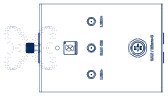
Front faceplate — bench supply (SRC)

Back faceplate — device under test (DUT)

M12 N2K pinout (J10)
J10 is a female M12 A-coded (Micro-C) receptacle. The diagram shows the pin layout viewed from the front (mating face) of the connector.

| Pin | Net | Role |
|---|---|---|
| 1 | SHIELD | Cable shield / drain |
| 2 | NET-S | DUT+ (LISN-filtered supply positive) |
| 3 | NET-C | DUT− (LISN-filtered supply negative) |
| 4 | NET-H | CAN-H |
| 5 | NET-L | CAN-L |
Standard NMEA 2000 / DeviceNET Micro-C pinout — any compliant N2K cable will mate correctly.
SMA termination
Three 50 Ω SMA terminators is the minimum kit. Unused SMA ports must be terminated to avoid resonances, standing waves, and false CM signatures during measurement. See User Manual → Common Pitfalls.
Engineering rationale
For the design intent behind the dual-face layout, the source/DUT directionality enforced by the LISN protection chain, and the per-connector mechanical detail (faceplate cutouts, render gallery, render geometry), see Connectors & Mechanical in the Circuit Design section.