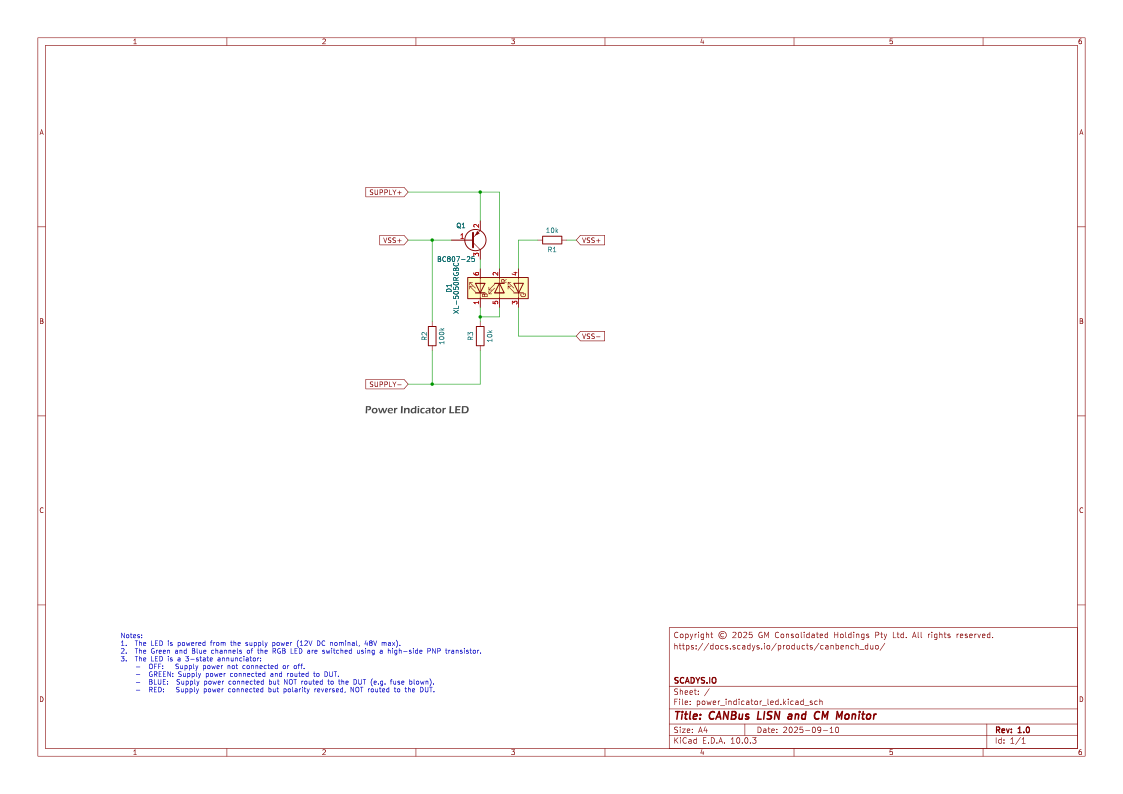
Power Indicator LED
CANBench Duo v1.1 — Fabricated prototype, sole built unit. V1.1 is electrically identical to the V1.2 schematic refresh but predates the InvenTree symbol-library migration; the schematic component metadata reflects legacy SCADYS naming. Testing and bench validation reference this V1.1 hardware.
Other versions: v1.2 — schematic refresh (next version)
Overview
A single XL-5050RGBC three-die RGB LED on the top extrusion encodes four supply-chain states. The encoding is entirely topological — there is no MCU, no firmware, no software. Each colour falls out of the rail relationships in the LISN supply-path protection chain.
This page covers a single sub-circuit — the Power Indicator LED — drawn on the power_indicator_led KiCad sheet. The LED is the fixture's front status indicator: it is in the operator's line of sight throughout a measurement, so the colour encoding is written to be readable at a glance during normal use.
Functional specification and design objectives
The power-indicator circuit must:
- give the operator an at-a-glance, always-on read of the bench-supply path state while a measurement is running;
- encode four distinct states — supply absent, normal operation, reverse polarity, and protection-chain fault — in a single front-facing RGB LED;
- derive every state from the LISN supply-path rail relationships alone, with no MCU, firmware, or active sensing;
- load the bench supply negligibly (target < 0.5 % of the LISN's 4 A continuous design current across the 12–48 V supply range); and
- keep each die comfortably below its 20 mA absolute-maximum across the full 12–48 V supply range.
State table
| Indicator | Condition | What it means | What to do |
|---|---|---|---|
| Off | No bench-supply voltage | The bench supply is not connected, the supply is set to 0 V, or the supply cable to the SRC sockets is open. | Check the bench supply is on and wired to the SRC banana pair (front faceplate). |
| Green | Correct polarity, both protection FETs conducting, F1 intact | Normal operation. LISN delivers the filtered supply to the DUT bananas (J1 / J3) and the M12 N2K connector (J10). | Proceed with measurement. |
| Blue | Q2 protection FET not fully conducting — typically because F1 has blown | A DUT-side over-current event has usually blown the SRC+ rail's 5 A Nano2 Slo-Blo fuse, depriving the upstream P-FET (Q2) of its drain reference. The bench supply is still present at the SRC pair; the DUT pair is dead. A brief Blue flash at supply turn-on (see below) is a separate, benign variant of the same mechanism. | Power the bench supply down. Remove the DUT. Replace F1. If the LED stays Blue with no DUT attached after a fresh fuse, suspect Q2. Investigate the DUT for an over-current condition before reconnecting. |
| Red | Reverse polarity at the SRC pair | The bench supply cables are reversed at the SRC banana pair — V_BLACK > V_RED. The internal protection FETs prevent current flow downstream, so the DUT pair is not energised. | Power the bench supply down. Reverse the SRC cables to the correct RED-to-SUPPLY+, BLACK-to-SUPPLY− orientation. |
A brief Blue flash for ~ ms at supply turn-on is normal and benign — Q2's gate-bias divider takes a few RC time constants to bring Q2 fully ON, and during that interval V(SUPPLY+) − V(VSS+) momentarily exceeds Q1's V_BE threshold. The LED settles to Green once Q2 reaches full conduction.
The LED is visible through the top extrusion of the YG-H10A enclosure (see render_1.PNG and render_2.PNG on the Connectors & Mechanical page), so the operator looking down at the bench can read the state at a glance.
Power Indicator LED
How it works
Five components implement the encoding:
| Ref | Value | Role |
|---|---|---|
D1 | XL-5050RGBC | Three-die RGB LED — independent R / G / B dies with separate anode + cathode pairs |
Q1 | BC807-25 (PNP, SOT-23) | High-side switch driving the Blue die anode |
R1 | 10 kΩ, 0805 | Green-die current limiter (anode side) |
R3 | 10 kΩ, 0805 | Red + Blue shared current limiter (cathode side) |
R2 | 100 kΩ, 0603 | Q1 base bias — provides the DC path from VSS+ to SUPPLY− that lets Q1 sense the SUPPLY+ − VSS+ delta |
The rail connections determine each state:
- Green —
D1.GA(Green anode) sits onVSS+through R1;D1.GK(Green cathode) sits onVSS−. When the protection FETs conduct, V(VSS+) ≫ V(VSS−), and Green is forward-biased. - Red —
D1.RA(Red anode) sits on the shared Red-anode / Blue-cathode node through R3 toSUPPLY−;D1.RK(Red cathode) sits onSUPPLY+. When the SRC pair is reverse-wired, V(SUPPLY−) > V(SUPPLY+) + V_F_red, and Red conducts. - Blue —
D1.BA(Blue anode) is driven by Q1's collector. Q1 is a PNP with E onSUPPLY+, B onVSS+. Q1 turns on when V(SUPPLY+) − V(VSS+) > V_BE_on ≈ 0.65 V. Under normal operation Q2 (the P-FET in the reverse-polarity protection chain) holds VSS+ within mV of SUPPLY+, so Q1 stays off and Blue is dark. When F1 blows, VSS+ no longer has a current path to SUPPLY+, R2 pulls VSS+ toward SUPPLY−, the V(SUPPLY+) − V(VSS+) gap opens up to the full supply voltage, Q1 saturates, and Blue lights via R3 toSUPPLY−. - Off — no supply means no current path; all three dies are dark.
The cleverness is that the Blue-state mechanism is the gate-protection circuit's own behaviour under fault, not a separate fault-detection circuit.
Performance
LED current at the typical 12 V N2K supply and the maximum 48 V supply:
| State | I_LED @ 12 V | I_LED @ 48 V | Notes |
|---|---|---|---|
| Green | 0.98 mA | 4.58 mA | Limited by R1 (10 kΩ); D1 die max is 20 mA — comfortable margin |
| Red | 1.00 mA | 4.60 mA | Limited by R3 (10 kΩ) |
| Blue | 0.90 mA | 4.50 mA | Limited by R3 (10 kΩ), reduced by Q1 V_CE_sat ≈ 0.2 V |
Brightness ranges from comfortably-readable at 12 V to bright but not blinding at 48 V — appropriate for an always-on indicator.
Resistor power utilisation
| Resistor | Footprint | Rated power | Worst-case dissipation @ 48 V | Utilisation |
|---|---|---|---|---|
| R1 | 0805, 0.25 W | 250 mW | 210 mW (Green ON) | 84 % |
| R3 | 0805, 0.25 W | 250 mW | 210 mW (Red or Blue ON) | 84 % |
| R2 | 0603, 0.1 W | 100 mW | 23 mW | 23 % |
At the 48 V supply ceiling, R1 and R3 sit at 84 % of their power rating when the corresponding die is on. V1.1 / V1.2 carry the 0805 footprint as a known steady-state limit at 48 V (see Gaps & next version).
Load on the supply
Total worst-case loading of the indicator circuit on the bench supply: ≈ 4.6 mA at 48 V (one die on). Against the LISN's 4 A continuous design current that's 0.1 % loading — entirely negligible.
PCB Layout
D1 is on B.Cu at (76.0, 90.0), facing up through the YG-H10A top extrusion. Q1, R1, R2, R3 are clustered on F.Cu beneath D1 inside a 5 × 3 mm island around (X = 75, Y = 90) — close to the SRC banana pair (J5 / J7 at X = 71.5) since that's the entry of the SUPPLY+ / SUPPLY− rails the indicator is sensing. The Q1.C → D1.BA trace stays under ~5 mm including one cross-layer via, keeping the high-impedance Blue-drive node short.
Why no firmware?
The indicator could equivalently be implemented as a single tri-colour LED driven by an MCU sampling rail voltages. The discrete topological version was chosen because:
- No firmware to debug. The state encoding is wired into the rail relationships; there is no code path that can be wrong.
- No power-up logic. Q1 + Q2 + Q3 all bias themselves up by the same rails they're protecting; there is no MCU initialisation sequence to fail.
- Cost. Five small passives + one BJT in SOT-23 + one RGB LED beats a microcontroller + crystal + decoupling + firmware-flash effort for this single-function need.
This is consistent with the broader CANBench Duo philosophy — the instrument is fully passive, no MCU on the board, no firmware in the field. Everything that happens, happens because of physics.
Components
| Ref | Value | Function | Datasheet |
|---|---|---|---|
| D1 | XL-5050RGBC | Three-die RGB LED, SMD5050-6P — independent R / G / B dies, separate anode + cathode pairs | XINGLIGHT XL-5050RGBC |
| Q1 | BC807-25 | PNP BJT, SOT-23 — high-side switch driving the Blue die anode | Nexperia BC807 |
| R1 | 10 kΩ | 0805, 0.25 W — Green-die current limiter (anode side) | — |
| R2 | 100 kΩ | 0603, 0.1 W — Q1 base bias (VSS+ to SUPPLY− DC path) | — |
| R3 | 10 kΩ | 0805, 0.25 W — Red + Blue shared current limiter (cathode side) | — |
Gaps & next version
Next version (V1.3)
- Upsize R1 and R3 to 1206 (0.4 W rating). At the 48 V supply ceiling, R1 and R3 sit at 84 % of their 0805 0.25 W rating when the corresponding die is on. V1.3 upsizes both to 1206 for better thermal margin. V1.1 / V1.2 carry the 0805 footprint as a known steady-state limit at 48 V.
Related pages
- LISN Supply Path — the fuse (F1), reverse-polarity protection FETs (Q2 P-FET on
SUPPLY+, Q3 N-FET onSUPPLY−), and theVSS+/VSS−rail definitions referenced by the state encoder - Connectors & Mechanical — the YG-H10A top extrusion through which D1 is visible
References
- XINGLIGHT, XL-5050RGBC RGB LED, SMD5050-6P — D1
- Nexperia, BC807 PNP BJT — Q1