LISN Supply Path
CANBench Duo v1.1 — Fabricated prototype, sole built unit. V1.1 is electrically identical to the V1.2 schematic refresh but predates the InvenTree symbol-library migration; the schematic component metadata reflects legacy SCADYS naming. Testing and bench validation reference this V1.1 hardware.
Other versions: v1.2 — schematic refresh (next version)
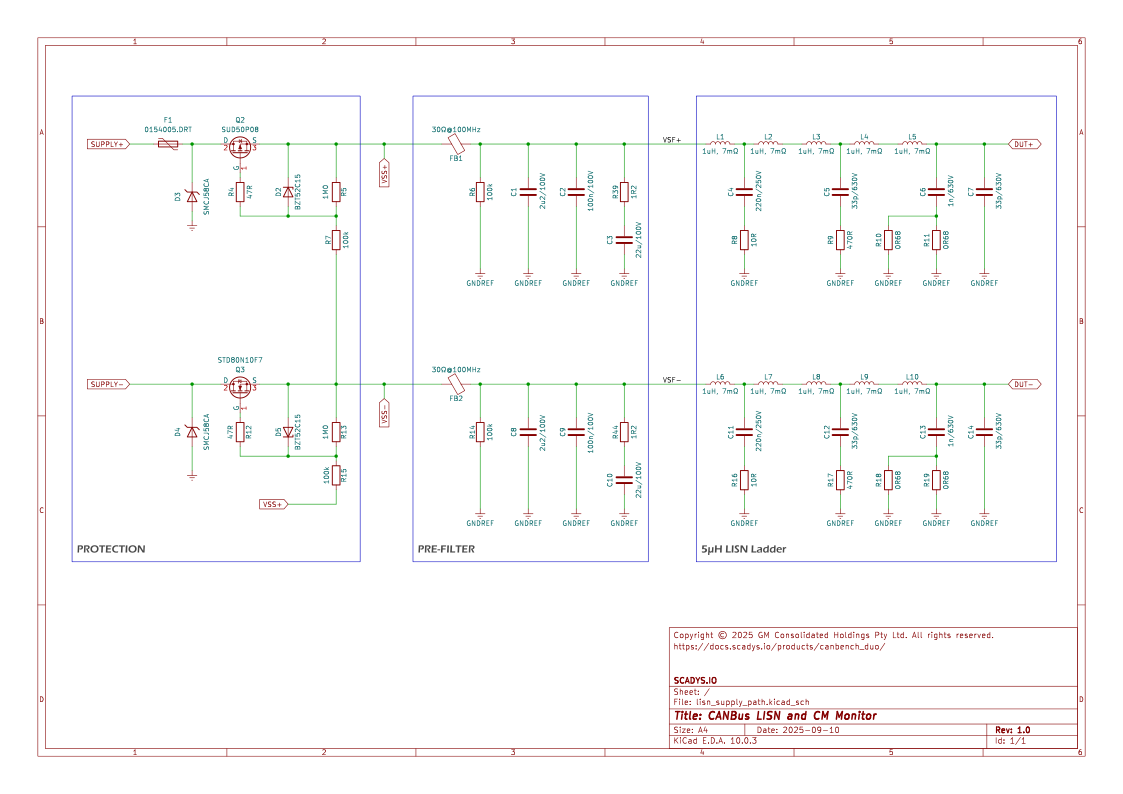
Overview
The LISN supply path is the four-stage passive front-end of the CANBench Duo. It implements a CISPR 25-style dual-line 5 µH artificial network for DC conducted-emissions measurement. The path takes a bench DC supply at the SOURCE banana sockets, delivers a filtered RF-stabilised copy of that supply to the DUT banana sockets, and presents a stable mostly-inductive source impedance to the DUT across the CISPR 25 measurement band (150 kHz to 108 MHz).
The entire stage is passive and bidirectional with respect to RF currents. There is no MCU, no firmware, no switching converter — only fuses, MOSFETs, diodes, ferrite beads, inductors, capacitors, and resistors.
This page covers a single sub-circuit — the LISN supply path — drawn on the lisn_supply_path KiCad sheet.
Functional specification and design objectives
The LISN supply path must:
- pass a 9–48 V DC bench supply from the SOURCE banana pair to the DUT banana pair at up to 4.0 A continuous (25 °C ambient), with a DC path drop of < 0.5 V at 4 A;
- present a CISPR 25-style 5 µH dual-line artificial-network impedance to the DUT across the 150 kHz – 108 MHz measurement band (≈ 4.7 Ω at 150 kHz, rising toward the inductive asymptote ≈ 31–37 Ω at 1 MHz);
- decouple the DUT's RF disturbance behaviour from the upstream bench-supply source impedance, so the measured emission signature is repeatable independent of the supply used;
- keep the impedance-vs-frequency curve smooth across the band (no sharp Q-peaks between ladder resonances) via frequency-staggered shunt-cap damping;
- protect against reverse polarity at SOURCE (FET ideal-diode pair) and clamp ESD / bench-class transients (TVS) without acting as an ISO 7637-2 load-dump absorber; and
- maintain rail-to-rail symmetry so that mode conversion does not corrupt the downstream measurement-port outputs.
LISN supply path
How it works
Power flows in four stages from the bench-supply input on the front faceplate to the DUT-side banana pair at the back faceplate.
Stage 1 — Protection
The positive rail enters from J5 (SRC+) and is fused immediately by F1, a 5 A Littelfuse Nano2 Slo-Blo in an OMNI-BLOK 154 series holder. The post-fuse net is clamped by D3 (SMCJ58CA, 58 V bidirectional TVS) to GNDREF. The negative rail (J7, SRC−) has its own TVS D4 directly to GNDREF.
Each rail then passes through a MOSFET acting as a reverse-polarity protection switch:
Q2— VBsemi SUD50P08 (P-channel TO-252, V_DSS = 100 V) on the positive rail, drain on the post-fuse net, source onVSS+Q3— STMicroelectronics STD80N10F7 (N-channel TO-252, V_DSS = 100 V) on the negative rail, drain onSUPPLY−, source onVSS−
The gate bias uses a discrete self-biased scheme: each FET's gate sits on a 10:1 divider (a 1 MΩ resistor from gate to source — R5/R13 — and a 100 kΩ resistor from gate to the opposite rail — R7/R15). A 47 Ω stopper (R4/R12) sits between the divider node and the gate to suppress oscillation. With correct polarity at SOURCE, the divider pulls each gate well past V_th toward the opposite rail (about −12 V for Q2, +12 V for Q3 at a 13 V CAN supply), turning the FETs hard on. With reversed polarity, both FETs sit at V_GS ≈ 0 V and only the body diodes can conduct — and they are oriented to block reverse current.
A 15 V Zener (D2 for Q2, D5 for Q3) clamps each FET's V_GS to a safe value against supply transients.
Why the VBsemi SUD50P08 100 V variant rather than the original Vishay 80 V part? Margin. The SMCJ58CA TVS clamps at 93.6 V peak during an ESD event. The 100 V V_DSS rating gives 6.8 % margin to the clamp voltage. The Vishay 80 V variant would have exceeded the rating by 17 % which is not acceptable for repeated events.
Stage 2 — Ferrite filter
Each post-protection rail (VSS+, VSS−) passes through a 30 Ω @ 100 MHz power ferrite bead (FB1 upper, FB2 lower — muRata BLE32PN300SN1L, R_DC = 1.6 mΩ). The ferrites couple in series and present a frequency-dependent loss that decouples the DUT's RF disturbance behaviour from the upstream bench supply's source impedance — a fundamental LISN function.
At the ladder entry, both rails carry an identical three-decade shunt stack to GNDREF:
- A 22 µF X7R bulk reservoir (
C3/C10, PSA Prosperity Dielectrics 2220), damped through a 1.2 Ω series resistor (R39/R44) to prevent it from forming a high-Q tank with the upstream impedance. V1.0 of the design used a Panasonic FK electrolytic at this position whose intrinsic ESR provided the damping; V1.1 swapped to a higher-stability MLCC and added the explicit damping resistor. - 2.2 µF X7R (
C1/C8) and 100 nF X7R (C2/C9) MLCCs, undamped — providing mid-band and HF decoupling. - Bleed resistors
R6/R14(100 kΩ from VSF± to GNDREF) provide a high-impedance discharge path when SOURCE is removed.
The post-ferrite rails (VSF+, VSF−) are the actual LISN-ladder inputs.
Stage 3 — 5 µH LISN ladder
Each rail then passes through a five-stage LC ladder with Q-damped shunt caps at each intermediate node. The upper rail is:
VSF+ → L1 → C4 (220 nF, damped by R8 = 10 Ω) → L2 → C5 (33 pF, damped by R9 = 470 Ω) → L3 → … → L5 → DUT+
Each series inductor is identical: 1 µH / 7 mΩ DCR (Shouhan CYA0630-1.0UH, rated 12 A saturation). Five series 1 µH per rail = 5 µH total, matching the CISPR 25 artificial-network target.
The frequency-staggered Q-damping is the standout feature of this design. Each shunt cap has a different RC corner determined by its series damping resistor:
| Ladder node | Cap | Damper | RC corner | Role |
|---|---|---|---|---|
| Between L1 and L2 | C4 (220 nF) | R8 (10 Ω) | 72 kHz | Bulk shunt; kicks in below the LISN band edge |
| Between L3 and L4 | C5 (33 pF) | R9 (470 Ω) | 10 MHz | Mid-band ringing damper |
| At DUT+ output | C6 (1 nF) | R10‖R11 (0.34 Ω) | ~ 470 MHz | HF ringing damper at the DUT-facing end |
The deliberate frequency stagger avoids the impedance peaks that an undamped multi-stage ladder would exhibit between the ladder's natural resonances. The result is a smooth band-wide impedance curve, ideal for repeatable conducted-emissions measurement.
A 33 pF C0G shunt (C7) sits at the DUT+ output direct-to-GNDREF (no series damper), providing the final fast HF roll-off at the DUT-facing end.
The lower rail is structurally identical with L6–L10, C11/R16, C12/R17, C13/R18‖R19, C14.
Stage 4 — Output to DUT
L5 and L10 hand off directly to DUT+ and DUT−, which leave this sheet on global labels and reach the DUT banana sockets (J1, J3) on the connectors-and-mechanical sheet, and also pin 2 / pin 3 of the M12 N2K connector (J10).
The DUT+ and DUT− outputs are also the RF tap points feeding the downstream LISN measurement-port sheets. The measurement-port chain AC-couples from these nets via three parallel capacitors (C15+C18+C19 on the upper rail, C20+C23+C24 on the lower) and presents the RF disturbance signal at SMA outputs J2 (RF_LISN_P) and J4 (RF_LISN_N). This is the standard CISPR LISN measurement geometry — the measurement port samples the RF voltage at the DUT-side rail, where the DUT's disturbance currents flow.
Performance
The values below are design intent, calculated against the as-installed V1.1 component datasheet specs in performance_review/lisn-supply-path.md. Empirical confirmation via thermal and VNA testing on the V1.1 hardware is pending.
| Parameter | Condition | Limit / spec | Notes |
|---|---|---|---|
| Operating input voltage (continuous) | DC bench use | 9–48 V | TVS clamps remain non-conductive; all downstream parts ≥ 100 V rated |
| Absolute continuous input ceiling | DC bench use | ≤ 55 V | Above ~ 55–58 V the SMCJ58CA TVS begins to conduct |
| ESD / benign surge tolerance | Fast transients on SRC posts | Clamped by D3 / D4 | For bench mishaps; not ISO 7637-2 load-dump absorption |
| Continuous current (as built) | 25 °C ambient | 4.0 A | Comfortable thermal margin |
| Continuous current (warm ambient) | 40 °C ambient | 3.0 A | ≈ 1 A derate for fuse + bead temperature rise |
| Short surge current | ≤ 10 ms, single shot | up to 10 A | Time-lag fuse rides through |
| Extended surge current | ≤ 100 ms, single shot | up to 6 A | Low duty cycle to prevent heat soak |
| DC path drop at 4 A bench-to-DUT | Calculated | ≈ 0.47 V | Dominated by the LISN ladder R_DC contribution |
| Total board dissipation at 4 A | Calculated | ≈ 2.0 W | 56 % in the LISN ladder inductors |
| Inductor saturation | Steady or surge | ≥ 12 A per inductor | The 1 µH parts are not the continuous-current bottleneck |
For the full breakdown of component-level dissipations, gate-bias divider analysis, TVS-vs-MOSFET margin, and continuous-current limiting factors, see performance_review/lisn-supply-path.md in the source repository.
The TVS clamp at 93.6 V is appropriate for ESD events and bench-class transients. ISO 7637-2 Pulse 5a/5b (load dump, 100–120 V sustained) would exceed the MOSFET V_DSS regardless of TVS behaviour. Do not use the CANBench Duo as a transient-injection compliance test fixture.
Design provenance
This LISN topology follows Jay_Diddy_B's EEVblog 5 µH LISN reference design. The key inherited choices:
- 5-section 1 µH ladder rather than a single 5 µH inductor — pushes each coil's self-resonance higher and spreads parasitics along the line, giving a flatter impedance vs. frequency than a lumped 5 µH would.
- Frequency-staggered damping at the ladder shunt-cap nodes — controlled-Q damping at each natural ladder resonance.
- F.Cu DC-filter islands + minimised pad sizes — parasitic-capacitance minimisation, keeping the ladder's HF behaviour clean.
- Self-driven ideal-diode reverse-polarity protection with discrete passive gate bias — lower BOM than an ideal-diode IC, with better margin to the TVS clamp voltage given the 100 V VBsemi FET variant chosen here.
PCB Layout
The supply chain is laid out left-to-right across the V1.1 PCB, signal-flow order matching the schematic. Specific layout choices worth calling out:
- The protection cluster (F1, D3, Q2 on the upper rail; D4, Q3 on the lower) sits near the SRC banana entry at the board's left edge (X ≈ 80–90 mm). The loop area is moderate (~ 150–200 mm²) — sufficient for the bench-class transient response targeted; not minimised because the LISN signal-flow direction makes a tighter loop awkward.
- The gate-mesh islands (the 1 MΩ + 100 kΩ + 47 Ω + 15 V Zener cluster around each FET's gate-source pins) are placed as compact 4-component islands per FET. The high-impedance gate net
Net-(Q2-G)shows just three F.Cu segments — short, clean, away from the high-current source traces. - The LISN ladder (L1–L5 upper, L6–L10 lower) is a straight horizontal chain at 9 mm uniform spacing, mirror-symmetric across the board's Y = 90 mm axis. Each chain is 36 mm long total.
- The damping-resistor row sits below the upper ladder (Y = 107.25 mm) and above the lower ladder (Y = 72.75 mm), parallel to the ladder, with R10 + R11 (and R18 + R19) stacked as parallel pairs for the 0.34 Ω total at the C6 / C13 shunt nodes.
- The C3 + R39 bulk-reservoir cluster sits at the VSF+ entry (X ≈ 100.7 mm) with R39 collocated 6 mm vertically from C3, both on a narrow PCB strip. The mirror C10 + R44 sits at the VSF− entry.
- GNDREF continuity beneath the ladder is preserved by the B.Cu flood — no moats, no splits in the ground plane under the LISN region. The F.Cu islands provide local return references for individual filter components without disturbing the B.Cu reference plane.
See pcb_review/lisn-supply-path-layout.md in the source repository for the full per-component coordinate table and verification against the schema-review's layout requirements.
Components
| Ref | Value | Function | Datasheet |
|---|---|---|---|
| F1 | 5 A Slo-Blo (0154005.DRT) | OMNI-BLOK 154-series holder + 449-series Nano² Slo-Blo insert — primary over-current protection on SUPPLY+ | Littelfuse 154 holder / 449 insert |
| D3, D4 | SMCJ58CA | 58 V bidirectional TVS — clamps SOURCE+ (D3) and SOURCE− (D4) transients to GNDREF | Littelfuse SMCJ58CA |
| Q2 | SUD50P08 | P-channel MOSFET (TO-252, 100 V) — high-side reverse-polarity protection on positive rail | Vishay SUD50P08 |
| Q3 | STD80N10F7 | N-channel MOSFET (TO-252, 100 V) — low-side reverse-polarity protection on negative rail | STMicroelectronics STD80N10F7 |
| D2, D5 | BZT52C15 | 15 V Zener — clamps Q2 (D2) / Q3 (D5) V_GS against supply transients | Diodes Inc. BZT52C15 |
| R4, R12 | 47 Ω | Gate series stopper for Q2 (R4) / Q3 (R12) — suppresses gate-drive oscillation | Yageo PE1206 |
| R5, R13 | 1 MΩ | Gate-to-source pull for Q2 (R5) / Q3 (R13) — upper leg of the 10:1 gate-bias divider | Yageo RC0603 |
| R7, R15 | 100 kΩ | Gate-to-opposite-rail bias for Q2 (R7) / Q3 (R15) — lower leg of the divider | Yageo RC0603 |
| R6, R14 | 100 kΩ | VSF+ (R6) / VSF− (R14) bleed resistor to GNDREF — discharges the rail when SOURCE is removed | Yageo RC0603 |
| FB1, FB2 | 30 Ω @ 100 MHz (BLE32PN300SN1L) | Power ferrite bead on VSF+ (FB1) / VSF− (FB2) — decouples DUT-side RF from the upstream supply | Murata BLE32PN300SN1L |
| L1–L10 | 1 µH / 7 mΩ (CYA0630-1.0UH) | LISN ladder series inductors, five per rail = 5 µH per rail (rated 12 A saturation) | Shouhan CYA0630-1.0UH — manufacturer page not publicly indexed |
| C1, C8 | 2.2 µF / 100 V X7R | VSF+ (C1) / VSF− (C8) mid-band decoupling cap | Murata GRM32ER72A225KA35L |
| C2, C9 | 100 nF / 100 V X7R | VSF+ (C2) / VSF− (C9) HF decoupling cap | Murata GCM21BR72A104KA37L |
| C3, C10 | 22 µF / 100 V X7R (2220) | Bulk reservoir on VSF+ (C3) / VSF− (C10), damped through R39 / R44 | PSA Prosperity Dielectrics FS55X |
| R39, R44 | 1.2 Ω | Series damper between the bulk cap and rail — VSF+ (R39) / VSF− (R44) | Yageo PE1206 |
| C4, C11 | 220 nF / 250 V X7R | Ladder shunt cap at node B, upper (C4) / lower (C11) — damped by R8 / R16 | Murata GRM32DR72E224KW01L |
| R8, R16 | 10 Ω (2512, 1 W) | Q-damper for C4 (R8) / C11 (R16) — 72 kHz RC corner | Yageo RT2512 |
| C5, C12 | 33 pF / 630 V C0G | Ladder shunt cap at node D, upper (C5) / lower (C12) — damped by R9 / R17 | Murata GCM31A5C2J330JX01D |
| R9, R17 | 470 Ω (2512, 1 W) | Q-damper for C5 (R9) / C12 (R17) — 10 MHz RC corner | Yageo RT2512 |
| C6, C13 | 1 nF / 630 V C0G | DUT-side ladder shunt, upper (C6) / lower (C13) — damped by R10‖R11 / R18‖R19 | Murata GRM31B5C2J102JW01L |
| R10, R11, R18, R19 | 0.68 Ω (0805) | Parallel-pair Q-damper (0.34 Ω each pair) for C6 (R10‖R11) / C13 (R18‖R19) — ~470 MHz RC corner | Yageo RC0805 |
| C7, C14 | 33 pF / 630 V C0G | Undamped HF shunt at DUT+ (C7) / DUT− (C14) direct to GNDREF | Murata GCM31A5C2J330JX01D |
Gaps & next version
Before next production run
- High-current rail trace widths — segment widths for SUPPLY±, VSS±, VSF±, and DUT± were not extracted in the layout review pass; confirm ≥ 1.5 mm (per IPC-2152 for the actual stackup) before committing to a production run.
- Empirical impedance / thermal confirmation — the operating envelope and ladder impedance figures are calculated design intent. A VNA port-impedance sweep and a thermal run at 4 A on the as-built hardware are pending to close the analytical bounds.
Next version
- Enclosure-to-GNDREF bond — J8 (Keystone 1211 chassis-ground stud) is the intended PCB-to-enclosure bond but is DNP on the current build; either populate it on the next revision or formally document chassis bonding through the connector shells (SMA + M12 shield).
- Inductor MPN metadata — the CYA0630-1.0UH symbol carries no
mpnproperty, so BOM exports omit the MPN string; add it as a library-hygiene follow-up.
References
- IEC, CISPR 25 — Vehicles, boats and internal combustion engines: Radio disturbance characteristics
- Jay_Diddy_B, EEVblog — 5 µH LISN reference design
- Vishay, SUD50P08 P-channel MOSFET
- STMicroelectronics, STD80N10F7 N-channel MOSFET
- Littelfuse, SMCJ58CA TVS Diode
- Diodes Inc., BZT52C15 Zener Diode
- Murata, BLE32PN300SN1L Power Ferrite Bead
- Littelfuse, 154 Series OMNI-BLOK Fuse Holder and 449 Series Nano² Slo-Blo Fuse
Related pages
- LISN Measurement Ports — the RF tap chains hanging off
DUT+/DUT− - Power Indicator LED — the front-panel state-encoder LED whose colours decode the supply-chain health
- Connectors and Mechanical — the bench-side and DUT-side banana sockets feeding and feeding from this circuit
- Circuit Design overview — the system architecture