CAN Common-Mode Port
CANBench Duo v1.1 — Fabricated prototype, sole built unit. V1.1 is electrically identical to the V1.2 schematic refresh but predates the InvenTree symbol-library migration; the schematic component metadata reflects legacy SCADYS naming. Testing and bench validation reference this V1.1 hardware.
Other versions: v1.2 — schematic refresh (next version)
The CAN common-mode measurement port is a high-impedance, non-terminating tap on the CAN bus that extracts the common-mode voltage of the CAN-H / CAN-L pair and presents it as a 50 Ω signal at SMA J6 for spectrum-analyser measurement. Common-mode disturbance often dominates the upper-band conducted-emissions signature of a CAN-bus system, and this port makes it directly measurable.
The CAN CM port is a high-impedance summing tap. The standard 120 Ω CAN-bus termination must be provided by the DUT and/or the upstream backbone. Connecting the CAN CM port to an unterminated bus will degrade signalling and produce bus errors. The bus-impedance perturbation when the bus is properly terminated (60 Ω each end with the standard 120 Ω terminators) is less than 3 % — negligible.
Overview
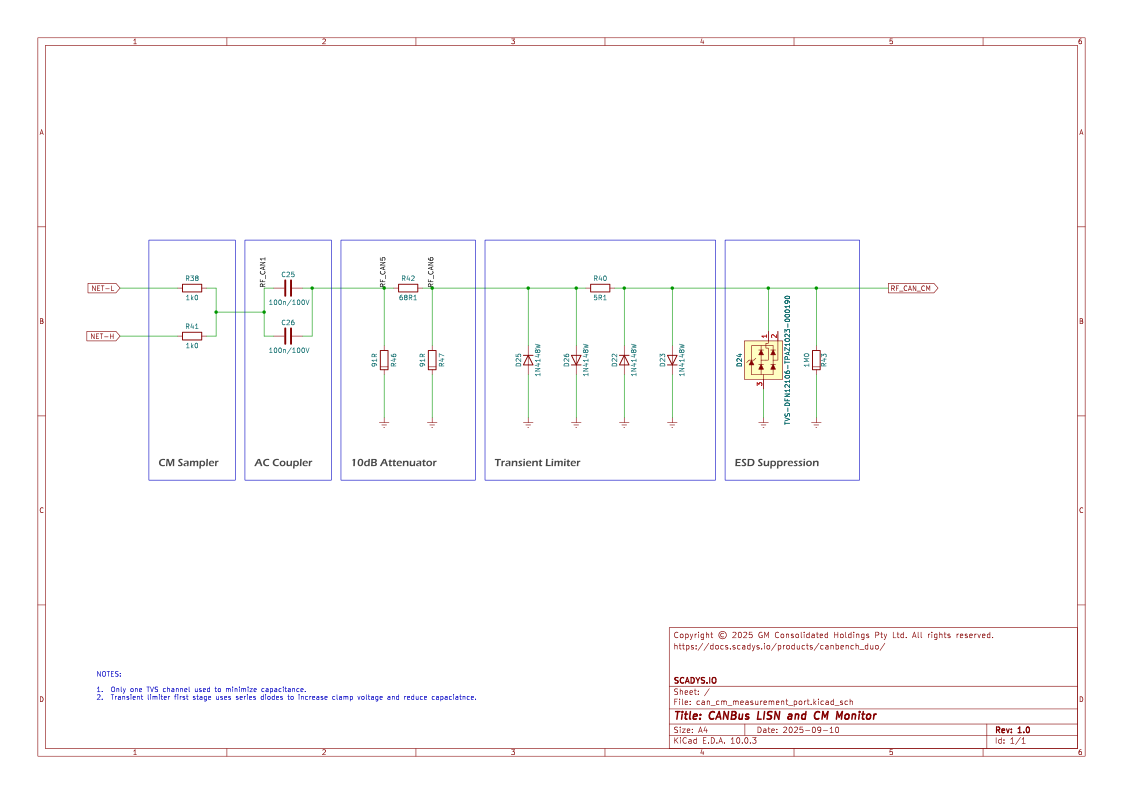
This page covers a single sub-circuit — the CAN Common-Mode Measurement Port — drawn on the can_cm_measurement_port KiCad sheet. A matched 1 kΩ summing pair extracts the bus common-mode voltage, an AC-couple pair blocks the bus DC bias, a two-stage π attenuator drops the signal to a level safe for a spectrum-analyser front end, and a multi-stage clamp / TVS cascade protects the analyser at the SMA output. The CAN-H / CAN-L lines arrive on pins 4 and 5 of the M12 N2K connector J10, drawn on the connectors-and-mechanical sheet.
Functional specification and design objectives
The CAN common-mode measurement port must:
- tap the CAN-H / CAN-L pair at the DUT-side M12 N2K connector and present the bus common-mode voltage
(V_H + V_L) / 2as a 50 Ω signal at SMAJ6; - load the bus negligibly — keep the bus-impedance perturbation below 3 % so it does not replace the bus's external 120 Ω termination;
- reject the differential-mode CAN signalling, with a common-mode rejection ratio bounded by the matched summing pair (≈ 60 dB at DC, degrading at HF);
- support the CISPR 25 measurement band, 150 kHz – 108 MHz;
- block the CAN bus DC operating point (nominally 2.5 V common-mode, with margin to 100 V) from reaching the analyser; and
- protect the spectrum-analyser front end from ESD and transients at the SMA via a layered clamp + TVS cascade.
CAN Common-Mode Measurement Port
How it works
The CAN bus enters via pins 4 (NET-H) and 5 (NET-L) of the M12 N2K connector J10 on the connectors-and-mechanical sheet. From there, the chain runs left-to-right along the board's central Y ≈ 90 mm axis through to the SMA J6 at the leftmost edge.

Stage 1 — Common-mode summing
Two equal-weight 1 kΩ thin-film resistors form the summing front-end:
R41— 1 kΩ, 0603 thin-film ±0.1 %, betweenNET-HandRF_CAN1R38— 1 kΩ, 0603 thin-film ±0.1 %, betweenNET-LandRF_CAN1
By Kirchhoff, the voltage at the summing node RF_CAN1 is (V_H + V_L) / 2 — the common-mode voltage of the CAN bus. The differential-mode component (CAN-H and CAN-L moving in opposite directions, which is how the CAN bus signals data) cancels by symmetry, leaving only the common-mode content at RF_CAN1.
The matching tolerance between R38 and R41 bounds the common-mode rejection ratio (CMRR) of the front-end. With 0.1 % matched thin-film, the theoretical CMRR at DC is about 60 dB. CMRR degrades at higher frequencies because the AC-couple capacitors (next stage) are X7R ±10 % — looser matching than the resistor pair — and because PCB trace asymmetry between the NET-H and NET-L paths adds further imbalance.
Stage 2 — AC-couple
Two parallel 100 nF capacitors block the CAN bus's DC offset (nominally 2.5 V common-mode):
C25— 100 nF / 100 V X7R (0805)C26— 100 nF / 100 V X7R (0805)
Combined parallel capacitance is 200 nF. The 100 V rating leaves a huge margin over the 2.5 V CAN-bus quiescent CM and the higher transient CM voltages possible during EMC events.
Stage 3 — Two-stage π attenuator
A two-stage π attenuator brings the common-mode amplitude down to a level safe for the spectrum-analyser input:
RF_CAN5 ─── R42 (68.1 Ω) ─── RF_CAN6 ─── R40 (5.1 Ω) ─── RF_CAN_CM ─── J6
                │                            │
              R46 (91 Ω)                  R47 (91 Ω)
                │                            │
              GNDREF                       GNDREF
All four attenuator resistors are 0.1 % thin-film for impedance precision. The combined transfer function from RF_CAN5 to RF_CAN_CM (loaded with 50 Ω at the SMA) is approximately −10 dB, with an input impedance at RF_CAN5 of about 48 Ω — close to the 50 Ω port target.
Note that the full transfer function from the CAN bus's common-mode voltage to the analyser SMA includes the voltage division across the 1 kΩ summing pair: the high-impedance summing front-end gives up about 21 dB on its own to avoid loading the bus, then the π attenuator adds another 10 dB, for a total of about 31 dB from V_CM at the bus to the analyser. Users back-calculating bus CM levels from analyser readings should account for this.
R40 (5.1 Ω) serves two roles: it is both the second-stage π attenuator's series element AND the current limiter between the outer and inner protection clamps in the next stage.
Stage 4 — Multi-stage protection cascade
The protection cascade follows the same pattern as the LISN measurement ports, but with simpler 1-diode clamps at both stages because CAN-bus signal swings are smaller than the LISN measurement-band signals — single forward V_F drops suffice without conducting at normal operating levels.
-
Outer 1-diode bipolar clamp at
RF_CAN6.D25(cathode on RF_CAN6, anode on GNDREF) andD26(anode on RF_CAN6, cathode on GNDREF) — anti-parallel 1N4148W pair clamping at ±0.6 V. -
R40(5.1 Ω) current limiter. Same R40 that is also the π-attenuator's second-stage series resistor. Limits current into the inner clamp during transient events. -
Inner 1-diode bipolar clamp at
RF_CAN_CM.D22andD23mirror the outer clamp arrangement at the SMA-output net. -
Integrated TVS
D24. Tech Public TPAZ1023-02F — same part used on the LISN measurement ports. Only Channel 1 populated; pin 1 toRF_CAN_CM, pin 3 to GNDREF, pins 2/4/5/6 are deliberately left unconnected for minimum parasitic capacitance.
Stage 5 — SMA output
RF_CAN_CM connects to J6 (SMA Female Vertical, 50 Ω) at the top extrusion. R43 (1 MΩ) ties RF_CAN_CM to GNDREF as a defined DC reference at the SMA when no analyser is connected.
Performance
Design intent — calculated in performance_review/can-cm-port.md against V1.1 BOM (electrically identical to V1.2).
| Parameter | Target | Status |
|---|---|---|
| Measurement band | 150 kHz – 108 MHz (CISPR 25) | Topology supports |
| Source impedance to analyser | 50 Ω | Network input impedance ≈ 48 Ω at LF |
| Added attenuation (π stage) | ≈ 10 dB | Two-stage π attenuator nominal |
| Total bus-to-SMA transfer | ≈ −31.5 dB at LF | 21 dB summing front-end loss + 10 dB attenuator |
| DC voltage block | up to 100 V | C25 / C26 100 V rating; CAN bus quiescent CM is 2.5 V |
| CMRR at DC | ≈ 60 dB | Bounded by R38 / R41 0.1 % matching |
| CMRR at 1 MHz | ~ 40 dB | Limited by C25 / C26 X7R ±10 % matching |
| CMRR at 108 MHz | < 30 dB | Limited by PCB trace asymmetry between NET-H and NET-L paths |
| CAN bus impedance perturbation | < 3 % | 2 kΩ inter-line load vs 60 Ω parallel terminators |
| Stray Cj at SMA output | ≈ 4.3 pF | Same as LISN measurement ports |
The CMRR vs frequency curve is bounded analytically here; SPICE / VNA characterisation on the as-built V1.1 board would close the analytical bound with measurement. The dominant HF limitation is the AC-couple capacitor matching (X7R ±10 %), not the matched-pair resistor front-end.
Same scope clarification as the LISN measurement ports — this is a passive measurement instrument, not a transient-injection compliance test fixture.
PCB Layout
The CAN CM port components sit in a single left-to-right cascade along the board's Y ≈ 90 mm axis — between the upper (LISN+) and lower (LISN−) measurement ports.
The dominant layout constraint is the symmetric placement of R38 and R41. The CAN CM port's CMRR depends critically on matched-length trace geometry from CAN-H and CAN-L (at J10's pins 4 and 5) to the summing node RF_CAN1 (at R38 / R41's RF_CAN1 pads). Even a millimetre of length asymmetry between the NET-H and NET-L traces translates to a CMRR penalty at higher frequencies. The V1.1 layout places R38 and R41 at the same X coordinate with a 1.6 mm Y spacing about the Y = 90 mm axis — supporting symmetric routing in principle. NET-H has 4 F.Cu segments and NET-L has 2 in the as-built layout; a future revision could re-route for closer length matching.
The protection cascade follows the same component-island pattern as the LISN measurement ports: clamp diode pairs as compact 2-component islands at their respective nodes, TPAZ1023 placed within 2.5 mm of the SMA centre pin, F.Cu coplanar ground pour around the RF traces.
R40 (5.1 Ω, 0603 thick-film AC0603) is the only thick-film resistor in the RF path. The rest of the chain uses YAGEO RT-series thin-film at 0.1 % tolerance. R40 only conducts during clamp events; the thick-film tolerance (±1 %, ±200 ppm/°C) is acceptable for the current-limiter role.
See pcb_review/can-cm-port-layout.md in the source repository for the per-component coordinate table.
Components
| Ref | Value | Function | Datasheet |
|---|---|---|---|
| R41 | 1 kΩ ±0.1 % | CM summing resistor on NET-H (CAN-H) path; matched pair with R38 | YAGEO RT0603 thin-film |
| R38 | 1 kΩ ±0.1 % | CM summing resistor on NET-L (CAN-L) path; matched pair with R41 | YAGEO RT0603 thin-film |
| C25, C26 | 100 nF / 100 V X7R (0805) | AC-couple pair from summing node RF_CAN1 to RF_CAN5 (200 nF total) | muRata GCM21BR72A104KA37L |
| R42 | 68.1 Ω ±0.1 % | π attenuator stage 1 series resistor (RF_CAN5 → RF_CAN6) | YAGEO RT0603 thin-film |
| R46 | 91 Ω ±0.1 % | π attenuator shunt to GNDREF at RF_CAN5 | YAGEO RT0603 thin-film |
| R47 | 91 Ω ±0.1 % | π attenuator shunt to GNDREF at RF_CAN6 | YAGEO RT0603 thin-film |
| R40 | 5.1 Ω ±1 % | π attenuator stage 2 series resistor / current limiter into the inner clamp (thick-film) | YAGEO AC0603 thick-film |
| D25, D26 | 1N4148W | Outer bipolar 1-diode clamp at RF_CAN6 (anti-parallel pair to GNDREF) | DIODES 1N4148W-7-F |
| D22, D23 | 1N4148W | Inner bipolar 1-diode clamp at RF_CAN_CM (anti-parallel pair to GNDREF) | DIODES 1N4148W-7-F |
| D24 | TPAZ1023-02F | Integrated multi-channel TVS; only Channel 1 populated (pin 1 = RF_CAN_CM, pin 3 = GNDREF, pins 2/4/5/6 n/c) | Tech Public TPAZ1023-02F |
| R43 | 1 MΩ ±1 % | DC bleeder from RF_CAN_CM to GNDREF — defined DC reference at the SMA when no instrument is connected | YAGEO RC0603 |
| J6 | SMA Female Vertical, 50 Ω | Panel-mount output to spectrum analyser / disturbance meter at the top extrusion | HCTL HC-SMA6565-13H-G |
Gaps & next version
Before next production run
- R38 / R41 matching. Resistor matching directly bounds the CMRR of the summing pair. Confirm the BOM specifies matched-pair-grade ±0.1 % parts and that any future substitution preserves the matching.
- TPAZ1023 ESD/TVS rating. The integrated-TVS specifications (clamp voltage, per-channel capacitance, peak-pulse current) are nominal datasheet values from an LCSC-hosted redirect; the manufacturer ("Tech Public") has no publicly indexed datasheet. Treat as datasheet-cited and verify against board behaviour where measurable.
- SMA ground via cluster around J6 is sparse — recurring observation across the RF ports; either fix in the next revision or accept and confirm by ESD test.
Next version (V1.3)
- CMRR HF bound is set by the C25 / C26 X7R ±10 % matching (looser than the R38 / R41 0.1 % pair); at 1 MHz CMRR may drop to ~ 40 dB. Switch C25 / C26 to a C0G matched pair (as on the LISN ladder) to tighten the HF CMRR.
- NET-H / NET-L trace asymmetry — the as-built layout has 4 F.Cu segments on NET-H versus 2 on NET-L. Re-route for symmetric matched-length traces to improve CMRR.
- R40 thick-film (AC0603 ±1 %, ±200 ppm/°C) in an otherwise thin-film RF chain — cleanup candidate (same observation as R21 on the LISN ports); acceptable for the current-limiter role today.
References
- DIODES Incorporated, 1N4148W-7-F SOD-123 switching diode (D22, D23, D25, D26)
- Tech Public, TPAZ1023-02F multi-channel TVS (D24)
- muRata, GCM21BR72A104KA37L 100 nF / 100 V X7R MLCC (C25, C26)
- YAGEO, RT0603 thin-film 0.1 % series (R38, R41, R42, R46, R47)
- YAGEO, AC0603 thick-film 1 % series (R40)
- YAGEO, RC0603 1 MΩ 1 % (R43)
- HCTL, HC-SMA6565-13H-G SMA Female Vertical 50 Ω (J6)
- ISO, ISO 11898-2 — Road vehicles — Controller area network (CAN) — Part 2: High-speed medium access unit (the 120 Ω termination requirement this port does not replace)
- NMEA, NMEA 2000 Standard — M12 Micro-C Code A pinout (J10 pin 4 = NET-H, pin 5 = NET-L)
- IEC, CISPR 25 — conducted-emissions measurement band (150 kHz – 108 MHz); IEC 61000-4-2 — electrostatic discharge
Related pages
- LISN Measurement Ports — the sister RF measurement chain; topologically similar but with 2-diode-series outer clamps for the higher LISN measurement-band amplitudes
- LISN Supply Path — the LISN ladder also delivers DC supply to the DUT via the M12 N2K connector (J10 pin 2 / pin 3); the CAN-H / CAN-L lines (pins 4 / 5) tapped here arrive on the same connector
- Connectors and Mechanical — J10 M12 N2K pin map (Shield, NET-S, NET-C, CAN-H, CAN-L) and J6 SMA placement on the top extrusion
- Power Indicator LED — supply-fault indicator; Q1 is confirmed isolated from the CAN measurement nets
- User Manual → Measurement Procedure — operational measurement workflow including the "external 120 Ω termination required" caveat